Want a back that looks wider and feels stronger, without stepping near a barbell? You’re in the right place.
A weak, tight back leads to bad posture, nagging pain, and a flat-looking physique. The good news is that you don’t need a full gym to fix this. With just a pair of dumbbells, you can build serious back strength and width from home or the gym floor.
In this guide, we’ll walk through the best dumbbell back exercises for every level, plus the honest trade-offs of training this way, so you can decide if it’s the right approach for your goals. Whether you’re new to lifting or looking to add variety to your routine, this dumbbell back workout will help you build a back that’s both strong and defined. Let’s get into it.
Why Train Your Back With Dumbbells?
Dumbbells aren’t just a backup option when the barbell is taken. They actually offer some real advantages for back training — but like any tool, they have downsides too. Here’s a balanced look at both before you commit to this style of training.
Advantages
- Better range of motion. Unlike barbells, dumbbells let each arm move independently. This means you can pull each side through a fuller, more natural range of motion. Your muscles get to stretch and contract more completely, which can lead to better growth over time.
- Fixes muscle imbalances. Many people have one side of their back that’s stronger than the other. Barbell exercises let the stronger side take over. Dumbbell exercises force each side to work on its own, so weak spots can’t hide.
- Beginner-friendly and accessible. You don’t need a rack, a bench, or a spotter for most dumbbell moves. This makes them ideal for home workouts, small gyms, or anyone just starting their strength journey.
- Lower barrier to entry for learning form. Because the load per hand is smaller, it’s generally easier to learn a hip hinge or rowing pattern with dumbbells before progressing to heavier barbell work.
Disadvantages
- Load ceiling. Dumbbells are limited by what you can lift in each hand and by how heavy the pair goes at your gym or home. Advanced lifters chasing maximum back strength will eventually outgrow dumbbell-only training and need barbells, machines, or cables.
- Grip becomes the limiting factor. On heavier rows and deadlifts, your grip often fatigues before your back does, which can cut a set short before the target muscles are fully worked.
- Awkward to load/unload safely. Bent-over positions with two heavy dumbbells put you at higher risk of losing control or straining your lower back during setup, especially compared to picking up a fixed barbell.
- Space and equipment cost. A full range of dumbbell weights (or a quality adjustable set) can take up more space and cost more than a single barbell and plate set for the same strength range.
Weigh these against your goals: if you’re training at home, fixing imbalances, or just starting out, dumbbells are usually the better call. If your main goal is maximal strength or you’re already an advanced lifter, you’ll likely want to combine dumbbells with barbell or cable work.
Muscles You’ll Target in a Dumbbell Back Workout
Before jumping into the exercises, it helps to know what you’re actually working. Your back isn’t one muscle — it’s a group of muscles that work together. According to Cleveland Clinic, these muscles run in layers from your neck down to your hips and support your torso, let you move, and help you breathe:
- Latissimus dorsi (lats): The large, wing-shaped muscles responsible for that “wide” look.
- Trapezius (traps): Runs from your neck to your mid-back and helps with shrugging and pulling.
- Rhomboids: Sit between your shoulder blades and help pull them together.
- Erector spinae: Runs along your spine and supports posture and lower back strength.
For a deeper anatomical breakdown of how each of these muscles works during pulling movements, ACE Fitness’s exercise library is a solid reference. A well-rounded routine hits all of these areas, not just one or two.
15 Best Dumbbell Back Exercises
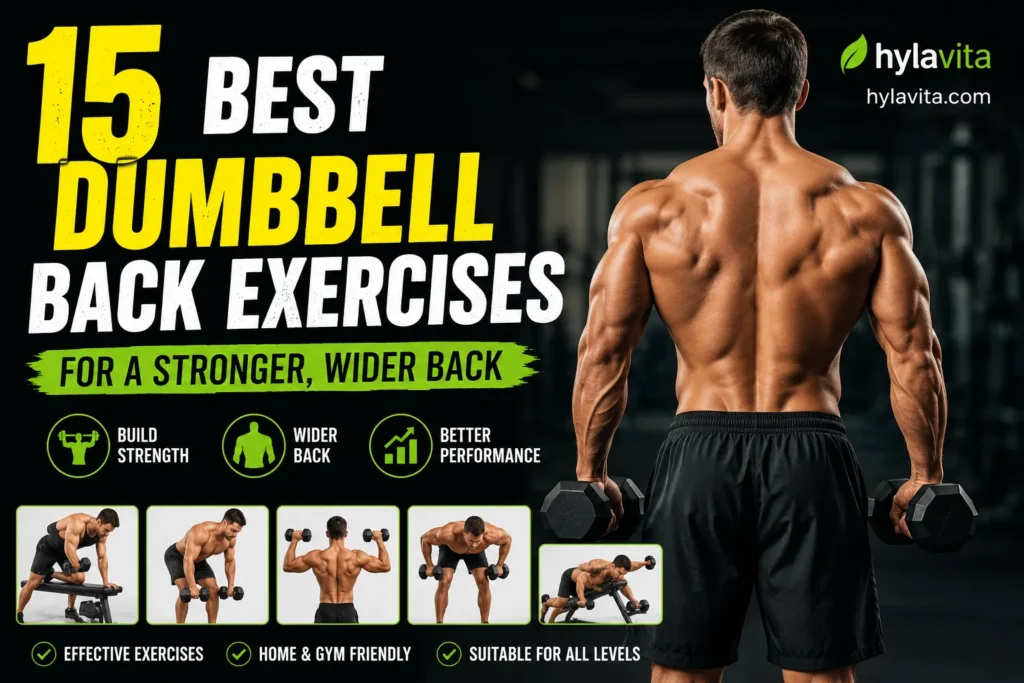
Here are 15 back exercises with dumbbells that cover width, thickness, and overall strength. You don’t need to do all of them in one session. Pick 4–6 per workout and rotate over time.
1. Single-Arm Dumbbell Row This is one of the most popular dumbbell exercises for back training, and for good reason. Place one knee and one hand on a bench, hold a dumbbell in the other hand, and pull it up toward your hip. It builds the lats and lets you focus on one side at a time.
2. Two-Arm Bent-Over Row Stand with feet shoulder-width apart, hinge at the hips, and hold a dumbbell in each hand. Pull both weights up toward your ribs at the same time. This move works your entire upper back and adds thickness over time.
3. Renegade Row Start in a plank position with a dumbbell in each hand. Row one dumbbell up while balancing on the other arm, then switch sides. This exercise challenges your core along with your back, so it’s great for building total-body stability.
4. Dumbbell Deadlift The deadlift is a classic strength move that also builds serious back strength. Stand with feet hip-width apart, dumbbells in front of your thighs, and hinge down while keeping your back flat. Then drive through your heels to stand back up. It works your lower back, glutes, and hamstrings together.
5. Dumbbell Romanian Deadlift (RDL) Similar to the regular deadlift but with less knee bend, the RDL puts more focus on your lower back and hamstrings. Keep the dumbbells close to your legs as you lower them, and feel the stretch before standing back up.
6. Dumbbell Pullover Lie on a bench with your upper back supported, holding one dumbbell with both hands above your chest. Lower it slowly behind your head, then bring it back up. This move stretches and works the lats in a way most other exercises don’t.
7. Chest-Supported Dumbbell Row Lie face-down on an incline bench with a dumbbell in each hand. Row both weights up toward your ribs. Because your chest is supported, there’s no risk of using momentum, which means better isolation for your back muscles.
8. Dumbbell Shrugs Hold a dumbbell in each hand at your sides and lift your shoulders straight up toward your ears. This simple move targets your traps and helps build that thick, strong look at the top of your back.
9. Dumbbell High Pull Hold dumbbells in front of your thighs, then pull them up explosively toward your chin, leading with your elbows. This works your traps and rear shoulders while also getting your heart rate up.
10. Dumbbell Reverse Fly Bend forward slightly with a dumbbell in each hand, arms hanging down. Raise both arms out to the sides like you’re making a “T” shape. This targets your rear delts and rhomboids, helping pull your shoulder blades together for better posture.
11. Dumbbell Seal Row Lie face-down on a flat, elevated bench with your arms hanging straight down. Row the dumbbells up toward your ribs. Because your whole body is supported, this is one of the strictest rowing exercises for isolating the back.
12. Kroc Row Named after powerlifter Janell Kroc, this is a heavier, higher-rep version of the single-arm row. Use a slightly heavier dumbbell than usual and let your body rotate a bit as you row. It’s great for building raw pulling strength.
13. Dumbbell Floor Row If you don’t have a bench, this works just as well. Lie face-down on the floor with dumbbells in hand, and row them up toward your ribs. It’s a simple, equipment-light way to hit your upper back anywhere.
14. Incline Dumbbell Row Lie chest-down on an incline bench set at a steep angle, dumbbells hanging below you. Row both arms up together or one at a time. This variation removes lower back strain, making it a good option for beginners or anyone with back sensitivity.
15. Dumbbell Good Morning Hold a dumbbell across your upper chest or at your sides, then hinge forward at the hips while keeping a slight bend in your knees. This move strengthens your lower back and hamstrings, and it also improves hip mobility over time.
How to Build a Balanced Dumbbell Back Workout
Picking exercises is only half the job. How you put them together matters too.
Mix Rowing and Hinging Movements
Rows (like the single-arm row) build width and thickness. Hinges (like deadlifts and good mornings) build lower back and posterior chain strength. A good workout includes both.
Train 2–3 Times Per Week
Your back muscles need time to recover, just like any other muscle group. The CDC’s Physical Activity Guidelines for Americans recommend that adults do muscle-strengthening activity covering all major muscle groups at least 2 days a week, with training spread across non-consecutive days when possible. Training your back twice or three times a week, with a rest day in between, usually works well for most people.
Related on Hylavita: browse more Strength Training guides for workout routines that pair well with this back-day plan.
Sample Beginner Routine
Here’s a simple dumbbell back workout to try if you’re just starting out:
- Two-Arm Bent-Over Row – 3 sets of 10–12 reps
- Single-Arm Dumbbell Row – 3 sets of 10 reps per side
- Dumbbell Reverse Fly – 3 sets of 12–15 reps
- Dumbbell Romanian Deadlift – 3 sets of 10 reps
- Dumbbell Shrugs – 3 sets of 15 reps
Adjust the weight so the last 2–3 reps of each set feel challenging but doable with good form.
Common Mistakes to Avoid
Even the best dumbbell back exercises won’t help much if your form is off. Watch out for these common errors.
Using momentum instead of muscle. Swinging the weight up with your body takes work away from your back. Slow down and control the movement instead.
Rounding your lower back. This is especially risky during deadlifts and rows. Keep your spine in a neutral position, and if you can’t, lower the weight.
Skipping the stretch. Not lowering the dumbbell fully means you’re cutting your range of motion short. Full reps lead to better results over time.
FAQ: Dumbbell Back Exercises
How often should I train my back with dumbbells? Most people do well training their back 2–3 times per week, with at least one rest day between sessions. This lines up with the CDC’s recommendation of at least 2 non-consecutive days of muscle-strengthening work per week, and gives your muscles time to recover and grow stronger.
Can dumbbells build a wide back like barbells can? Yes. Dumbbell exercises, especially rows and pullovers, can build a wide, strong back just as effectively as barbell training for most lifters. The trade-off, as noted above, is that very advanced lifters may eventually need heavier loading options than dumbbells alone can provide. The key is consistency and progressively increasing the weight over time.
What’s the best dumbbell exercise for lower back pain? Gentle moves like the Romanian deadlift or good morning, done with light weight and strict form, can help strengthen the lower back. However, if you have existing pain, it’s smart to check with a doctor or physical therapist first — see the disclaimer below.
How heavy should my dumbbells be for back exercises? There’s no single right answer since it depends on your strength level. As a general rule, pick a weight where the last few reps of each set feel hard but your form stays solid throughout.
Do I need a bench for dumbbell back workouts? No. While a bench helps with certain moves like chest-supported rows, many exercises like bent-over rows, deadlifts, and floor rows can be done without one.
Conclusion
Building a stronger, wider back doesn’t require fancy equipment. As this guide shows, a simple pair of dumbbells and consistent effort with the right dumbbell back exercises can go a long way — as long as you go in aware of both the benefits and the limits of training this way.
Start with a few moves from this list, focus on good form, and add weight gradually as you get stronger. Your back (and your posture) will thank you.
Ready to get started? Pick five exercises from this list and try them in your next workout.
Disclaimer:
This article is for general informational and educational purposes only and is not intended as, and should not be substituted for, professional medical or fitness advice, diagnosis, or treatment.