Medical Disclaimer:
This article is for general educational and informational purposes only and is not a substitute for professional medical advice, diagnosis, or treatment.
Tight on time and don’t want to fight for squat rack space at the gym? A pair of dumbbells and a small patch of floor is all you need to build strong, toned thighs.
Many people think leg day requires a barbell or a machine. That’s simply not true. Dumbbell exercises for thighs can build real strength, shape your quads and hamstrings, and even improve your balance — all from home or a quiet gym corner. According to the Mayo Clinic, free weights like dumbbells are one of the “classic” strength-training tools, and adults are generally advised to train each major muscle group at least twice a week to see real strength gains.
In this guide, you’ll find the best dumbbell thigh exercises, how to do them safely, the honest pros and cons of training legs with dumbbells, and a simple workout plan you can start today.
Why Use Dumbbells for Thigh Workouts?
Dumbbells are one of the most beginner-friendly tools in strength training. They’re cheap, easy to store, and don’t take up much space.
Unlike machines, dumbbells force each leg to work on its own. This means one leg can’t “cheat” by doing more work than the other. Over time, this helps fix muscle imbalances and builds more even strength.
Benefits Beyond Strength
Dumbbell training for legs also improves balance and coordination. Since you’re holding free weights instead of a fixed bar, your stabilizer muscles have to work harder.
For example, a dumbbell lunge challenges your core and ankles in a way a leg press machine never will. This carries over into everyday movement — walking, climbing stairs, even carrying groceries. The Mayo Clinic notes that strength training in general can help improve balance, protect joints, and support everyday physical function as you age.
Advantages and Disadvantages of Dumbbell Thigh Exercises
Dumbbells are a great tool for training legs, but they’re not the right fit for every goal or every body. Here’s a balanced look before you get started.
Advantages
- Low cost, low space. A single pair of adjustable dumbbells can replace an entire home leg-day setup.
- Fixes side-to-side imbalances. Because each leg lifts and stabilizes independently, dumbbells expose and help correct strength differences between your left and right side in a way a barbell or machine often masks.
- Greater joint freedom. You’re not locked into a fixed bar path, so you can adjust your stance and range of motion to what feels comfortable for your hips and knees.
- Builds real stabilizer strength. Balancing the weight yourself trains the smaller muscles around your ankles, knees, and hips — useful for everyday movement, not just the gym.
- Scales from beginner to intermediate. Light dumbbells are forgiving for beginners, and you can keep adding weight or reps as you progress.
Disadvantages
- Grip becomes the limiting factor. As the weight goes up, your hands and forearms often fatigue before your thighs do, which can cap how much your leg muscles get overloaded.
- Harder to load heavy. Because you’re holding weight at your sides rather than on your back (as with a barbell squat), it’s mechanically difficult to load your thighs as heavily with dumbbells alone.
- Less back and core support. A barbell back squat lets a rack support the setup; with dumbbells, your grip and core do more of the stabilizing work, which can be tiring on high-rep sets.
- Plateaus sooner for advanced lifters. Once you’re strong enough to need very heavy loads, dumbbells (especially fixed sets at home) may stop providing enough resistance for continued growth.
- Form errors are easy to miss. Without a mirror or a coach, it’s easy to let your knees cave in or your back round, especially as fatigue sets in on your last few reps.
Muscles Worked During Dumbbell Thigh Exercises
Before jumping into the moves, it helps to know what you’re actually training.
- Quadriceps – front of the thigh, used in squats and lunges
- Hamstrings – back of the thigh, used in deadlifts and leg curls
- Glutes – your hip muscles, which support almost every thigh movement
- Adductors and abductors – inner and outer thigh muscles, used in side lunges and step-ups
Most dumbbell thigh exercises work more than one of these muscles at once. That’s actually a good thing — it means fewer exercises give you more results.
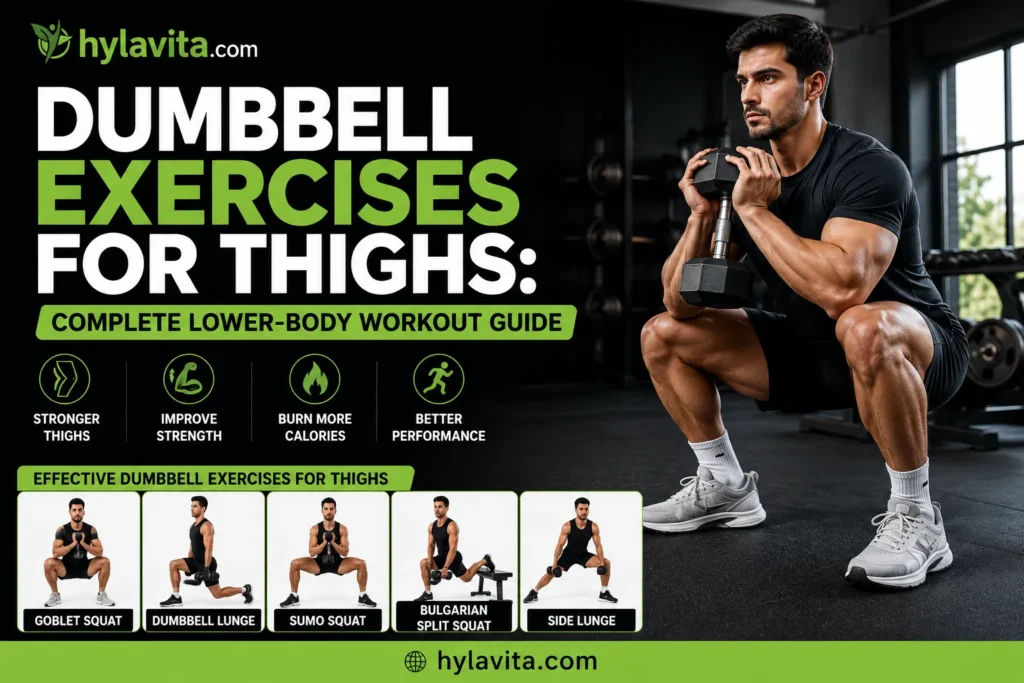
Best Dumbbell Exercises for Thighs
Here are the most effective moves for building thigh strength. Start light, focus on form, and add weight slowly over time.
1. Dumbbell Squats for Thighs
Dumbbell squats for thighs are the foundation of any lower-body routine. They work your quads, hamstrings, and glutes together.
How to do it:
- Hold a dumbbell in each hand at your sides, or one dumbbell close to your chest.
- Stand with feet shoulder-width apart.
- Lower your hips down and back, like you’re sitting in a chair.
- Keep your chest up and knees in line with your toes.
- Push through your heels to stand back up.
Aim for 3 sets of 10–12 reps. If your form starts to break down, that’s a sign to stop or lower the weight. For a detailed, step-by-step breakdown of squat mechanics, ACE Fitness’s exercise library is a good reference to check your form against.
2. Dumbbell Lunges
Lunges isolate one leg at a time, which makes them great for fixing strength imbalances.
How to do it:
- Hold a dumbbell in each hand.
- Step one foot forward and lower your back knee toward the floor.
- Both knees should bend to about 90 degrees.
- Push through your front heel to return to standing.
Try walking lunges or stationary lunges — both work well. Do 3 sets of 8–10 reps per leg.
3. Dumbbell Romanian Deadlift (RDL)
This move targets the hamstrings and glutes, muscles that squats and lunges don’t fully hit.
How to do it:
- Hold dumbbells in front of your thighs.
- Keep a slight bend in your knees.
- Hinge at your hips, lowering the weights toward your shins.
- Keep your back flat, not rounded.
- Squeeze your glutes to return to standing.
Go slow on this one. Speed here often leads to poor form and back strain. 3 sets of 10 reps is plenty.
4. Dumbbell Step-Ups
Step-ups mimic climbing stairs, which makes them practical as well as effective.
How to do it:
- Hold a dumbbell in each hand.
- Step one foot onto a sturdy bench or box.
- Push through that foot to lift your body up.
- Step back down with control.
Use a box height that lets you keep good form — usually knee height or slightly below. Do 3 sets of 10 reps per leg.
5. Dumbbell Sumo Squats
This variation targets the inner thighs more than a regular squat does.
How to do it:
- Hold one dumbbell with both hands in front of you.
- Stand with feet wider than shoulder-width, toes pointed slightly out.
- Lower into a squat, keeping your chest tall.
- Push through your heels to stand.
This is one of the best thigh workout with dumbbells options if your inner thighs feel weak or underworked.
6. Dumbbell Side Lunges
Side lunges train the muscles that regular squats and lunges tend to skip — the inner and outer thighs.
How to do it:
- Hold a dumbbell in each hand.
- Take a wide step to one side.
- Bend that knee and push your hips back, keeping the other leg straight.
- Push off to return to standing, then repeat on the other side.
Do 3 sets of 8 reps per side. Keep the movement slow to protect your knees.
Sample Dumbbell Thigh Workout Plan
Here’s a simple full routine using dumbbell exercises for legs. Do this two to three times a week, with at least one rest day in between sessions — the Mayo Clinic recommends resting a full day between sessions that train the same muscle group.
| Exercise | Sets | Reps |
|---|---|---|
| Dumbbell Squats | 3 | 10–12 |
| Dumbbell Lunges | 3 | 8–10 per leg |
| Romanian Deadlift | 3 | 10 |
| Step-Ups | 3 | 10 per leg |
| Sumo Squats | 2 | 12 |
Rest 45–60 seconds between sets. Beginners can start with lighter dumbbells and focus on getting the movement right before adding weight.
Common Mistakes to Avoid
Even good exercises can cause problems if the form is off. Here are a few things to watch for.
Rounding Your Back
This happens most often during Romanian deadlifts. A rounded back puts pressure on your spine instead of your hamstrings. Keep your chest lifted and your back flat throughout the movement.
Letting Knees Cave Inward
During squats and lunges, your knees should track over your toes, not collapse inward. This is a common cause of knee pain over time.
Going Too Heavy Too Soon
It’s tempting to grab the biggest dumbbells in the rack. However, lifting too heavy before your form is solid usually leads to injury, not faster results. Build up gradually instead.
Skipping Warm-Ups
Cold muscles are more prone to strain. Spend five minutes doing bodyweight squats, leg swings, or a light walk before starting your dumbbell thigh exercises.
Tips for Faster, Safer Results
Consistency matters more than intensity. Training your thighs twice a week consistently will beat one brutal session every few weeks.
Progressive overload is key. This simply means adding a little more weight, or a few more reps, over time. Your muscles grow stronger when they’re gradually challenged more than before.
Don’t forget recovery. Muscles rebuild during rest, not during the workout itself. Aim for at least one full rest day between leg sessions, and make sure you’re eating enough protein to support muscle repair.
Finally, listen to your body. Some muscle soreness after a new workout is normal. Sharp or lasting joint pain is not — if that happens, scale back the weight or check your form. If you have a chronic health condition, are new to exercise, or are over 40 and haven’t been active recently, the Mayo Clinic recommends checking with a healthcare professional before starting a new strength-training routine.
If you’re also working on your upper body, our guide to dumbbell back exercises covers the same at-home, minimal-equipment approach for building a stronger back.
FAQs About Dumbbell Exercises for Thighs
Can dumbbell exercises really build thigh muscle?
Yes. Dumbbells provide enough resistance to challenge your muscles, especially when you gradually increase the weight over time. Many people build noticeable thigh strength and shape using only dumbbells.
How often should I do dumbbell thigh exercises?
Two to three times a week is a good starting point for most people. This gives your muscles enough stimulus to grow while allowing time to recover between sessions.
What weight of dumbbells should beginners use for thighs?
Beginners often start with dumbbells between 5 and 15 pounds per hand, depending on fitness level. The right weight is one that challenges you by the last few reps of a set, without breaking your form.
Are dumbbell squats better than bodyweight squats?
Dumbbell squats add resistance, which helps build more strength and muscle than bodyweight squats alone. However, bodyweight squats are still useful for beginners or as a warm-up before adding weight.
Can I do dumbbell thigh exercises every day?
It’s not recommended. Muscles need time to recover and rebuild after strength training. Training the same muscle group every day can lead to overuse injuries instead of faster progress.
Conclusion
Dumbbell exercises for thighs are one of the simplest ways to build lower-body strength without needing a full gym setup. Squats, lunges, deadlifts, and step-ups target your quads, hamstrings, and glutes from every angle. Like any tool, dumbbells have real trade-offs — they’re inexpensive and joint-friendly, but they can be harder to load heavy as you get stronger, so it’s worth knowing both sides before you build your routine around them.
Start with lighter weights, focus on form, and add resistance gradually as you get stronger. Consistency, not intensity, is what actually builds results over time.
Ready to get started? Pick up a pair of dumbbells, try the workout plan above, and give your thighs a workout they’ll actually feel tomorrow.