Feeling lost every time you walk into a gym? You are not alone. In fact, bodyweight training is one of the easiest ways to get strong without any equipment.
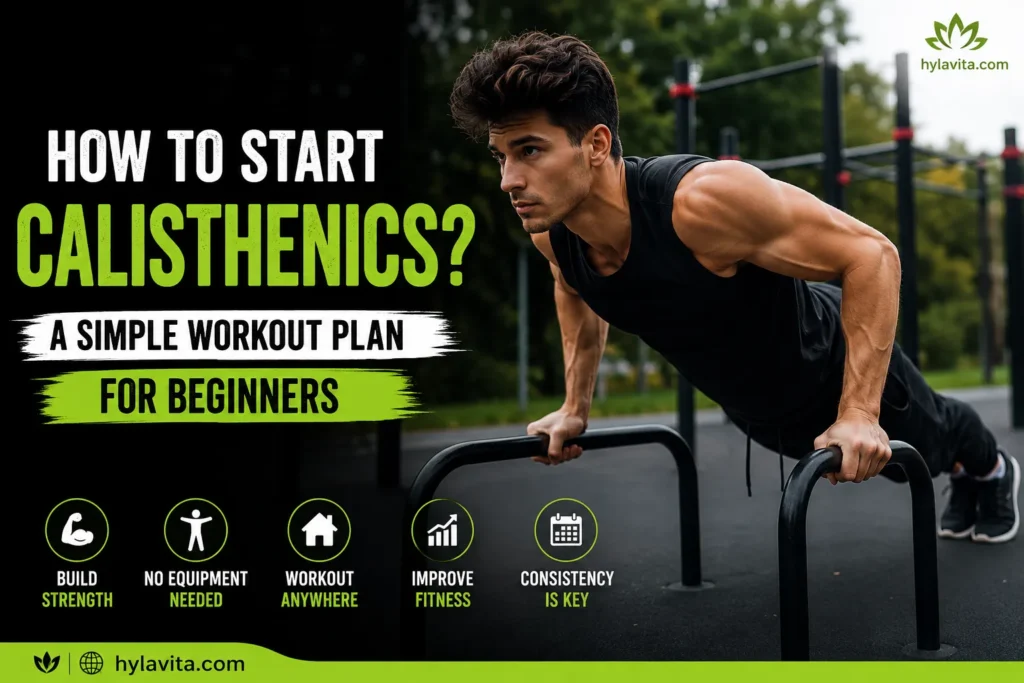
If you have ever wanted to build strength but felt overwhelmed by machines and weights, calisthenics might be the answer. After all, a good calisthenics workout plan uses only your body weight, a bit of space, and some patience. So, in this guide, you will learn exactly how to start, what exercises to do, how to weigh the pros and cons, and how to build a routine that actually works.
By the end, you will have a clear beginner calisthenics workout plan you can follow this week — no gym membership required. For more equipment-free routines, browse the Fitness & Exercise section on Hylavita.
Disclaimer: This article is for general educational purposes only and is not a substitute for professional medical advice, diagnosis, or treatment. Always talk to your doctor or a qualified physical therapist before starting a new exercise program, especially if you are pregnant, recovering from an injury, or managing a chronic condition such as heart disease, arthritis, or osteoporosis.
What Is Calisthenics and Why Should Beginners Try It?
Calisthenics is a type of strength training that uses your own body weight instead of dumbbells or machines. For instance, push-ups, squats, and pull-ups are all classic calisthenics moves.
This style of training has been around for centuries. Specifically, ancient Greek soldiers used bodyweight movements to build strength for battle. Today, however, people use it for fitness, muscle tone, and flexibility. In line with this, Harvard Health Publishing notes that calisthenics remains a well-rounded, low-frills way for people of nearly any fitness level to build functional strength, since the load scales automatically with the exerciser’s own body (Harvard Health, 2024).
Benefits of a Beginner Calisthenics Workout Plan
There are several reasons beginners love calisthenics:
- No equipment needed. You can train in your living room, backyard, or a park.
- Builds functional strength. You get better at real movements, like pushing, pulling, and squatting.
- Improves flexibility and balance. Additionally, many moves stretch your muscles as they strengthen them.
- Free of cost. As a result, you save money on gym memberships and equipment.
That said, calisthenics is not just for beginners. Advanced athletes use it too, for moves like the human flag or one-arm push-ups. Still, you have to start with the basics first.
Advantages and Disadvantages of Calisthenics
No workout style is perfect for everyone, so it helps to weigh both sides before committing.
Advantages
- Accessible and free. All you need is a small patch of floor, which makes it ideal if you cannot afford a gym membership.
- Scales to any fitness level. For example, beginners can use easier variations like knee push-ups, while advanced athletes progress to skills like muscle-ups.
- Builds multiple qualities at once. Consequently, a single session can improve strength, muscular endurance, coordination, and mobility together, rather than isolating one muscle at a time.
- Low injury risk when done correctly. Because the resistance is your own body weight, the load is naturally limited compared to heavy free weights.
- Convenient. Overall, you can train at home, while traveling, or outdoors, with no commute to a facility.
Disadvantages
- Harder to build maximal strength. Without external weights, it becomes difficult to keep overloading big muscle groups like the legs once basic bodyweight squats feel easy.
- Some exercises need equipment eventually. For instance, pull-ups and dips are much easier to progress with access to a bar, which is not always available at home.
- Progress can plateau. Even so, beginners advance quickly, though intermediate lifters often need creative variations, such as added tempo, single-limb moves, or a weighted vest, to keep improving.
- Learning curve for advanced skills. Movements like handstands or planches, in particular, require significant time, patience, and mobility work.
- Less precise muscle isolation. If your goal is to target one specific muscle, like an isolated bicep curl, calisthenics is therefore less direct than machines or dumbbells.
Ultimately, weighing these trade-offs against your own goals will help you decide how much of your routine should be bodyweight-only versus supplemented with equipment down the line.
How to Start Calisthenics the Right Way
Before jumping into any calisthenics training program, a little preparation goes a long way. Think of it like learning to drive — you don’t start on the highway.
Set a Realistic Goal
First, decide what you want. Do you want more strength? Better endurance? A leaner look? Either way, your goal will shape how you train, so keep it simple and specific.
Learn Proper Form First
Bad form leads to injuries and slow progress. For example, a sloppy push-up with a sagging back trains the wrong muscles. So, take time to learn each movement correctly, even if it means doing fewer reps.
Warm Up Every Time
Spend 5 to 10 minutes warming up before each session. That way, arm circles, light jogging, and bodyweight squats get your blood flowing and reduce the risk of strain.
The Best Beginner Calisthenics Exercises
Every solid calisthenics workout routine starts with a handful of basic moves. Therefore, master these first before adding harder variations.
Push Exercises
Push-ups work your chest, shoulders, and triceps. If a full push-up feels too hard, start on your knees or push against a wall instead.
Pull Exercises
Pull-ups and rows train your back and biceps. Meanwhile, if you cannot do a pull-up yet, try holding at the top of the bar, called a dead hang, to build grip and back strength first.
Squat and Lunge Exercises
Bodyweight squats and lunges build your legs and glutes. Throughout each rep, keep your knees in line with your toes and your chest upright.
Core Exercises
Planks and leg raises strengthen your abs and lower back. In turn, a strong core protects your spine during every other exercise.
Together, these categories cover almost every muscle group. Once you feel confident, you can look up more calisthenics exercises like dips, pistol squats, and handstand practice.
A Simple Calisthenics Workout Plan for Beginners
Here is a basic plan you can follow. Ideally, do this routine three times a week, with a rest day in between each session. This lines up with the CDC’s general recommendation that adults perform muscle-strengthening activity at least two days a week, targeting all major muscle groups (CDC, 2023).
Day 1: Full-Body Basics
- Push-ups (or knee push-ups): 3 sets of 8–10 reps
- Bodyweight squats: 3 sets of 12–15 reps
- Plank: 3 sets, hold for 20–30 seconds
- Glute bridges: 3 sets of 12 reps
Day 2: Pull and Core Focus
- Inverted rows or dead hangs: 3 sets of 6–8 reps (or hold 15–20 seconds)
- Lunges: 3 sets of 10 reps per leg
- Bicycle crunches: 3 sets of 15 reps
- Superman holds: 3 sets, hold for 15–20 seconds
Day 3: Full-Body Repeat with Small Increases
Simply repeat Day 1, but try to add one or two extra reps per set. Over time, small increases each week are how strength builds.
Altogether, this routine takes around 30 to 40 minutes per session, which fits easily into most schedules.
Sample Weekly Calisthenics Workout Schedule
Consistency matters more than intensity when you are just starting out. So, here is a simple calisthenics workout schedule to follow:
| Day | Focus |
|---|---|
| Monday | Full-Body Basics |
| Tuesday | Rest or light walk |
| Wednesday | Pull and Core Focus |
| Thursday | Rest or light walk |
| Friday | Full-Body Repeat |
| Saturday | Optional light activity |
| Sunday | Rest |
Overall, this schedule gives your muscles time to recover, which is when they actually grow stronger. Because of this, skipping rest days often leads to burnout or injury, so do not skip them just because you feel eager.
How to Progress in Your Calisthenics Training Program
Once the beginner routine starts feeling easy, it’s time to make it harder. This process is called progressive overload, and it applies to bodyweight training just as much as weightlifting.
Increase Reps Gradually
Add one or two reps to each set every week or two. Over months, small, steady increases add up.
Try Harder Variations
For example, move from knee push-ups to full push-ups, or from wall sits to full squats. As your body adapts, harder versions of each exercise become the next step.
Slow Down Your Movements
Slower reps increase time under tension, which challenges your muscles more without needing new equipment. To try this, take 3 seconds to lower into a squat instead of 1 second.
Track Your Workouts
Write down your reps and sets each session. Doing so helps you see progress and know when it’s time to level up.
Common Mistakes Beginners Make
Even a good calisthenics workout plan can fail if these mistakes creep in.
- Skipping warm-ups. Doing so raises injury risk significantly.
- Rushing through reps. After all, fast, sloppy reps train less muscle than slow, controlled ones.
- Training too often. Remember, rest days are part of the plan, not a break from it.
- Ignoring nutrition. Instead, muscles need protein and enough calories to recover and grow.
- Comparing yourself to advanced athletes. Since everyone starts somewhere, focus on your own progress.
FAQ: Calisthenics for Beginners
How many days a week should beginners do calisthenics? Three days a week is a good starting point for most beginners, since this gives your muscles enough time to rest and rebuild between sessions.
Can I build muscle with calisthenics alone? Yes, calisthenics can build noticeable muscle, especially for beginners. As you advance, though, you may need harder variations or added resistance, like a weighted vest, to keep progressing.
Do I need any equipment to start calisthenics? No, you can start with zero equipment using push-ups, squats, and planks. That said, a pull-up bar is helpful later on, even though it is not required to begin.
How long before I see results from a calisthenics workout routine? Most beginners notice some strength gains within 3 to 4 weeks of consistent training. Visible physical changes, on the other hand, usually take longer, often around 8 to 12 weeks, depending on diet and consistency.
Is calisthenics good for weight loss? Calisthenics can support weight loss because it burns calories and builds muscle, which raises your resting metabolism. However, weight loss also depends heavily on your diet, so combine training with healthy eating habits for the best results.
Conclusion
Starting calisthenics does not need to be complicated. With a simple beginner calisthenics workout plan, a few basic exercises, and a consistent weekly schedule, you can build real strength using just your body weight.
Above all, remember that progress takes time. So, focus on good form, rest when needed, and slowly increase the challenge as you grow stronger. Try the routine above for the next four weeks, and notice how your strength and confidence improve along the way. If you’re looking for the next step up, meanwhile, Hylavita’s strength training guides cover equipment-based progressions once bodyweight training starts to feel easy.