15 Best Indoor Exercises for a Rainy Day (No Equipment)
Rain tapping on your window doesn’t have to mean skipping your workout. In fact, some of the best workouts happen when you’re stuck indoors with nothing but floor space.
If you’ve been searching for the best indoor exercises for rainy day routines, you’re in the right place. This list covers 15 simple moves you can do without any equipment — no dumbbells, no resistance bands, nothing but your own bodyweight and a bit of motivation.
Whether you’re a student cramming workouts between classes, a busy professional with 20 free minutes, or just someone who hates getting soaked on a morning run, these indoor exercises for rainy days will keep you moving. So, let’s get into it.
A quick note before you start: This guide is for generally healthy adults. However, if you’re new to exercise, pregnant, or managing a health condition or injury, talk to a doctor or physical therapist first. For more detail, see the full disclaimer at the end of this article.
Why Rainy Days Shouldn’t Stop Your Fitness Routine
Skipping workouts every time it rains adds up. In fact, miss enough sessions, and your progress slows down or even reverses.
Fortunately, your body doesn’t need a treadmill or a park to get a real workout. According to the Centers for Disease Control and Prevention (CDC), adults need at least 150 minutes of moderate-intensity aerobic activity a week, plus muscle-strengthening activity on two or more days — and bodyweight training counts toward both.
On top of that, rainy day workouts save time. There’s no commute to the gym, no waiting for equipment, and no umbrella required. Instead, you just roll out a mat (or use a rug) and start.
Pros and Cons of No-Equipment Bodyweight Workouts
Bodyweight training is a great fallback for rainy days, but it’s still worth knowing where it shines and where it falls short, so you can plan around the gaps.
Advantages
- No cost, no gear. You can do a full workout with zero equipment and zero gym membership.
- Works anywhere. Whether it’s a living room, a hotel room, or an office floor, the workout travels with you.
- Low injury risk for beginners. Because movements like squats, glute bridges, and planks are easier to control than loaded barbell lifts, they make a reasonable entry point for new exercisers.
- Builds real strength and endurance. Research reviewed by the CDC shows that muscle-strengthening bodyweight activity meets official exercise guidelines just as well as weight-room training, as long as it’s done consistently.
- Easy to scale. Reps, tempo, and rest periods can be adjusted up or down for any fitness level.
Limitations
- Progressive overload gets harder over time. Once bodyweight squats or push-ups start to feel easy, you’ll eventually need bands, weights, or advanced variations (like single-leg squats or decline push-ups) to keep building strength, since bodyweight alone has a ceiling.
- Limited lower-body loading. Although moves like squats and lunges challenge the legs, without added resistance they build less raw strength than weighted training.
- High-impact moves aren’t for everyone. For example, jumping jacks, burpees, and high knees put repeated stress on the knees and lower back, which isn’t ideal if you have joint pain or are new to exercise.
- Space and floor surface matter. Specifically, hardwood or tile without a mat can be hard on the knees and wrists during planks, lunges, and push-ups.
- Motivation can dip without a coach or class. Without a trainer or group setting, some people find it harder to stay consistent with a home-only routine.
15 Best Indoor Exercises for Rainy Days
Here are 15 no-equipment indoor workout moves, grouped by what they target. Overall, pick a few from each group below to build a full-body rainy day routine.
Cardio Moves
- Jumping Jacks — A classic for a reason, jumping jacks raise your heart rate fast and warm up your whole body in under a minute. Do 3 sets of 30 seconds.
- High Knees — Stand tall and jog in place, bringing your knees up toward your chest. Because this move works your core as well as your legs, it’s a great heart-rate booster. Try 3 rounds of 20 seconds each, with short breaks in between.
- Mountain Climbers — This move combines cardio with core work. Specifically, start in a plank position and drive your knees toward your chest, one at a time, quickly. Do 3 sets of 30 seconds.
- Burpees — Burpees combine a squat, a push-up, and a jump into one move. As a result, they’re tough, but they burn a lot of energy fast. Start with 3 sets of 8 reps, and slow the pace down if you’re a beginner.
- Step-Ups (Using Stairs or a Sturdy Chair) — If you have stairs at home, use them for a quick leg and cardio workout in one. Do this for 2 to 3 minutes, resting as needed.
Strength Moves
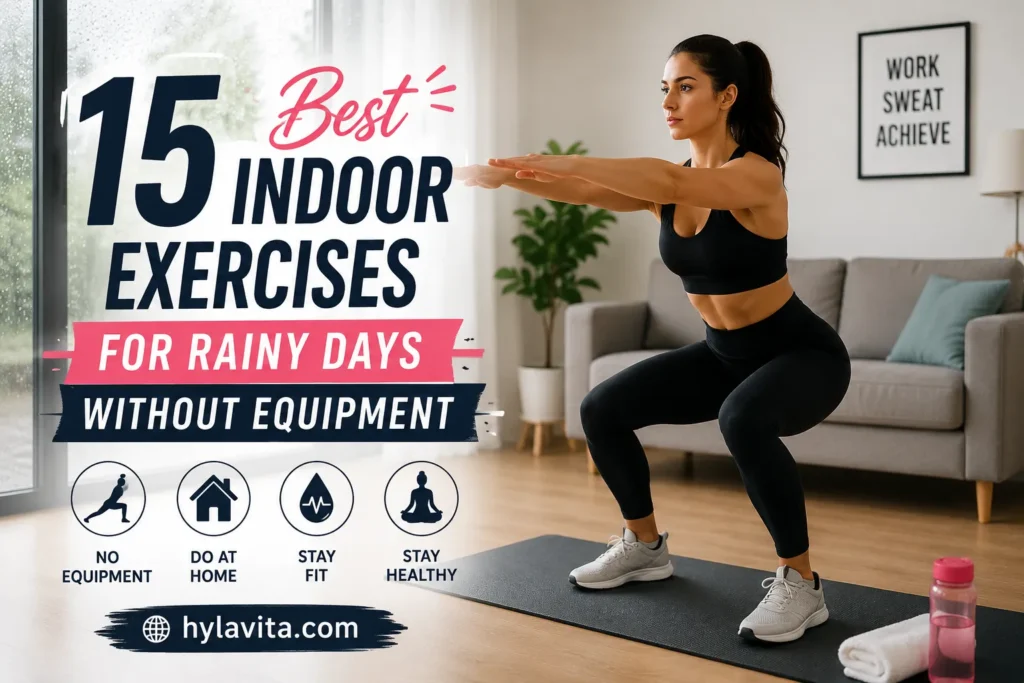
- Bodyweight Squats — Squats build strength in your legs and glutes without needing a single weight. So, keep your chest up and your knees behind your toes. Aim for 3 sets of 12 to 15 reps.
- Lunges — Step forward, bend both knees to 90 degrees, then push back to standing. Alternate legs for balance and strength. Do 10 reps per leg, for 2 to 3 sets.
- Push-Ups — Push-ups work your chest, shoulders, and arms all at once. If a full push-up is too tough at first, drop to your knees for support instead. Start with 3 sets of 8 to 10 reps and build up over time.
- Wall Sit — Lean against a wall and slide down until your knees are at a 90-degree angle. Then, hold that position, and feel your legs shake. Hold for 30 to 45 seconds, 2 to 3 times.
Core Moves
- Plank Hold — Planks build core strength without any twisting or crunching. Simply keep your body in a straight line from head to heels. Hold for 20 to 40 seconds, and repeat 3 times.
- Glute Bridges — Lie on your back, feet flat on the floor, then lift your hips toward the ceiling. This targets your glutes and, at the same time, your lower back. Aim for 15 reps, for 3 sets.
- Bicycle Crunches — Lie down and pedal your legs in the air while twisting your elbow toward the opposite knee. Although it’s simple, it’s effective for your core. Try 3 sets of 15 reps per side.
- Standing Side Crunches — Stand with feet hip-width apart, hands behind your head, then lift one knee to the side while bringing your elbow down to meet it. Do 12 reps per side, for 3 sets.
- Superman Hold — Lie face down and lift your arms and legs off the ground at the same time. This move strengthens your lower back, which often gets ignored otherwise. Hold for 15 to 20 seconds, repeat 3 times.
Cool-Down and Flexibility
- Yoga Stretch Flow — After all that movement, stretch it out. For instance, a short flow of cat-cow, child’s pose, and downward dog helps your muscles recover. Spend 5 to 10 minutes on this at the end of your workout.
How to Build a Full Rainy Day Workout Routine
You don’t need to do all 15 exercises in one session. Instead, mix and match based on your goals and how much time you have.
Quick 15-Minute Routine (Beginners): First, pick 5 exercises. Then, do each one for 30 seconds, rest for 15 seconds, and move to the next. Finally, repeat the circuit twice.
Full 30-Minute Routine (Intermediate): Combine cardio moves (jumping jacks, high knees, burpees) with strength moves (squats, push-ups, lunges), and then finish with core work and stretching.
Low-Impact Option (For Joint Pain or Beginners): Skip jumping moves like burpees and jacks. Instead, stick to squats, wall sits, planks, and glute bridges, since these still build strength without stress on your knees.
Tips to Stay Motivated on Rainy Days
Rainy weather can make anyone want to stay under a blanket. So, here’s how to push through.
- Set a timer, not a goal. Instead of aiming for “a good workout,” aim for 20 minutes, since a timer makes starting feel less overwhelming.
- Play music or a podcast. Sound keeps your energy up; in fact, a good playlist can turn a boring routine into something you look forward to.
- Track your progress. Write down your reps or sets each time, because watching small improvements keeps you coming back.
- Make it a habit, not a weather decision. Try scheduling your workout at the same time each day, so rain becomes a non-issue instead of an excuse.
Common Mistakes to Avoid
Even simple indoor workout ideas can go wrong if you’re not careful.
For example, skipping a warm-up increases your risk of strain, even for bodyweight moves. Indeed, Mayo Clinic notes that a proper warm-up raises muscle temperature and increases blood flow, which can help lower soreness and injury risk. So, spend a few minutes on light movement, such as marching in place or arm circles, before diving into the circuit.
Also, rushing through reps with bad form reduces the benefit and raises injury risk, so take your time, especially with squats and lunges. Finally, don’t compare your first workout to someone else’s tenth, because progress takes weeks, not days.
FAQ: Indoor Exercises for Rainy Days
1. Can I really get fit with no equipment? Yes. Bodyweight exercises like squats, push-ups, and planks build real strength and endurance. In fact, many people reach their fitness goals using only bodyweight training.
2. How long should a rainy day workout be? Anywhere from 15 to 30 minutes works well for most people. Even a short, consistent routine, for instance, beats an occasional long one.
3. What are the best indoor exercises for rainy day cardio? Jumping jacks, high knees, mountain climbers, and burpees are great cardio options, since they need no equipment and little space.
4. Can beginners do these rainy day workouts? Absolutely. Start with fewer reps, a slower pace, and low-impact options like wall sits and glute bridges. Then, you can build up intensity over time.
5. How often should I do indoor workouts? Three to five times a week works well for most goals, as long as you leave rest days in between to let your muscles recover.
Conclusion
Rain doesn’t have to break your workout streak. With these 15 best indoor exercises for rainy day sessions, you have everything you need to stay active without stepping outside or buying equipment.
So, start small, stay consistent, and mix these moves into a routine that fits your schedule. That way, the next time it pours outside, you’ll already know exactly what to do.
Ready to get moving? Then pick five exercises from this list and try them right now, rain or shine.
For more no-equipment routines, recovery tips, and beginner-friendly training guides, you can also visit the Home Workouts section on Hylavita.
Rain tapping on your window doesn’t have to mean skipping your workout. In fact, some of the best workouts happen when you’re stuck indoors with nothing but floor space.
If you’ve been searching for the best indoor exercises for rainy day routines, you’re in the right place. This list covers 15 simple moves you can do without any equipment — no dumbbells, no resistance bands, nothing but your own bodyweight and a bit of motivation.
Whether you’re a student cramming workouts between classes, a busy professional with 20 free minutes, or just someone who hates getting soaked on a morning run, these indoor exercises for rainy days will keep you moving. Let’s get into it.
A quick note before you start: This guide is for generally healthy adults. If you’re new to exercise, pregnant, or managing a health condition or injury, talk to a doctor or physical therapist before starting a new routine. See the full disclaimer at the end of this article.
Why Rainy Days Shouldn’t Stop Your Fitness Routine
Skipping workouts every time it rains adds up. Miss enough sessions, and your progress slows down or reverses.
The good news is that your body doesn’t need a treadmill or a park to get a real workout. According to the Centers for Disease Control and Prevention (CDC), adults need at least 150 minutes of moderate-intensity aerobic activity a week, plus muscle-strengthening activity on two or more days — and bodyweight training counts toward both.
Rainy day workouts also save time. There’s no commute to the gym, no waiting for equipment, and no umbrella required. You just roll out a mat (or use a rug) and start.
Pros and Cons of No-Equipment Bodyweight Workouts
Bodyweight training is a great fallback for rainy days, but it’s worth knowing where it shines and where it falls short so you can plan around the gaps.
Advantages
- No cost, no gear. You can do a full workout with zero equipment and zero gym membership.
- Works anywhere. Living room, hotel room, office floor — the workout travels with you.
- Low injury risk for beginners. Movements like squats, glute bridges, and planks are easier to control than loaded barbell lifts, which makes them a reasonable entry point for new exercisers.
- Builds real strength and endurance. Research reviewed by the CDC shows that muscle-strengthening bodyweight activity meets official exercise guidelines just as well as weight-room training when done consistently.
- Easy to scale. Reps, tempo, and rest periods can be adjusted up or down for any fitness level.
Limitations
- Progressive overload gets harder over time. Once bodyweight squats or push-ups feel easy, you need bands, weights, or advanced variations (single-leg squats, decline push-ups) to keep building strength — bodyweight alone has a ceiling.
- Limited lower-body loading. Moves like squats and lunges challenge the legs, but without added resistance they build less raw strength than weighted training.
- High-impact moves aren’t for everyone. Jumping jacks, burpees, and high knees put repeated stress on the knees and lower back, which isn’t ideal if you have joint pain or are new to exercise.
- Space and floor surface matter. Hardwood or tile without a mat can be hard on the knees and wrists during planks, lunges, and push-ups.
- Motivation can dip without a coach or class. Without a trainer or group setting, some people find it harder to stay consistent with a home-only routine.
15 Best Indoor Exercises for Rainy Days
Here are 15 no-equipment indoor workout moves, grouped by what they target. Pick a few from each group to build a full-body rainy day routine.
- Jumping Jacks — A classic for a reason. Jumping jacks raise your heart rate fast and warm up your whole body in under a minute. Do 3 sets of 30 seconds.
- High Knees — Stand tall and jog in place, bringing your knees up toward your chest. This move works your core and gets your legs burning. Try 3 rounds of 20 seconds each, with short breaks in between.
- Bodyweight Squats — Squats build strength in your legs and glutes without needing a single weight. Keep your chest up and knees behind your toes. Aim for 3 sets of 12 to 15 reps.
- Lunges — Step forward, bend both knees to 90 degrees, then push back to standing. Alternate legs for balance and strength. Do 10 reps per leg, for 2 to 3 sets.
- Push-Ups — Push-ups work your chest, shoulders, and arms all at once. If a full push-up is tough, drop to your knees for support. Start with 3 sets of 8 to 10 reps and build up over time.
- Plank Hold — Planks build core strength without any twisting or crunching. Keep your body in a straight line from head to heels. Hold for 20 to 40 seconds, and repeat 3 times.
- Mountain Climbers — This move combines cardio with core work. Start in a plank position and drive your knees toward your chest, one at a time, quickly. Do 3 sets of 30 seconds.
- Glute Bridges — Lie on your back, feet flat on the floor, then lift your hips toward the ceiling. This targets your glutes and lower back. Aim for 15 reps, for 3 sets.
- Bicycle Crunches — Lie down and pedal your legs in the air while twisting your elbow toward the opposite knee. Try 3 sets of 15 reps per side.
- Wall Sit — Lean against a wall and slide down until your knees are at a 90-degree angle. Hold for 30 to 45 seconds, 2 to 3 times.
- Step-Ups (Using Stairs or a Sturdy Chair) — If you have stairs at home, use them for a quick leg and cardio workout in one. Do this for 2 to 3 minutes, resting as needed.
- Burpees — Burpees combine a squat, a push-up, and a jump into one move. They’re tough, but they burn a lot of energy fast. Start with 3 sets of 8 reps, and slow the pace down if you’re a beginner.
- Standing Side Crunches — Stand with feet hip-width apart, hands behind your head. Lift one knee to the side while bringing your elbow down to meet it. Do 12 reps per side, for 3 sets.
- Superman Hold — Lie face down and lift your arms and legs off the ground at the same time. This move strengthens your lower back, which often gets ignored. Hold for 15 to 20 seconds, repeat 3 times.
- Yoga Stretch Flow — After all that movement, stretch it out. A short flow of cat-cow, child’s pose, and downward dog helps your muscles recover. Spend 5 to 10 minutes on this at the end of your workout.
How to Build a Full Rainy Day Workout Routine
You don’t need to do all 15 exercises in one session. Instead, mix and match based on your goals and how much time you have.
Quick 15-Minute Routine (Beginners): Pick 5 exercises. Do each one for 30 seconds, rest for 15 seconds, then move to the next. Repeat the circuit twice.
Full 30-Minute Routine (Intermediate): Combine cardio moves (jumping jacks, high knees, burpees) with strength moves (squats, push-ups, lunges) and finish with core work and stretching.
Low-Impact Option (For Joint Pain or Beginners): Skip jumping moves like burpees and jacks. Stick to squats, wall sits, planks, and glute bridges instead. These still build strength without stress on your knees.
Tips to Stay Motivated on Rainy Days
Rainy weather can make anyone want to stay under a blanket. Here’s how to push through.
- Set a timer, not a goal. Instead of aiming for “a good workout,” aim for 20 minutes. A timer makes starting feel less overwhelming.
- Play music or a podcast. A good playlist can turn a boring routine into something you look forward to.
- Track your progress. Write down your reps or sets each time. Watching small improvements keeps you coming back.
- Make it a habit, not a weather decision. Schedule your workout at the same time each day so rain becomes a non-issue.
Common Mistakes to Avoid
Even simple indoor workout ideas can go wrong if you’re not careful.
Skipping a warm-up increases your risk of strain, even for bodyweight moves. Mayo Clinic notes that a proper warm-up raises muscle temperature and increases blood flow, which can help lower soreness and injury risk — so spend a few minutes on light movement (marching in place, arm circles) before diving into the circuit.
Rushing through reps with bad form also reduces the benefit and raises injury risk. Take your time, especially with squats and lunges. And don’t compare your first workout to someone else’s tenth — progress takes weeks, not days.
FAQ: Indoor Exercises for Rainy Days
1. Can I really get fit with no equipment? Yes. Bodyweight exercises like squats, push-ups, and planks build real strength and endurance. Many people reach their fitness goals using only bodyweight training.
2. How long should a rainy day workout be? Anywhere from 15 to 30 minutes works well for most people. Even a short, consistent routine beats an occasional long one.
3. What are the best indoor exercises for rainy day cardio? Jumping jacks, high knees, mountain climbers, and burpees are great cardio options that need no equipment and little space.
4. Can beginners do these rainy day workouts? Absolutely. Start with fewer reps, a slower pace, and low-impact options like wall sits and glute bridges. You can build up intensity over time.
5. How often should I do indoor workouts? Three to five times a week works well for most goals, with rest days in between to let your muscles recover.
Conclusion
Rain doesn’t have to break your workout streak. With these 15 best indoor exercises for rainy day sessions, you have everything you need to stay active without stepping outside or buying equipment.
Start small, stay consistent, and mix these moves into a routine that fits your schedule. The next time it pours outside, you’ll already know exactly what to do.
Ready to get moving? Pick five exercises from this list and try them right now, rain or shine.
For more no-equipment routines, recovery tips, and beginner-friendly training guides, visit the Home Workouts section on Hylavita.ne.
Medical Disclaimer:
This article is for general informational and educational purposes only and is not a substitute for professional medical advice, diagnosis, or treatment.