Ever tried to touch your toes while someone held your hand for balance? That small bit of support can change everything. In fact, it’s the whole idea behind yoga poses for 2.
Doing yoga alone can feel a little lonely at times. Fortunately, partner yoga fixes that, because it turns a solo stretch into a shared moment with a friend, partner, or family member.
In this guide, you’ll find 15 easy yoga poses for two people, plus a clear-eyed look at the advantages and disadvantages so you can decide if it’s right for you. Overall, each pose is beginner-friendly and fun to try at home, and you won’t need any fancy equipment. Just you, a partner, and a bit of floor space.
What Is Partner Yoga and Why Try It?
Partner yoga is simply yoga done with another person. Instead of holding a pose alone, you lean on each other, literally.
For example, you might use your partner’s body weight to deepen a stretch, or you might balance together in a pose neither of you could hold alone. In short, it’s teamwork, but with stretching.
According to the National Center for Complementary and Integrative Health (NCCIH), part of the National Institutes of Health, yoga typically combines physical postures, breathing techniques, and meditation. Additionally, studies show that yoga may help people manage stress and improve mental/emotional health, sleep, and balance. As a result, partner yoga builds on those same fundamentals while adding a social, trust-building layer that solo practice doesn’t offer.
Advantages and Disadvantages of Partner Yoga
Before you roll out the mats, it helps to weigh the upsides against the trade-offs, since partner yoga isn’t automatically “better” than solo yoga — it’s simply a different tool for a different goal.
Advantages
- Deeper stretches with assisted support. Because a partner’s gentle weight or resistance can help you ease further into a stretch, you may reach depths you couldn’t manage alone.
- Builds trust and communication. Leaning back into someone and being held steady is a direct trust exercise, so poses only work if you talk through what feels good and what doesn’t.
- Motivation and accountability. After all, it’s easier to skip a solo session than to bail on a friend who’s already on the mat with you.
- Shared enjoyment. Wobbling, laughing, and problem-solving a pose together therefore makes the practice feel more like play than a workout.
- Accessible to non-athletes. Most of the poses in this guide need little strength or flexibility to start, so beginners can jump right in.
- Possible mental health upside. The NCCIH notes that yoga may help people manage stress and support good health habits — benefits that partner practice can further reinforce through social connection.
Disadvantages
- Higher injury risk in some poses. Adding a second person’s weight or momentum, as in Double Downward Dog or Camel Assist, raises the stakes if either person loses balance. Indeed, the NCCIH cautions that although yoga is generally considered safe for healthy people when practiced appropriately, you can still get hurt, and learning without supervision has been associated with increased risk.
- Requires a willing, available partner. Unlike solo yoga, you can’t just roll out a mat whenever you feel like it; instead, scheduling around someone else adds friction.
- Mismatched skill or size can complicate poses. A big difference in height, weight, or flexibility between partners can make balance poses harder or less effective, though this isn’t necessarily a dealbreaker.
- Less control over your own pace. In solo yoga, you move entirely on your own terms, whereas partner yoga means checking in, negotiating depth, and sometimes slowing down (or speeding up) for someone else.
- Not a substitute for instruction. Learning partner poses from an article or video, without ever having in-person guidance, carries more risk of misalignment than a supervised class — a point the Mayo Clinic also raises for solo learners, noting that beginners usually find it helpful to learn with an instructor even though books and videos can teach the basics.
Who Can Try These Poses
These easy yoga poses for two people work for almost anyone. For instance, couples, friends, parents and kids, or even coworkers on a break can all try them.
You don’t need to be flexible or experienced, since most poses on this list are beginner level. However, if you have an injury or health condition, check with a doctor first.
Getting Started: Tips Before You Begin
A little prep makes partner yoga safer and smoother. So, here are a few quick tips to run through first.
Choose the Right Partner
Pick someone close to your height and weight if possible, because this makes balance poses easier. That said, trust matters more than matching bodies.
Set Up Your Space
Clear a flat, open area, then roll out two yoga mats side by side, or one large mat if you’re sharing. Also, remove furniture, rugs, or anything you could trip over.
Communicate Throughout
Talk to your partner during each pose, and ask if a stretch feels good or too intense. This one habit, above all, prevents most partner yoga injuries.
15 Easy Partner Yoga Poses for Beginners
Here are 15 yoga poses for 2 that are simple to learn and safe to try at home, organized from gentle seated stretches through to more active standing and balance poses.
Seated and Grounding Poses (1–3)
1. Seated Cat-Cow
Sit back-to-back with your partner, legs crossed. As you both inhale, arch your backs slightly and look up; then, as you exhale, round your spines forward. Throughout the movement, your backs stay in gentle contact.
This pose warms up the spine, and it also helps you sync your breathing with your partner.
2. Double Downward Dog
One partner starts in a normal downward dog position. Meanwhile, the second partner places their hands on the mat in front of the first person, then rests their feet on the first partner’s lower back, forming a second downward dog on top.
This stretches the shoulders, hamstrings, and back for both people. Because of the added weight involved, go slow here, and only the more experienced partner should be on top at first.
3. Partner Forward Fold
Sit facing each other with legs spread wide, feet touching your partner’s feet. Hold hands and lean forward together, letting the stronger puller ease back gently to deepen the other’s stretch.
This is one of the easiest yoga poses for two, and it feels amazing on tight hamstrings.
Standing and Balance Poses (4–6)
4. Back-to-Back Chair Pose
Stand back-to-back with your partner, feet hip-width apart. Slowly bend your knees and slide down as if sitting in a chair, using each other’s back for support, then hold for a few breaths before rising together.
This pose builds leg strength, and it also teaches you to move as one unit.
5. Double Tree Pose
Stand side by side, inner arms wrapped around each other’s waist or shoulder. Each person then lifts the outer foot onto the inner ankle, calf, or thigh (never directly on the knee), balancing together like two trees growing side by side.
6. Seated Twist
Sit back-to-back with legs crossed. Both partners twist to the same side, placing hands on each other’s opposite knee for a gentle assist, then hold before switching sides.
This move helps digestion and loosens the spine, so it’s a calm, easy pose for beginners.
Core and Heart-Opening Poses (7–9)
7. Partner Boat Pose
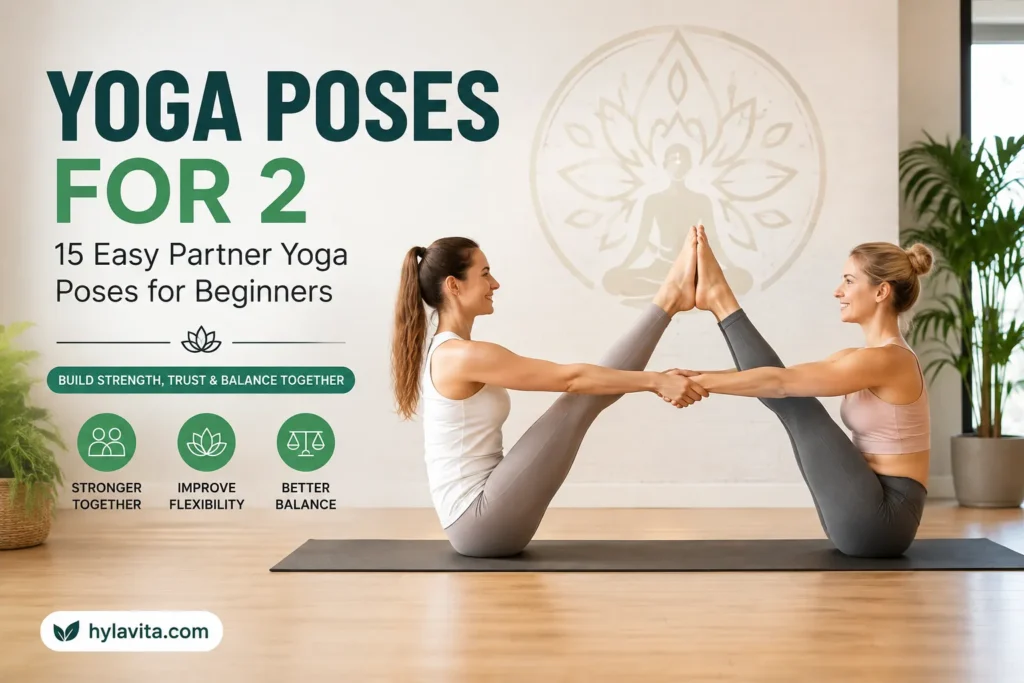
Sit facing each other, knees bent, feet touching. Hold hands and lift your feet off the ground, balancing on your sit bones, then slowly straighten your legs so your feet meet in the middle, forming a V-shape together.
This one works your core hard, so expect some wobbling and laughing — that’s completely normal.
8. Supported Fish Pose
One partner lies on their back with arms out to the sides. Meanwhile, the second partner kneels behind their head and gently supports the base of their skull, helping the chest open and lift slightly.
This is a gentle heart-opener, and it feels especially relaxing after a long day.
9. Double Warrior
Stand facing the same direction, one behind the other, in warrior 2 pose. Match your stance and arm position exactly, like mirror images, since this builds strength and helps you notice your own alignment through your partner.
Deeper Stretches (10–12)
10. Partner Side Stretch
Sit cross-legged, side by side, close enough to link your near arms together overhead. Lean away from each other slightly, stretching your sides, then switch and repeat on the other side.
11. Camel Assist Pose
One partner kneels and leans back into a gentle camel pose (a backbend). The second partner stands behind, offering a hand or light support at the lower back to help balance.
Only go as far back as feels comfortable, since this is an intermediate stretch that should be eased into slowly.
12. Double Pigeon Stretch
Sit facing each other in a seated figure-four position, one leg bent in front. Lean forward and hold hands, gently pulling each other into a deeper hip stretch.
This targets tight hips, which is common if you sit at a desk all day.
Cool-Down Poses (13–15)
13. Standing Partner Balance
Face your partner and hold both hands. Both of you lean back at the same time, keeping arms straight, until you find a balance point where neither of you falls, then hold before slowly pulling back up together.
14. Partner Child’s Pose
One partner sits in child’s pose, arms stretched forward on the mat. The second partner then sits gently on their lower back (with light weight only) or places both hands there for a calming, grounding press.
Always ask before adding weight, since some backs need a lighter touch.
15. Savasana Together
End your session lying side by side, or head-to-head, in savasana (final relaxation pose). Close your eyes and breathe together for a few minutes.
This simple, still pose is, above all, the perfect way to end any partner yoga session. If you want to build a broader relaxation habit beyond the mat, see Hylavita’s daily self-care guidance for more ways to wind down.
Safety Tips for Partner Yoga
Partner yoga is generally safe, but a few precautions go a long way.
- Warm up first with light stretching or a short walk.
- Never force a stretch, because pain is a sign to stop, not push harder.
- Keep talking to your partner throughout each pose.
- Skip deep backbends or inversions if you’re pregnant, injured, or new to yoga.
- Have a rolled towel or cushion nearby for extra support under knees or backs.
The NCCIH’s guidance on general yoga safety applies just as much to partner practice: specifically, to reduce your risk of injury, practice yoga under the guidance of a qualified instructor, since learning on your own without supervision has been associated with increased risks. Therefore, treat the poses above as an introduction, not a replacement for in-person instruction, especially for the more advanced poses like Double Downward Dog or Camel Assist.
FAQ: Common Questions About Yoga Poses for 2
What are the easiest yoga poses for two people to start with?
Seated cat-cow, partner forward fold, and seated twist are the easiest yoga poses for two beginners, since they need little balance or strength and focus mainly on gentle stretching.
Can beginners do partner yoga poses safely?
Yes, most partner yoga poses are safe for beginners as long as you move slowly and communicate. So, start with seated or standing poses before trying balance or backbend poses.
Do couples yoga poses require flexibility?
No, you don’t need to be flexible to try couples yoga poses. Instead, flexibility improves over time with practice, and many poses are designed to help you build it gradually.
How long should a partner yoga session last?
A beginner partner yoga session can last anywhere from 15 to 30 minutes. Afterward, you can always add more poses or repeat favorites as you both get more comfortable.
Is partner yoga good for non-romantic partners, like friends or family?
Absolutely. Partner yoga works well for friends, parents and children, siblings, or coworkers, since the poses are about balance and trust, not romance.
Conclusion
Yoga poses for 2 turn a normal workout into something shared. Overall, you get the same stretching and strength benefits as solo yoga, plus a boost in trust and connection with your partner, along with the extra coordination and safety considerations that come with practicing alongside someone else.
Start with a few easy yoga poses for two, like the seated cat-cow or partner forward fold, then work your way up to balance poses as you both get more confident. If stress relief is your main goal, pair this practice with Hylavita’s broader stress management resources for a fuller routine.
Grab a mat, find a partner, and give these partner yoga poses a try this week. You might be surprised, after all, how much fun stretching can be with a friend by your side.
Ever tried to touch your toes while someone held your hand for balance? That small bit of support can change everything. It’s the whole idea behind yoga poses for 2.
Doing yoga alone can feel a little lonely at times. Partner yoga fixes that. It turns a solo stretch into a shared moment with a friend, partner, or family member.
In this guide, you’ll find 15 easy yoga poses for two people, plus a clear-eyed look at the advantages and disadvantages so you can decide if it’s right for you. Each pose is beginner-friendly and fun to try at home. No fancy equipment needed. Just you, a partner, and a bit of floor space.
What Is Partner Yoga and Why Try It?
Partner yoga is simply yoga done with another person. Instead of holding a pose alone, you lean on each other, literally.
You use your partner’s body weight to deepen a stretch. Or you balance together in a pose neither of you could hold alone. It’s teamwork, but with stretching.
According to the National Center for Complementary and Integrative Health (NCCIH), part of the National Institutes of Health, yoga typically combines physical postures, breathing techniques, and meditation, and studies show yoga may help people manage stress and improve mental/emotional health, sleep, and balance. Partner yoga builds on those same fundamentals while adding a social, trust-building layer that solo practice doesn’t offer.
Advantages and Disadvantages of Partner Yoga
Before you roll out the mats, it helps to weigh the upsides against the trade-offs. Partner yoga isn’t automatically “better” than solo yoga — it’s a different tool for a different goal.
Advantages
- Deeper stretches with assisted support. A partner’s gentle weight or resistance can help you ease further into a stretch than you could reach alone.
- Builds trust and communication. Leaning back into someone and being held steady is a direct trust exercise, and poses only work if you talk through what feels good and what doesn’t.
- Motivation and accountability. It’s easier to skip a solo session than to bail on a friend who’s already on the mat with you.
- Shared enjoyment. Wobbling, laughing, and problem-solving a pose together makes the practice feel more like play than a workout.
- Accessible to non-athletes. Most of the poses in this guide need little strength or flexibility to start.
- Possible mental health upside. The NCCIH notes that yoga may help people manage stress and support good health habits — benefits that partner practice can reinforce through social connection.
Disadvantages
- Higher injury risk in some poses. Adding a second person’s weight or momentum (as in Double Downward Dog or Camel Assist) raises the stakes if either person loses balance. The NCCIH cautions that yoga is generally considered a safe form of physical activity for healthy people when practiced appropriately, but as with other physical activity, you can get hurt doing it, and learning without supervision has been associated with increased risks.
- Requires a willing, available partner. Unlike solo yoga, you can’t just roll out a mat whenever you feel like it — scheduling around someone else adds friction.
- Mismatched skill or size can complicate poses. A big difference in height, weight, or flexibility between partners can make balance poses harder or less effective, though this isn’t a dealbreaker.
- Less control over your own pace. In solo yoga you move entirely on your own terms; partner yoga means checking in, negotiating depth, and sometimes slowing down (or speeding up) for someone else.
- Not a substitute for instruction. Learning partner poses from an article or video, without ever having in-person guidance, carries more risk of misalignment than a supervised class — something the Mayo Clinic also flags for solo learners: although you can learn yoga from books and videos, beginners usually find it helpful to learn with an instructor.
Who Can Try These Poses
These easy yoga poses for two people work for almost anyone. Couples, friends, parents and kids, or even coworkers on a break can try them.
You don’t need to be flexible or experienced. Most poses on this list are beginner level. However, if you have an injury or health condition, check with a doctor first.
Getting Started: Tips Before You Begin
A little prep makes partner yoga safer and smoother. Here are a few quick tips.
Choose the Right Partner
Pick someone close to your height and weight if possible. This isn’t a strict rule, but it makes balance poses easier. Trust matters more than matching bodies, though.
Set Up Your Space
Clear a flat, open area. Roll out two yoga mats side by side, or one large mat if you’re sharing. Remove furniture, rugs, or anything you could trip over.
Communicate Throughout
Talk to your partner during each pose. Ask if a stretch feels good or too intense. This one habit prevents most partner yoga injuries.
15 Easy Partner Yoga Poses for Beginners
Here are 15 yoga poses for 2 that are simple to learn and safe to try at home.
1. Seated Cat-Cow
Sit back-to-back with your partner, legs crossed. As you both inhale, arch your backs slightly and look up. As you exhale, round your spines forward. Your backs stay in gentle contact the whole time.
This pose warms up the spine. It also helps you sync your breathing with your partner.
2. Double Downward Dog
One partner starts in a normal downward dog position. The second partner places their hands on the mat in front of the first person, then rests their feet on the first partner’s lower back, forming a second downward dog on top.
This stretches the shoulders, hamstrings, and back for both people. Go slow here, and only the more experienced partner should be on top at first.
3. Partner Forward Fold
Sit facing each other with legs spread wide, feet touching your partner’s feet. Hold hands and lean forward together. Let the stronger puller ease back gently to deepen the other’s stretch.
This is one of the easiest yoga poses for two, and it feels amazing on tight hamstrings.
4. Back-to-Back Chair Pose
Stand back-to-back with your partner, feet hip-width apart. Slowly bend your knees and slide down as if sitting in a chair, using each other’s back for support. Hold for a few breaths, then rise together.
This pose builds leg strength. It also teaches you to move as one unit.
5. Double Tree Pose
Stand side by side, inner arms wrapped around each other’s waist or shoulder. Each person lifts the outer foot onto the inner ankle, calf, or thigh (never directly on the knee). Balance together like two trees growing side by side.
6. Seated Twist
Sit back-to-back with legs crossed. Both partners twist to the same side, placing hands on each other’s opposite knee for a gentle assist. Hold, then switch sides.
This move helps digestion and loosens the spine. It’s a calm, easy pose for beginners.
7. Partner Boat Pose
Sit facing each other, knees bent, feet touching. Hold hands and lift your feet off the ground, balancing on your sit bones. Slowly straighten your legs so your feet meet in the middle, forming a V-shape together.
This one works your core hard. Expect some wobbling and laughing, that’s normal.
8. Supported Fish Pose
One partner lies on their back with arms out to the sides. The second partner kneels behind their head and gently supports the base of their skull, helping the chest open and lift slightly.
This is a gentle heart-opener. It feels especially relaxing after a long day.
9. Double Warrior
Stand facing the same direction, one behind the other, in warrior 2 pose. Match your stance and arm position exactly, like mirror images. This builds strength and helps you notice your own alignment through your partner.
10. Partner Side Stretch
Sit cross-legged, side by side, close enough to link your near arms together overhead. Lean away from each other slightly, stretching your sides. Switch and repeat on the other side.
11. Camel Assist Pose
One partner kneels and leans back into a gentle camel pose (a backbend). The second partner stands behind, offering a hand or light support at the lower back to help balance.
Only go as far back as feels comfortable. This is an intermediate stretch, so ease into it slowly.
12. Double Pigeon Stretch
Sit facing each other in a seated figure-four position, one leg bent in front. Lean forward and hold hands, gently pulling each other into a deeper hip stretch.
This targets tight hips, which is common if you sit at a desk all day.
13. Standing Partner Balance
Face your partner and hold both hands. Both of you lean back at the same time, keeping arms straight, until you find a balance point where neither of you falls. Hold, then slowly pull back up together.
14. Partner Child’s Pose
One partner sits in child’s pose, arms stretched forward on the mat. The second partner sits gently on their lower back (with light weight only) or places both hands there for a calming, grounding press.
Always ask before adding weight. Some backs need a lighter touch.
15. Savasana Together
End your session lying side by side, or head-to-head, in savasana (final relaxation pose). Close your eyes and breathe together for a few minutes.
This simple, still pose is the perfect way to end any partner yoga session. If you want to build a broader relaxation habit beyond the mat, see Hylavita’s daily self-care guidance for more ways to wind down.
Safety Tips for Partner Yoga
Partner yoga is generally safe, but a few precautions go a long way.
- Warm up first with light stretching or a short walk.
- Never force a stretch. Pain is a sign to stop, not push harder.
- Keep talking to your partner throughout each pose.
- Skip deep backbends or inversions if you’re pregnant, injured, or new to yoga.
- Have a rolled towel or cushion nearby for extra support under knees or backs.
The NCCIH’s guidance on general yoga safety applies just as much to partner practice: to reduce your risk of injury, practice yoga under the guidance of a qualified instructor, since learning on your own without supervision has been associated with increased risks. Treat the poses above as an introduction, not a replacement for in-person instruction, especially for the more advanced poses like Double Downward Dog or Camel Assist.
FAQ: Common Questions About Yoga Poses for 2
What are the easiest yoga poses for two people to start with?
Seated cat-cow, partner forward fold, and seated twist are the easiest yoga poses for two beginners. They need little balance or strength and focus mainly on gentle stretching.
Can beginners do partner yoga poses safely?
Yes, most partner yoga poses are safe for beginners as long as you move slowly and communicate. Start with seated or standing poses before trying balance or backbend poses.
Do couples yoga poses require flexibility?
No, you don’t need to be flexible to try couples yoga poses. Flexibility improves over time with practice, and many poses are designed to help you build it gradually.
How long should a partner yoga session last?
A beginner partner yoga session can last anywhere from 15 to 30 minutes. You can always add more poses or repeat favorites as you both get more comfortable.
Is partner yoga good for non-romantic partners, like friends or family?
Absolutely. Partner yoga works well for friends, parents and children, siblings, or coworkers. The poses are about balance and trust, not romance.
Conclusion
Yoga poses for 2 turn a normal workout into something shared. You get the same stretching and strength benefits as solo yoga, plus a boost in trust and connection with your partner — along with the extra coordination and safety considerations that come with practicing alongside someone else.
Start with a few easy yoga poses for two, like the seated cat-cow or partner forward fold. Then work your way up to balance poses as you both get more confident. If stress relief is your main goal, pair this practice with Hylavita’s broader stress management resources for a fuller routine.
Grab a mat, find a partner, and give these partner yoga poses a try this week. You might be surprised how much fun stretching can be with a friend by your side.
Medical Disclaimer:
This article is for general informational and educational purposes only and is not a substitute for professional medical advice, diagnosis, or treatment.