Do your hips feel stiff after a long day of sitting? You are not alone. Most people who sit at desks or drive a lot deal with tight hips at some point.
That’s where 90/90 hip rotations come in. This simple movement is one of the best tools for building hip mobility, and you don’t need any equipment to do it. It’s a staple move in physical therapy clinics and mobility coaching programs, which is exactly why it’s worth understanding properly rather than just copying a routine off social media.
In this guide, you’ll learn what 90/90 hip rotations are, why they work, how to do them correctly, and — importantly — the advantages and disadvantages of adding them to your routine. We’ll also cover the 90/90 hip stretch, the 90/90 hip switch, and other useful variations. By the end, you’ll have everything you need to decide whether this exercise belongs in your routine, and how to add it safely.
For more evidence-based, plain-language fitness guidance like this, you can always browse the full library of workout and mobility guides on Hylavita.
What Are 90/90 Hip Rotations?
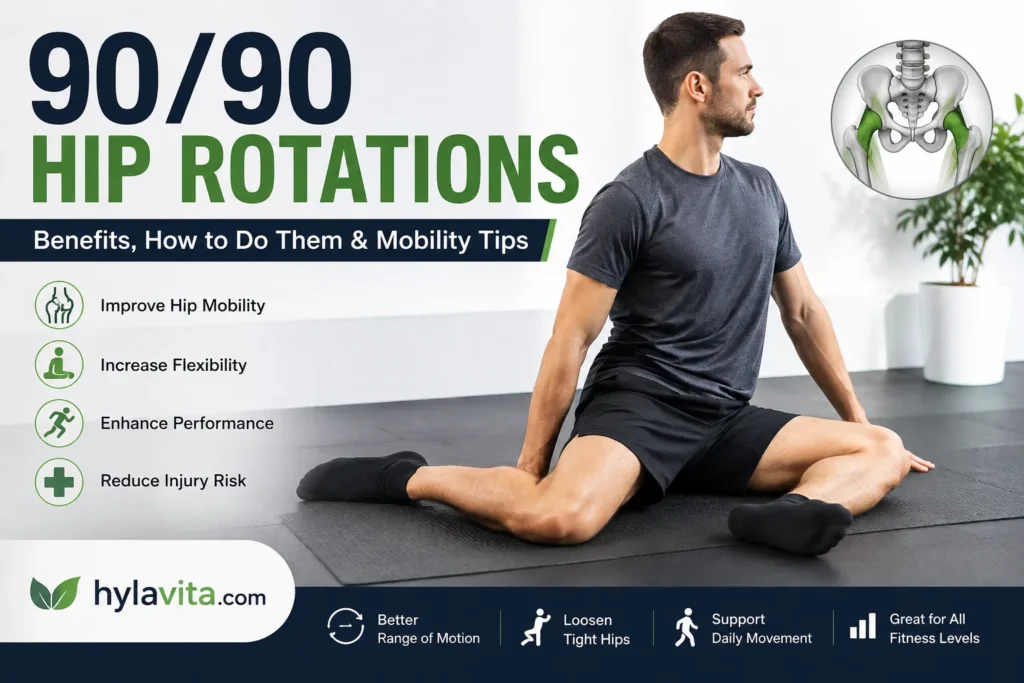
The 90/90 hip rotation is a floor-based exercise. You sit on the ground with both knees bent at 90-degree angles, one leg in front of you and one leg to the side.
The name comes from those two 90-degree angles. One leg points forward with the knee bent, and the other leg points out to the side, also bent.
This position looks simple. However, it targets your hip joints in a way that most stretches miss. It works your internal and external hip rotation at the same time — the front leg moves into external rotation while the back leg moves into internal rotation — which is something everyday movement rarely does, as Cleveland Clinic explains.
Unlike a static stretch where you hold one position, 90/90 hip mobility drills involve movement. You rotate from one side to the other, which trains your hips to move through a fuller range of motion.
Why 90/90 Hip Mobility Matters
Your hips are ball-and-socket joints. This means they should move in many directions, not just forward and back.
Sadly, modern life doesn’t ask much of our hips. Sitting in a chair, driving a car, or scrolling on your phone all keep your hips in one narrow position for hours.
Over time, this can lead to tight hip flexors, weak glutes, and stiff hip rotation. This might show up as lower back pain, knee discomfort, or trouble squatting deep. Healthline notes that research on people with generalized lower back pain and reduced hip mobility has found that targeted hip stretches and exercises can help improve pain and function, which is part of why this move shows up so often in rehab settings.
The 90/90 hip exercise directly addresses this problem. It trains the rotation your hips need but rarely get from daily life.
Who Benefits Most From This Exercise
This drill helps almost everyone, but a few groups notice the biggest difference.
- Desk workers and students who sit for long stretches each day
- Runners and cyclists who need better hip rotation for stride and pedal efficiency
- Weightlifters who want deeper, safer squats
- Dancers, martial artists, and yoga practitioners who need open hips for their sport
- Older adults working to maintain hip flexibility and reduce fall risk
If you fall into any of these groups, this exercise is worth adding to your weekly routine. If you’re also dealing with general tightness through the front of the hip, it’s worth reading up on hip flexor anatomy so you understand what you’re actually stretching — Physiopedia has a solid breakdown of the muscles involved.
Benefits of 90/90 Hip Rotations
Let’s break down what this exercise actually does for your body.
Improves hip rotation range. This is the main benefit. The movement trains both internal and external hip rotation together. Most exercises only train one direction, so this drill fills that gap.
Reduces lower back and knee strain. When your hips can’t rotate well, your lower back and knees often try to compensate. This extra strain can lead to pain over time. Better hip mobility takes pressure off these joints.
Supports better squat and deadlift form. If you lift weights, hip rotation affects your squat depth and bar path. Tight hips often force your knees or lower back to move in ways they shouldn’t. The 90/90 hip stretch helps fix this at the source.
Helps with everyday movement. Getting in and out of a car, tying your shoes, or turning to grab something behind you all use hip rotation. Better mobility here makes daily tasks feel easier and smoother.
Builds body awareness. Because the movement is slow and controlled, it teaches you to notice how your hips feel and move. This awareness carries over into other exercises and sports.
Advantages and Disadvantages of 90/90 Hip Rotations
No exercise is a perfect fit for everyone, and 90/90 hip rotations are no exception. Here’s an honest look at both sides before you add it to your routine.
Advantages
- No equipment needed. You can do this exercise on any floor, at home, at the gym, or while traveling.
- Trains a movement pattern most routines skip. Very few everyday exercises train internal and external hip rotation together, so this drill fills a real gap in most people’s mobility work.
- Scales easily. Beginners can start with a static hold, while more advanced exercisers can move into the full switch or add variations like the elevated 90/90.
- Carries over to sport and lifting. Better hip rotation supports squat depth, running stride, and rotational sports like golf or tennis.
- Quick to fit into a routine. A few minutes as a warm-up or standalone drill is enough to see benefits over time.
Disadvantages
- Can aggravate hip impingement (FAI). Because the move pushes the hip into a deep, combined rotation, people with femoroacetabular impingement or certain hip labral issues may find it uncomfortable or irritating, as Cleveland Clinic points out — this is one reason it’s not a one-size-fits-all stretch.
- Uncomfortable for stiff or larger-bodied beginners. Getting into the position can feel awkward or unstable at first, particularly for anyone with very limited hip mobility to start with.
- Easy to do with poor form. Leaning too far forward, collapsing the chest, or using your hands to force the rotation can reduce the benefit and put unwanted stress on the knees.
- Not a strength exercise. On its own, it improves range of motion but doesn’t build the hip and glute strength needed to control that new range, so it works best paired with strengthening work rather than used in isolation.
- Knee position can bother some people. Because the front knee bears some rotational load, anyone with existing knee pain or a meniscus issue may need to modify or skip this move.
How to Do 90/90 Hip Rotations (Step-by-Step)
Here is the basic setup and movement, broken into simple steps.
Step 1: Get into position. Sit on the floor. Bend your front leg to 90 degrees, with your shin roughly in line with your body. Bend your back leg to 90 degrees as well, with that shin pointing out to the side. Keep your chest tall and your hands resting on the floor for balance if needed.
Step 2: Rotate to the other side. Lift both knees slightly off the ground. Rotate your hips so your legs switch sides. Your front leg becomes your back leg, and your back leg becomes your front leg. This switch is often called the 90/90 hip switch. It’s the core movement of the whole exercise.
Step 3: Control the movement. Move slowly. Don’t use momentum or swing your legs. The goal is control, not speed. Keep your torso as upright as possible during the switch. Avoid leaning too far forward or using your hands to push yourself through the motion.
Step 4: Repeat. Do 8 to 12 controlled switches per side to start. As your hips open up, you can increase reps or hold each position for a few seconds.
Common Mistakes to Avoid
- Rushing the movement. Speed reduces control and mobility gains.
- Letting the chest collapse forward. This takes tension away from the hips.
- Using hands to force the rotation. Let your hips do the work.
- Skipping the warm-up. Cold hips are more prone to strain.
90/90 Hip Stretch Variations
Once you’re comfortable with the basic movement, try these variations to challenge your hips further.
Static 90/90 hip stretch. Instead of switching sides, simply hold the 90/90 position on one side. Lean your chest gently toward your front shin. Hold for 20 to 30 seconds, then switch sides.
Active lean 90/90. From the 90/90 position, lean your torso forward over your front leg, then return upright. Repeat several times before switching sides. This adds strength work to the mobility drill.
Elevated 90/90. Place your back foot on a low bench or step. This increases the stretch on the back hip and adds a bit more challenge.
90/90 with overhead reach. While holding the position, reach one arm overhead and rotate your torso slightly. This adds a spinal mobility element to the hip work.
If you’re building out a full lower-body mobility or strength session around this move, Hylavita’s strength training and posture guides are a good next stop for structuring the rest of your workout.
When and How Often to Do This Exercise
You can use 90/90 hip rotations as a warm-up before workouts or as a standalone mobility session.
For warm-ups, 5 to 8 slow reps per side is enough to prepare your hips for training. For dedicated mobility work, aim for 2 to 3 sessions per week, doing 2 to 3 sets of 8 to 12 reps.
Consistency matters more than intensity here. A few minutes, done regularly, will do more for your hips than one long session done occasionally.
Safety Tips and Precautions
This exercise is generally safe for most people. Still, keep these tips in mind.
- Move within a pain-free range. Mild stretching discomfort is normal, but sharp pain is not.
- Warm up first. A short walk or light movement before this drill helps your hips respond better.
- Modify if needed. If sitting flat on the floor is uncomfortable, sit on a small cushion or yoga block.
- Check with a professional if you have hip or knee issues. Anyone with a hip replacement, recent surgery, femoroacetabular impingement, or ongoing joint pain should speak with a doctor or physical therapist before trying this move, particularly given the impingement concerns noted above.
Everybody’s hips are different. Some people will find this move easy right away. Others may need weeks of practice before it feels smooth. Both are normal.
FAQ Section
What muscles do 90/90 hip rotations work? This exercise mainly works the muscles around your hip joint, including the glutes, hip rotators, and hip flexors. It also lightly engages your core, since you need to stay balanced during the switch.
Can beginners do 90/90 hip rotations? Yes. Beginners can start with the static hold version before trying the full switch. Going slow and using a smaller range of motion at first makes the exercise easier to learn.
How is the 90/90 hip switch different from the stretch? The 90/90 hip stretch involves holding one position to lengthen the muscles. The 90/90 hip switch adds movement, as you rotate from one side to the other. The switch builds mobility, while the static stretch focuses more on flexibility.
Is it normal to feel tight during this exercise? Yes, mild tightness is common, especially if you sit a lot or haven’t trained hip rotation before. This should ease with regular practice. However, sharp or shooting pain is not normal and means you should stop and check your form or consult a professional.
How long until I notice better hip mobility? Many people notice small improvements within 2 to 4 weeks of regular practice. However, results vary based on your starting mobility, how often you train, and other factors like activity level. Patience and consistency matter more than speed.
Conclusion
90/90 hip rotations are a simple but effective tool for better hip mobility, and understanding both the advantages and the disadvantages helps you use the move wisely rather than blindly. They train rotation your hips rarely get from daily life, which can ease back pain, improve your squat, and make everyday movement feel smoother — but they’re not the right fit for everyone, particularly people with hip impingement or certain knee issues.
Start with the basic position, move slowly, and add variations like the static stretch or elevated version as you progress. Try adding 90/90 hip rotations to your warm-up or mobility routine this week, and give your hips the movement they’ve been missing. For more mobility, strength, and posture guides, explore the Fitness & Exercise section on Hylavita.
Medical disclaimer: This article is for general informational and educational purposes only and is not a substitute for professional medical advice, diagnosis, or treatment.