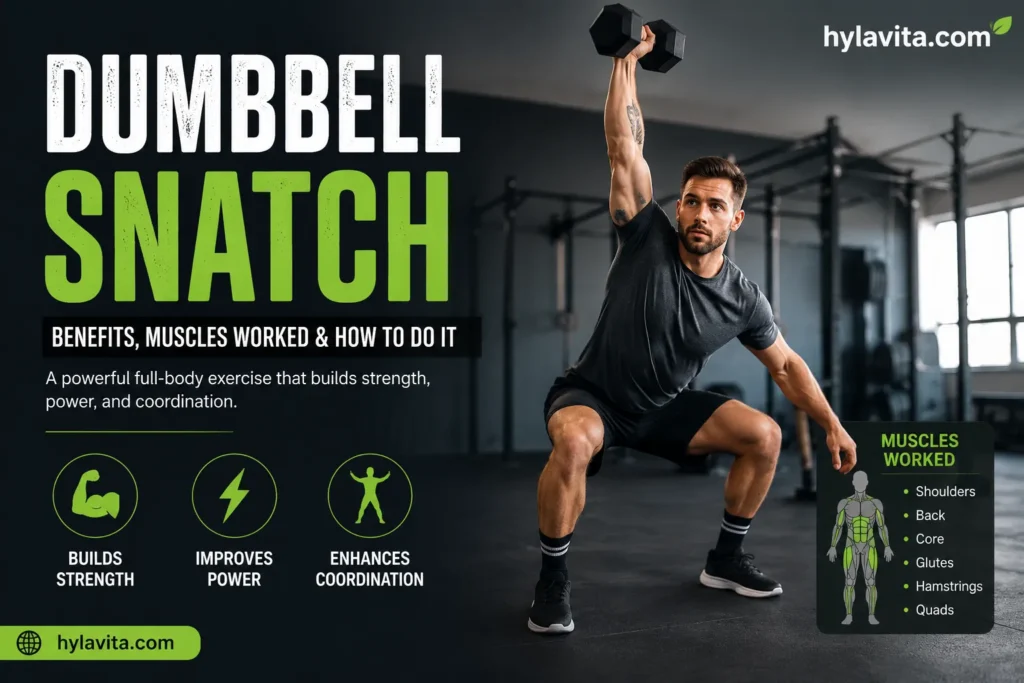
Picture one exercise that trains your legs, back, shoulders, and grip all at once, in a single explosive move. That’s the dumbbell snatch.
If you’ve ever watched someone at the gym yank a dumbbell from the floor straight overhead in one smooth motion, you’ve seen it. It looks impressive. But is it right for you?
The dumbbell snatch is one of the most efficient full-body movements you can add to your routine. It builds power, strength, and coordination in a way few other exercises can match. In this guide, we’ll break down what the dumbbell snatch is, which muscles it works, its real advantages and disadvantages, and how to do it with good form — even if you’ve never tried it before. For more strength-training fundamentals, browse Hylavita’s health and fitness library.
What Is a Dumbbell Snatch?
The dumbbell snatch is a single-arm, full-body exercise. You lift a dumbbell from the floor to overhead in one continuous motion.
It’s adapted from the Olympic barbell snatch, which uses two hands. The dumbbell version uses one arm at a time, which is why it’s also called the single-arm dumbbell snatch or one-arm dumbbell snatch. According to ACE’s Exercise Library entry on the snatch pattern, the movement relies on an explosive first pull off the floor, a second pull that drives the hips open, and a “catch” phase where the lifter drops under the weight to receive it overhead.
Because you use one arm, the dumbbell version demands more balance and core control than the barbell lift. It’s harder than it looks — but for most people, it’s also gentler on the joints than loading a barbell with both hands.
Why It’s Different From Other Lifts
Most gym exercises isolate one muscle group. A bicep curl works your biceps. A leg press works your legs.
The dumbbell snatch doesn’t work that way. It uses your whole body in one fluid movement, from your feet to your fingertips. Strength coaches classify this as a “compound” or “multi-joint” exercise — a movement that recruits several muscle groups and joints at once, which is part of why it shows up so often in general strength programs and CrossFit-style workouts.
Advantages and Disadvantages of the Dumbbell Snatch
No exercise is right for everyone. Before adding the dumbbell snatch to your program, it helps to weigh what it does well against where it falls short.
| Advantages | Disadvantages |
|---|---|
| Trains explosive power, not just raw strength — carries over to sprinting, jumping, and sports | Technically demanding; poor form is common in beginners and raises injury risk |
| Works the legs, back, shoulders, core, and grip in one movement, saving workout time | Not ideal for anyone with an existing shoulder injury, wrist issue, or unmanaged lower-back pain |
| Unilateral (one arm at a time), which helps correct left-right strength imbalances | Requires real coordination between the hip drive and the arm pull — the learning curve is longer than most machine exercises |
| Minimal equipment needed — just one dumbbell and enough overhead clearance | High shoulder demand during the overhead catch, which can aggravate sensitive joints if you skip a warm-up |
| Doubles as a conditioning tool since it raises heart rate quickly | Easy to overload with too much weight before technique is solid, which encourages compensations like a rounded back |
| Fits well into functional-fitness and athletic training programs | Not a good substitute for dedicated strength work (like squats or presses) if pure maximal strength is your main goal |
The takeaway: the dumbbell snatch rewards patience. It’s an excellent tool for the right person and the wrong choice if you skip the technique work.
Benefits of the Dumbbell Snatch
This move isn’t just for athletes. It offers real benefits for everyday fitness too.
Builds Total-Body Power
The dumbbell snatch trains your body to produce force quickly. This is called power, and it’s different from raw strength. Power helps with sprinting, jumping, and quick movements in daily life or sports.
Improves Coordination and Balance
Since you’re moving a weight through space with one arm, your body has to stabilize itself constantly. Over time, this sharpens your balance and coordination. Think of it like training your nervous system, not just your muscles.
Burns Calories Efficiently
Because the dumbbell snatch uses so many muscles at once, it raises your heart rate fast. A few rounds of snatches can feel like a mini cardio workout. This makes it a smart choice if you’re short on time but want a tough session.
Strengthens Grip and Core
Holding onto a dumbbell as it moves overhead challenges your grip strength. At the same time, your core has to work hard to keep you steady. Both of these carry over into daily tasks, like carrying groceries or lifting furniture — and grip strength in particular is increasingly studied as a broader marker of physical health, not just a hand-specific trait.
Works Well for Functional Fitness
Functional fitness means training movements you actually use in real life, like bending, lifting, and reaching overhead. The dumbbell snatch mimics these patterns, which is why it’s popular in general strength programs and athletic conditioning, and why full-body movements are generally favored over isolated ones for building everyday, transferable strength.
Muscles Worked by the Dumbbell Snatch
The dumbbell snatch is a true full-body exercise. Here’s a breakdown of the main muscles involved.
Lower Body
- Glutes — power the hip extension that drives the weight up
- Hamstrings — help with the hip hinge at the start
- Quadriceps — assist as you stand up from the squat position
Core and Back
- Core muscles — stabilize your spine throughout the lift
- Lower back (erector spinae) — supports posture during the pull
- Lats and upper back — help guide the dumbbell upward
Upper Body
- Shoulders (deltoids) — control the weight as it moves overhead
- Traps — engage during the shrug phase of the pull
- Forearms and grip — work hard to hold onto the dumbbell
In short, this single exercise hits nearly every major muscle group. That’s rare for one movement.
How to Do a Dumbbell Snatch (Step-by-Step)
Good form matters more than heavy weight here. Start light and focus on the pattern before adding load.
Step 1: Set Your Starting Position
Place a dumbbell on the floor between your feet. Stand with feet shoulder-width apart. Hinge at your hips and bend your knees slightly, like you’re about to pick up a suitcase.
Grab the dumbbell with one hand. Keep your back flat and your chest up.
Step 2: Start the Pull
Drive through your feet and extend your hips forcefully. This is the “hip drive,” and it’s where most of the power comes from — not your arm.
As the dumbbell rises past your knees, keep it close to your body.
Step 3: Pull and Punch Overhead
Once the dumbbell reaches chest height, shrug your shoulder and pull your elbow up and back. Then, rotate your arm and punch the dumbbell straight overhead.
Your arm should end up fully extended, with the dumbbell locked out above your shoulder.
Step 4: Control the Descent
Don’t just drop the weight. Lower it back down with control, following the same path it went up. This protects your shoulder and keeps your form consistent for the next rep.
Step 5: Repeat on Both Sides
Since this is a single-arm exercise, make sure to train both sides evenly. Switch arms after your set, or alternate reps, depending on your program.
Dumbbell Snatch Technique Tips
Small technique fixes can make a big difference in how the lift feels and how safe it is.
- Keep the dumbbell close. The closer it stays to your body during the pull, the more efficient your movement will be. If it swings out in front of you, you’ll lose power and strain your shoulder.
- Use your hips, not your arm. A common mistake is trying to muscle the weight up with the arm alone. Think of your arm as a guide — the real power should come from your hip drive.
- Don’t rush the descent. Many beginners let the dumbbell drop fast on the way down. This can strain your shoulder joint over time. Slow it down and stay in control.
- Start light. Because this move is technical, start with a light dumbbell, even if it feels too easy at first. Once your form is solid, gradually increase the weight.
Common Mistakes to Avoid
Even experienced lifters can fall into bad habits with this exercise:
- Rounding the back during the pull, which puts pressure on the spine
- Letting the dumbbell swing away from the body instead of staying close
- Skipping the hip drive and relying only on the arm
- Using too much weight before mastering the technique
- Not warming up the shoulder joint before overhead work
If you notice any of these, slow down and focus on form before adding more weight or reps.
Who Should (and Shouldn’t) Do This Exercise
The dumbbell snatch works well for beginners learning full-body movement patterns, as well as intermediate and advanced lifters looking to build power. It’s also common in CrossFit-style workouts and athletic training programs.
That said, it may not be ideal for people with existing shoulder injuries or lower-back issues. If you have joint pain or a past injury, check with a doctor or physical therapist before trying this move. As with any new exercise, it’s smart to learn the pattern with an empty hand or light object first.
For more guidance on building a well-rounded strength routine around moves like this, see Hylavita’s fitness and exercise coverage.
FAQ
Is the dumbbell snatch good for beginners? Yes, but beginners should start with a very light dumbbell and focus on learning the movement pattern first. It’s a technical lift, so patience matters more than speed or weight in the beginning.
How many reps and sets should I do? Most programs use 3 to 5 sets of 5 to 8 reps per arm. Lighter weights with more reps work well for conditioning, while heavier weights with fewer reps build strength and power.
What’s the difference between a dumbbell snatch and a kettlebell snatch? Both movements follow a similar pattern, but a dumbbell has a different shape and grip than a kettlebell. Many people find the kettlebell snatch slightly easier to control because of its handle, while the dumbbell snatch demands a bit more grip and wrist stability.
Can the dumbbell snatch help with weight loss? It can support weight loss as part of a balanced routine, since it burns calories and raises your heart rate quickly. No single exercise causes weight loss on its own — diet and consistent training matter more overall.
What muscles does the dumbbell snatch work the most? It works your glutes, hamstrings, shoulders, and core the most, though nearly every major muscle group plays a supporting role. This is exactly why it’s considered such an efficient full-body exercise.
Conclusion
The dumbbell snatch is a powerful, efficient exercise that trains your entire body in one movement. From your legs and core to your shoulders and grip, few exercises offer this much value in so little time — but it comes with a real technical learning curve and isn’t the right fit for every body.
Start light, focus on the hip drive, and keep the dumbbell close to your body as you lift. With practice, the dumbbell snatch will start to feel smooth and natural, not rushed or forced.
If you’re ready to add power and full-body strength to your workouts, give the dumbbell snatch a try in your next training session. Just remember: good form always comes before heavy weight.
Medical Disclaimer: This article is for general informational and educational purposes only and is not intended as medical advice, diagnosis, or treatment.