What Is Zone 2 Cardio Training?
Zone 2 cardio is exercise at a low, steady pace. Specifically, you keep your heart rate in a particular range. It’s not too easy, and it’s not too hard either.
Think of it as a pace you could keep for an hour. In other words, you’re moving, but you’re not gasping for air.
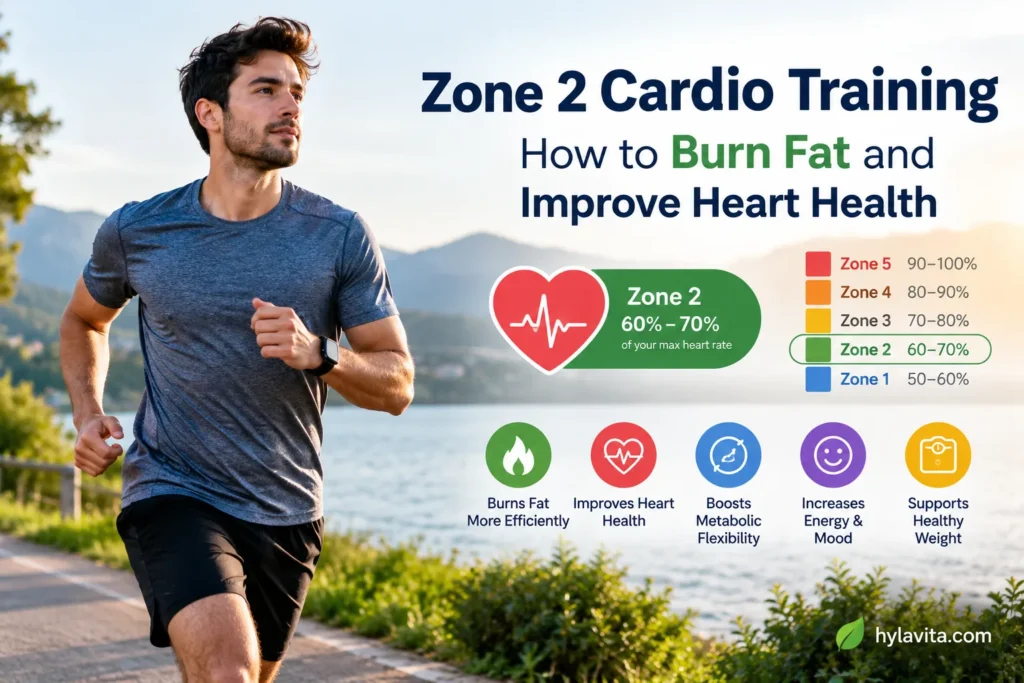
Your body has five heart rate zones, ranging from Zone 1 (very light) to Zone 5 (maximum effort). Zone 2 sits near the bottom, usually around 60% to 70% of your max heart rate.
At this pace, your body mostly burns fat for fuel. As a result, it doesn’t rely much on stored sugar (glycogen). Over time, this makes your body better at using fat as energy, even when you’re resting.
Here’s a simple way to check if you’re in Zone 2: you should be able to talk in full sentences. However, singing a song should feel hard.
Many people think cardio has to hurt to work, but Zone 2 proves that wrong. It’s slow and comfortable, yet it still builds a stronger heart over time.
Runners and cyclists have used this training for decades. Now, though, doctors and researchers are paying more attention to it too. In fact, they’re finding it helps more than just athletes it supports everyday heart health as well.
How to Calculate Your Zone 2 Heart Rate
Before you start, you need to know your heart rate zones.
The 220-Age Formula (and Its Limitations)
First, subtract your age from 220. That’s your estimated max heart rate, and Zone 2 is 60% to 70% of that number.
For example, a 40-year-old has a max heart rate of about 180. Therefore, Zone 2 falls between 108 and 126 beats per minute.
Keep in mind, though, that this formula is just a rough estimate. Since it doesn’t account for your real fitness level or genetics, use it as a starting point rather than a strict rule.
The Talk Test Method
Alternatively, no math is needed here just check your breathing while you exercise.
You should be able to talk in full sentences, but singing should feel hard. If you’re gasping for air, slow down. Overall, this method is simple and matches how your body actually feels.
Using a Heart Rate Monitor or Fitness Tracker
For more precision, a monitor gives you exact numbers instead of guesswork.
Chest straps are the most accurate, since they read your heart’s signals directly. Smartwatches and fitness bands work too, though they’re a bit less precise.
Fortunately, many devices calculate your zones automatically once you enter your age and fitness level. This makes Zone 2 training much easier to track in real time.
The Science Behind Zone 2 Training
Zone 2 training does something powerful inside your cells. Here’s what’s actually happening in your body.
Mitochondrial Density and Aerobic Efficiency
Mitochondria are tiny structures inside your cells that turn food into energy your body can use. Think of them as tiny power plants the more you have, the more energy you can produce.
Specifically, Zone 2 training helps your body build more mitochondria. It also makes your existing mitochondria work better.
Consequently, your body becomes more efficient over time. You can do more activity using less effort, and your muscles get better at using oxygen too.
This is why Zone 2 training helps endurance: your body simply gets better at producing steady energy.
Fat Oxidation vs. Carbohydrate Burning
Your body uses two main fuel sources during exercise: fat and carbohydrates (stored as glycogen).
At low intensity, your body prefers to burn fat, and this is exactly what happens in Zone 2. As you push harder, however, your body switches to carbs. Carbs burn faster, but they also run out quicker.
By comparison, fat is a much bigger energy reserve even lean people carry thousands of stored calories as fat.
Ultimately, training in Zone 2 teaches your body to tap into fat more easily. This means better fat burning, even during other activities, and it also means you rely less on carbs, so you don’t hit “the wall” as quickly.
Key Benefits of Zone 2 Cardio Training
Zone 2 training offers real benefits for your body. Here’s what you can expect.
Burns Fat More Efficiently
At this pace, your body prefers fat as fuel, and over time, it gets even better at burning it.
Essentially, you train your body to tap into fat stores, which helps even when you’re not exercising.
So it’s not about burning tons of calories fast rather, it’s about training your body’s fuel system long-term.
Improves Heart Health and Cardiovascular Endurance
Your heart is a muscle, and Zone 2 training makes it stronger.
Because a stronger heart pumps more blood with each beat, it doesn’t have to work as hard. As a result, your resting heart rate often drops over time a sign of better cardiovascular fitness.
Additionally, regular Zone 2 training supports healthy blood pressure, keeping your whole cardiovascular system working well.
Boosts Metabolic Flexibility
Metabolic flexibility means your body can switch fuel sources easily, using fat or carbs depending on what you need.
Unfortunately, many people rely too heavily on carbs for energy, which can lead to energy crashes and cravings. Zone 2 training, however, improves this flexibility. Since your body learns to use fat more efficiently, this can lead to steadier energy throughout the day.
Enhances Recovery from High-Intensity Workouts
Zone 2 isn’t just for beginners athletes use it too.
Because easy, low-intensity cardio increases blood flow to your muscles, it helps clear out waste products from harder workouts. It also reduces overall stress on your body, making it a great active recovery option.
For this reason, many athletes use Zone 2 on their “easy” training days, since it helps them recover while still moving.
Supports Long-Term Weight Management
Zone 2 is gentle on your joints, which makes it easier to stick with over time.
Since you can do it often without feeling burned out, consistency matters more than intensity for weight management. It also helps regulate appetite and energy levels, which in turn makes healthy habits easier to maintain long-term.
Zone 2 vs. Other Heart Rate Zones
Your body has five heart rate zones, and each one trains your body differently.
For instance, Zone 1 is very light, like a slow walk, while Zone 2 is light but steady, similar to a brisk walk or easy jog. Moving up, Zone 3 picks up the pace but still feels manageable.
By contrast, Zone 4 is hard you’re breathing heavily and can only say a few words. At the top end, Zone 5 is your max effort, which you can only hold for short bursts.
Overall, each zone has a purpose: lower zones build your aerobic base, while higher zones build speed and power.
Zone 2 vs. High-Intensity Interval Training (HIIT)
HIIT means short bursts of intense effort you push hard, then rest, then push again.
Zone 2, on the other hand, is slow, steady, and sustained for longer periods.
Although HIIT burns more calories in less time and is great for building speed and power, Zone 2 burns fewer calories per minute. Still, you can do it for much longer.
Additionally, HIIT puts more stress on your body and needs more recovery time afterward, whereas Zone 2 is gentle enough to do almost every day without burning out.
That said, most experts recommend both: use Zone 2 to build your base, and use HIIT to add intensity and challenge. Together, they create a well-rounded fitness routine, since neither one fully replaces the other.
Best Exercises for Zone 2 Cardio
You can do Zone 2 training with almost any cardio activity. Here are the most popular options.
Walking, Jogging, and Running
Walking is the easiest way to start, since a brisk walk can easily keep you in Zone 2.
For fitter people, though, walking might feel too easy in that case, try a slow jog instead.
Running works too, but pace matters a lot, because most runners go too fast for true Zone 2. As a result, you may need to run slower than feels natural, which can be humbling at first.
Cycling
Cycling is gentle on your joints, which makes it a great Zone 2 option.
You can cycle outdoors or use a stationary bike, and both work well for staying in range. A bike also makes it easy to control your effort, since you can adjust resistance to stay steady.
Swimming
Swimming works your whole body at once and is also very easy on your joints.
That said, keep your strokes smooth and steady, and avoid racing or pushing too hard. This can be tricky at first, since swimming naturally raises your heart rate fast. So, start slow, and check your effort often.
Rowing
Rowing combines cardio with light strength work, using your legs, arms, and back together.
Keep your pace steady and controlled, and avoid pulling too hard on each stroke. Conveniently, a rowing machine also makes tracking easier, since many machines show your heart rate in real time. This helps you stay in Zone 2 without guessing.
How Long and How Often Should You Train in Zone 2?
Zone 2 training takes time to work it’s not a quick fix, but a long game.
Generally, most experts suggest 2 to 4 sessions per week, with each session lasting 30 to 60 minutes.
If you’re just starting, begin with shorter sessions; even 20 minutes is a good starting point. Then, as your fitness improves, slowly add more time, building up to 45 or 60 minutes per session.
Some athletes, of course, do much more Zone 2 training, sometimes for hours several times a week. Still, you don’t need to go that far most people see real benefits with less time.
Ultimately, consistency matters more than long single sessions. For example, three 30-minute sessions beat one long, tough workout.
So give it a few weeks before expecting big changes, since your body needs time to adapt and improve. Stick with it, and the results will follow.
Common Mistakes to Avoid in Zone 2 Training
Zone 2 sounds simple, but people still get it wrong. Here are the mistakes to watch for:
- Going too fast. This is the biggest mistake most people think they’re in Zone 2, but they’re not. Even though your ego wants to push harder, ignore it and slow down more than feels natural.
- Skipping a heart rate check. Guessing your zone often leads to mistakes, so use a monitor or the talk test to stay accurate.
- Expecting fast results. Since Zone 2 training builds fitness slowly, don’t expect big changes in just a few days.
- Doing it inconsistently. One workout won’t do much; instead, you need regular sessions to see real benefits.
- Ignoring other types of training. Zone 2 is great, but it’s not everything mix in strength training and some higher-intensity work too.
- Comparing your pace to others. Because everyone’s Zone 2 looks different, don’t compare your speed to a friend’s.
- Skipping the warm-up. Jumping straight into Zone 2 can feel harder than it should, so ease into it with a few minutes of easy movement.
Avoid these mistakes, and your training will pay off faster.
Sample Zone 2 Training Plan for Beginners
Not sure where to start? Here’s a simple 4-week plan.
Week 1: Do 3 sessions of 20 minutes each. Walking or light cycling works well; focus on finding your Zone 2 pace.
Week 2: Next, bump up to 3 sessions of 25 minutes. Keep the same easy, steady pace, and use the talk test to check yourself.
Week 3: Then, move to 3 or 4 sessions of 30 minutes. By now, you might feel more comfortable in Zone 2.
Week 4: Finally, aim for 4 sessions of 30 to 40 minutes, mixing activities like walking and cycling.
After Week 4: Keep building slowly, adding 5 to 10 minutes every week or two. Above all, don’t rush the process.
A simple weekly example might look like this:
- Monday: 30-minute brisk walk
- Wednesday: 30-minute cycling session
- Friday: 30-minute jog or swim
- Sunday: 40-minute walk or easy hike
Otherwise, rest or do light activity, and listen to your body as you go.
This plan is flexible, so adjust it based on how you feel.
Tips to Stay Motivated During Low-Intensity Workouts
Zone 2 training can feel boring at first, so here’s how to keep yourself motivated:
- Listen to something you enjoy. Podcasts, music, or audiobooks make the time fly by, so save your favorite show for workout time only.
- Train with a friend. Since Zone 2 pace is perfect for chatting, this makes exercise feel social rather than like a chore.
- Change your scenery. For instance, try a new walking trail or bike route a new view keeps things interesting.
- Track your progress. Use an app or journal to log your workouts, since watching your consistency grow feels rewarding.
- Set small, simple goals. Focus on showing up, not performance; after all, just completing the session counts as a win.
- Remind yourself why you started. Think about your heart health and long-term energy this helps you push through boring days.
- Make it part of your routine. Same time, same days each week this turns exercise into a habit, not a decision.
- Be patient with yourself. Some days will feel harder than others, and that’s completely normal, so don’t be discouraged.
In short, Zone 2 training rewards consistency. Show up, even when it feels slow.
Frequently Asked Questions (FAQ)
Is Zone 2 cardio good for weight loss?
Yes, it can help with weight loss, since your body burns mostly fat at this pace.
That said, weight loss also depends on your diet exercise alone won’t fix poor eating habits. Zone 2 works best alongside healthy food choices, so combine both for the best results.
It’s also easier to stick with long-term, and this consistency matters more than short, intense workouts.
How do I know if I’m really in Zone 2?
The easiest way is the talk test: you should be able to speak in full sentences, but singing should feel too hard. If it’s easy, you’re going too slow.
For more accuracy, use a heart rate monitor and aim for 60% to 70% of your max heart rate. However, if you’re gasping for air, you’ve gone too far slow down and find your rhythm again.
Can I combine Zone 2 with strength training?
Yes, they work well together, and many people do both in the same week.
Ideally, try Zone 2 on separate days from strength training, since this helps you recover better. Alternatively, you can do Zone 2 after lifting weights, just keeping the pace light and easy.
That said, avoid doing hard cardio and heavy lifting on the same day, because your body needs time to recover properly. Together, strength and cardio support each other well, building a balanced fitness routine.
Conclusion
Zone 2 cardio isn’t flashy it’s slow, steady, and simple.
But that’s exactly why it works: it builds a stronger heart over time. It also teaches your body to burn fat more efficiently, and these benefits add up the longer you stick with it.
You don’t need fancy equipment to start; a pair of shoes and a willingness to walk is enough.
So, start where you are even 20 minutes a few times a week helps. Use the talk test or a heart rate monitor, since either one keeps you honest about your pace.
Above all, be patient with the process, because real changes take weeks, not days. Additionally, mix it with strength training or some higher-intensity work to create a well-rounded fitness routine.
Most importantly, stay consistent. Show up, even on days it feels slow your heart will thank you for it.
Hylavita’s sugestion to read
- Dumbbell Exercises for Thighs: Full Lower-Body Guide
- Calisthenics Workout Plan for Beginners: How to Start Today
- What Is Provascin Used For? Benefits, Dosage & Side Effects
Other readings
- The Power of Zone 2 Training For Fat Loss
- Easy Does It: Why You Should Target Zone 2 Cardio Workouts
- What Is Zone 2 Cardio? Benefits, Basics & How to Get Started
Disclaimer: This article is for informational purposes only and is not medical advice. Always consult a doctor before starting any new exercise program, especially if you have a heart condition or other health concerns. Individual results from Zone 2 cardio training may vary based on age, fitness level, and overall health. The author and publisher are not responsible for any injury or health issues resulting from the use of this information.