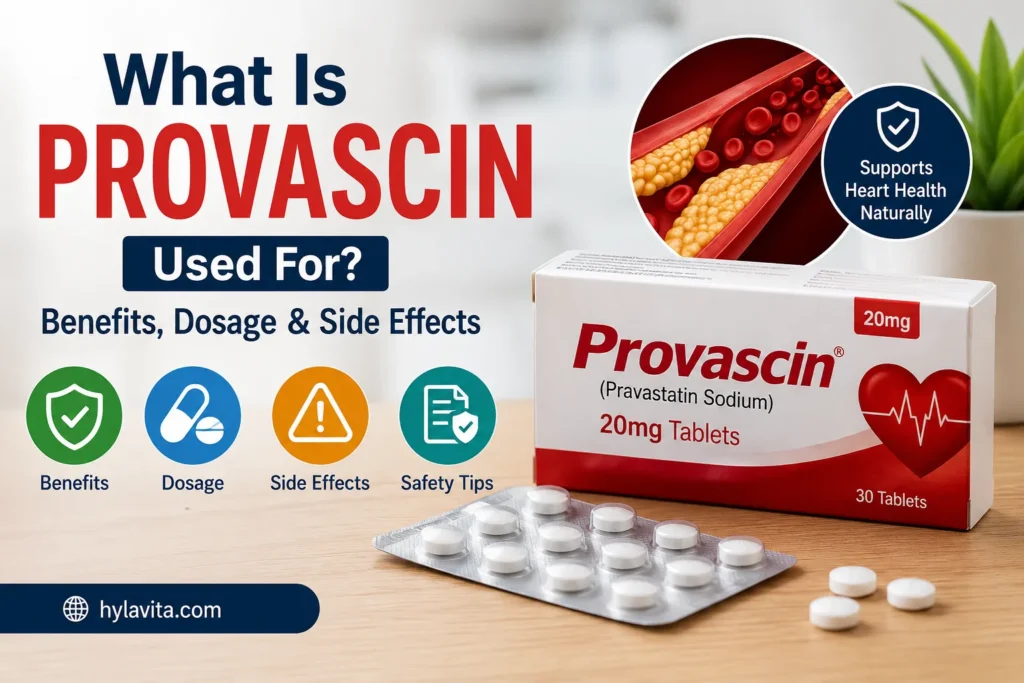
If you’ve seen the name Provascin online and wondered what it actually does, you’re not alone. Search for it, and you’ll find several different answers.
That’s the tricky part. Some pages call Provascin a prescription-style medication for blood pressure. Others describe it as a heart-health dietary supplement with ingredients like CoQ10. A few even say it’s not one single product at all, but a name used by different sellers for different formulas.
In this article, we’ll walk through what Provascin is claimed to do, the benefits people report, general dosage guidance, possible side effects, the trade-offs of trying it, and — most importantly — how to check what you’re actually buying before you take it. By the end, you’ll know exactly what questions to ask before adding Provascin to your routine.
How this article was put together: we cross-checked the general marketing claims associated with the “Provascin” name against public regulatory guidance from the U.S. Food and Drug Administration (FDA) and clinical summaries from the Mayo Clinic and the NIH Office of Dietary Supplements, since Provascin itself isn’t listed in any major drug or supplement database. Where a specific claim couldn’t be verified against those sources, we’ve flagged it as an unproven marketing claim rather than a fact.
What Is Provascin?
Provascin is a name that shows up mostly in online health articles and supplement marketing, tied to heart and blood vessel support.
Here’s the catch: there’s no single, standardized Provascin listed with major drug or supplement databases. That means the ingredients, strength, and even the type of product (drug vs. supplement) can vary depending on where you buy it.
Is Provascin a Drug or a Supplement?
This depends entirely on the source. Some websites describe Provascin as working like a prescription blood pressure drug, affecting enzymes that control how blood vessels tighten or relax. Others describe it as a dietary supplement, built from ingredients like CoQ10 (Coenzyme Q10) and L-Carnitine — both of which are real, well-studied nutrients linked to heart and energy support.
This distinction actually matters legally, not just semantically. In the U.S., prescription drugs must prove safety and effectiveness to the FDA before they reach the market. Dietary supplements do not go through that premarket approval process — manufacturers are responsible for their own safety and labeling claims, and the FDA generally only acts after a product is already for sale <cite index=”81-11,81-12″>since firms don’t have to provide FDA with safety evidence before or after marketing, except when a supplement contains a new dietary ingredient not previously in the food supply</cite>. That’s a very different risk profile than a regulated medication.
Because of this mix-up, the single most important step before using any product called Provascin is checking its actual label and ingredient list. A supplement and a prescription drug are regulated completely differently, and they carry very different risks.
Why the Name Causes Confusion
Think of it like the term “energy drink.” The name tells you the general purpose, but not the exact formula, dose, or ingredients inside the can. Different brands could use the same category name while containing very different things.
If a product is being marketed to you as Provascin, treat the name as a starting point for research, not as proof of what’s actually inside the bottle.
Provascin Uses: What Is It Claimed to Help With?
Based on how Provascin is marketed, it’s most often positioned around heart and circulation support. Common claimed uses include:
- Supporting healthy blood pressure levels
- Improving blood flow and circulation
- Supporting healthy cholesterol or lipid levels
- Reducing feelings of fatigue linked to poor circulation
- General cardiovascular wellness support
For example, someone with cold hands and feet, or who feels sluggish by mid-afternoon, might be drawn to a circulation-support product like this. However, these are wellness claims, not proven medical treatments — and they shouldn’t replace medication or care your doctor has already prescribed for a diagnosed condition like hypertension or high cholesterol.
Provascin Uses for Heart Health
Most marketing around Provascin centers on the heart. The idea is that better blood flow means your heart doesn’t have to work as hard to move blood through your body. In theory, that could ease pressure on your cardiovascular system over time.
That said, “supports heart health” is a broad, common claim across the supplement industry. It’s worth asking: supports it how, and based on what evidence? A trustworthy seller should be able to answer that clearly. If a formulation genuinely contains CoQ10, for instance, there’s real clinical research behind it — <cite index=”10-42″>a Mayo Clinic review notes that CoQ10 may improve congestive heart failure symptoms, and although findings are mixed, it might help lower blood pressure</cite>. That’s a meaningfully different claim than a product simply borrowing the reputation of a well-studied ingredient without disclosing how much of it is actually in the bottle.
Provascin Benefits: What People Report
Reported Provascin benefits generally fall into a few categories. Keep in mind these are user-reported or marketing claims, not confirmed clinical outcomes.
Circulation and Energy
Many descriptions of Provascin focus on improved blood flow. Better circulation can, in general, mean more oxygen reaching your muscles and organs — which may translate into feeling less tired during the day.
Cholesterol and Lipid Support
Some sources mention Provascin’s role in supporting healthier cholesterol levels. If true of a specific formulation, this would likely come from ingredients that support how the body processes fats, rather than a direct drug-like effect.
Antioxidant Support
A few descriptions mention antioxidant properties, meant to protect blood vessels from everyday wear and oxidative stress. This is a common feature of heart-health supplements in general, not something unique to Provascin specifically.
A practical note: if a product promises noticeable results in cholesterol, blood pressure, energy, weight, and mental focus all at once, treat that as a red flag. Real, well-studied treatments usually target one or two specific things well, not everything at once.
Advantages and Disadvantages of a Product Like Provascin
Because “Provascin” isn’t one fixed formula, these advantages and disadvantages apply generally to unstandardized heart-support products sold under ambiguous names — not to a specific, verified product.
Potential advantages
- May be easy to buy without a prescription if it’s genuinely sold as a supplement
- Could contain legitimate, researched ingredients (like CoQ10 or L-Carnitine) if the label is accurate
- Marketed for a common, relatable concern — everyday circulation and energy — rather than a narrow condition
- Typically lower cost and fewer access barriers than a prescription medication
Potential disadvantages
- No standardized formula, so you can’t be sure what you’re actually getting from one seller to the next
- Not evaluated by the FDA for safety or effectiveness before it reaches the market, since it’s marketed as a supplement rather than a drug
- Marketing claims (like “supports blood pressure”) are wellness claims, not proof of a clinical effect
- Risk of interactions with existing blood pressure medication, cholesterol drugs, or blood thinners
- Delayed or inconsistent effects — supplement-style ingredients typically take weeks to show any change, unlike prescription medication
- Could lead someone to delay or replace evidence-based medical treatment for a diagnosed condition
Provascin Dosage: General Guidance
Because Provascin isn’t a standardized product, there is no single official dosage that applies to every version sold under this name. This is genuinely important, so it’s worth repeating: never guess a dose based on an article. Always follow the instructions on your specific product’s label, or your doctor’s prescription if it was prescribed to you.
General Safety Habits Around Dosage
- Read the label on your specific bottle or package before taking anything.
- If it’s a supplement, take it with food unless the label says otherwise — this can reduce stomach upset.
- Don’t exceed the amount listed on the packaging, even if you feel like it “isn’t working yet.”
- Give it a few weeks of consistent use before expecting to notice any change, since supplements typically work gradually.
- Store it as directed, usually somewhere cool and dry, away from direct sunlight.
When to Talk to a Doctor First
Check with a doctor or pharmacist before starting Provascin if you:
- Are pregnant or breastfeeding
- Already take blood pressure or cholesterol medication
- Have a diagnosed heart condition
- Take blood thinners or other prescription drugs
- Are unsure whether the product is a supplement or a prescription-strength item
This step matters more than it might seem. Combining an unverified product with existing heart medication could cause your blood pressure to drop too low, or interact in ways that are hard to predict.
Provascin Side Effects
Reported side effects associated with Provascin-type products are generally described as mild, though this can vary by formulation. Commonly mentioned side effects include:
- Digestive discomfort, especially if taken on an empty stomach
- Mild headache
- Lightheadedness, particularly if it affects blood pressure
- Allergic reactions to plant-based or herbal ingredients
What to Do If You Notice Side Effects
If you experience mild symptoms like stomach upset, try taking it with a meal instead of on an empty stomach. If symptoms are persistent, severe, or include anything like swelling, difficulty breathing, chest pain, or a rash, stop use immediately and seek medical attention.
In short, mild and temporary reactions are common with many supplements as your body adjusts. Anything sudden or severe is not something to wait out — get medical help. If you believe you’ve had a serious reaction to a dietary supplement, you can also report it to the FDA’s Safety Reporting Portal.
How to Check If a Provascin Product Is Legitimate
Before buying anything called Provascin, a few quick checks can save you a headache later:
- Look for a full ingredient list. A legitimate product will clearly list every ingredient and its amount.
- Check for manufacturer information. A real company will have a verifiable name, address, and contact details.
- See if it’s a drug or supplement. Prescription drugs go through FDA approval; supplements do not need pre-approval but must follow labeling rules. Know which category you’re dealing with. The FDA’s own Questions and Answers on Dietary Supplements explains exactly what must legally appear on a supplement label.
- Search for the exact product name plus “FDA” or “recall.” This can turn up warnings if there have been issues.
- Ask your pharmacist. Pharmacists can often tell you quickly whether something is a recognized medication, a common supplement blend, or neither.
If you’re doing broader research into heart-healthy habits, supplements, and vitamins beyond this one product name, our vitamins and supplements guides cover how to evaluate ingredients and claims more generally.
FAQs About Provascin
What is Provascin used for? Provascin is most commonly marketed for heart and circulation support, including claims around blood pressure, blood flow, and cholesterol. However, since it isn’t a single standardized product, exact uses depend on the specific formulation you have in hand.
Is Provascin a prescription medicine? It depends on the source. Some descriptions present it as a prescription-style drug, while others describe it as an over-the-counter supplement. Check your product’s actual label and, if in doubt, ask a pharmacist to confirm.
What is the right Provascin dosage? There’s no single official dosage that applies across all products using this name. Always follow the exact instructions on your product’s label or a prescription from your doctor, rather than a general number found online.
What are the main Provascin side effects? Commonly reported side effects include mild stomach upset, headache, and lightheadedness. Severe reactions like swelling, chest pain, or difficulty breathing are not normal and require immediate medical attention.
Can I take Provascin with my blood pressure medication? You shouldn’t combine it with existing blood pressure or heart medication without talking to your doctor first. Mixing an unverified product with prescription drugs can cause unpredictable interactions or a blood pressure drop.
Conclusion
Provascin is a name tied to heart and circulation support, but it isn’t a single, clearly standardized product — the uses, ingredients, and even whether it’s a drug or a supplement can change depending on where you find it. Weighed against the advantages, the disadvantages above — no standardized formula, no FDA premarket review, and the risk of drug interactions — are significant enough that verification should come before purchase, not after. The safest approach is simple: check the actual label, confirm what you’re buying, and talk to a doctor or pharmacist before starting it, especially if you already take heart-related medication.
Medical Disclaimer: This article is for general informational purposes only and is not medical advice.