
Medical Disclaimer: This article is for general educational purposes only and is not a substitute for professional dental or medical advice, diagnosis, or treatment. Never disregard professional dental advice or delay seeking it because of something you’ve read here. If you have a persistent, painful, or worsening bump on your gums, contact a licensed dentist or physician promptly. If you think you may have a dental or medical emergency, call your dentist or emergency services immediately.
Notice a strange bump on your gums while brushing your teeth? You are not alone, and in most cases, it is not an emergency.
A bump on gums can show up for many reasons. Some are harmless and go away on their own. Others are a sign that you need to see a dentist soon.
In this guide, we will walk through the 10 most common causes of gum bumps, the advantages and disadvantages of each treatment path, and how to tell a painful bump apart from a painless one so you know when it’s time to get help.
About this article: This guide was compiled and reviewed for factual accuracy using publicly available clinical information from the Cleveland Clinic and the National Institute of Dental and Craniofacial Research (NIDCR), part of the U.S. National Institutes of Health.
What Does a Bump on Gums Usually Mean?
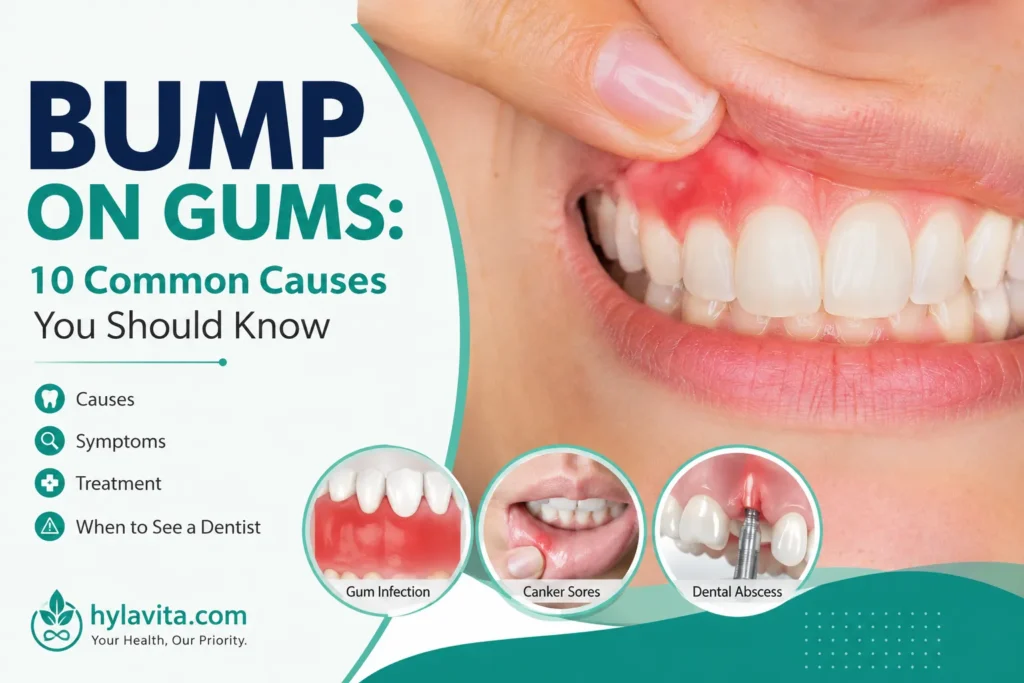
A bump on gums is simply a raised spot on the soft tissue that covers your jawbone and holds your teeth in place. It can be small or large, soft or hard, red or the same color as the rest of your gum.
Most bumps happen because of irritation, infection, or minor trauma. For example, biting your cheek, brushing too hard, or trapped food can all trigger a gum bump.
However, some bumps point to a deeper issue, like a tooth infection. That’s why it helps to know the common bump-on-gums causes before you decide what to do next. If you’re also managing broader oral hygiene habits, our preventive care and symptoms guides walk through everyday routines that reduce your risk of mouth irritation in the first place.
Painless Bump vs. Painful Bump
Not every gum bump feels the same, and that difference matters.
A painless bump on gums often means the body is dealing with mild irritation or a slow-growing tissue change. You might not even notice it until you run your tongue over it.
A painful bump on gums, on the other hand, usually signals infection or inflammation. It may throb, feel warm, or hurt more when you chew or touch it.
10 Common Causes of a Bump on Gums
Here are the most frequent reasons people develop a bump on their gums.
1. Canker Sore (Aphthous Ulcer)
Canker sores are small, round sores with a white or yellow center and a red border. They are not contagious. According to the Cleveland Clinic, most minor canker sores are smaller than a pea and heal on their own within a couple of weeks without scarring.
They often show up after stress, a minor injury, or eating acidic food.
Advantages and disadvantages of watchful waiting:
| Advantages | Disadvantages |
|---|---|
| No cost, no procedure needed | Can be painful while it heals |
| Usually resolves in 1-2 weeks on its own | May recur, especially with stress or certain foods |
| Salt water rinses can ease discomfort at home | Large or unusually persistent sores may signal a different condition |
2. Gum Abscess
A gum abscess is a pocket of pus caused by a bacterial infection. It usually looks like a red, swollen bump and can be quite painful. Per the Cleveland Clinic, a periodontal abscess most often develops from untreated gum disease and can spread to surrounding bone and tissue without treatment.
This is one of the more serious causes on this list. An abscess needs dental treatment because the infection will not clear up on its own.
Advantages and disadvantages of treatment options:
| Option | Advantages | Disadvantages |
|---|---|---|
| Drainage by a dentist | Fast relief from pressure and pain | Doesn’t address the underlying infected tissue on its own |
| Antibiotics | Controls the spread of infection | Doesn’t remove the source; overuse contributes to resistance |
| Leaving it untreated | None | Infection can spread to the jaw, bloodstream, or other tissues |
3. Mucocele (Mucous Cyst)
A mucocele forms when a small salivary gland gets blocked or damaged, often from biting the lip or cheek. Fluid builds up under the tissue and creates a soft, dome-shaped bump.
Mucoceles are usually painless. Some go away on their own, while larger ones may need a simple procedure to remove.
Advantages and disadvantages:
| Option | Advantages | Disadvantages |
|---|---|---|
| Waiting it out | Non-invasive, often resolves without treatment | Can take weeks to resolve; may recur if the habit continues |
| Minor surgical removal | Permanent resolution | Requires a dental visit and minor procedure with typical recovery time |
4. Irritation Fibroma
This is a firm, smooth bump that forms from repeated irritation, like from a rough tooth edge, a denture, or accidental cheek biting. Think of it like a callus, but on your gum tissue instead of your hand.
Fibromas are benign and typically painless. A dentist can remove one if it bothers you or keeps getting bitten.
Advantages and disadvantages of removal vs. monitoring:
| Option | Advantages | Disadvantages |
|---|---|---|
| Monitoring | No procedure or cost | Can keep getting irritated or bitten repeatedly |
| Surgical removal | Eliminates the irritation cycle permanently | Minor procedure with a short healing period |
5. Pyogenic Granuloma
This bump grows fast and often bleeds easily, even with light brushing. It’s more common during pregnancy, which is why it’s sometimes called a “pregnancy tumor,” though it is not cancer. The Cleveland Clinic notes these lesions are noncancerous but are made of fragile blood vessels, which is why they bleed so readily.
Despite the name, a pyogenic granuloma is not related to pus in the way an abscess is. It usually needs to be removed if it keeps growing or bleeding.
Advantages and disadvantages:
| Option | Advantages | Disadvantages |
|---|---|---|
| Waiting (common in pregnancy) | Many shrink or disappear after delivery | Can bleed frequently and interfere with eating in the meantime |
| Surgical removal | Stops bleeding and growth | Lesions can recur, especially if removed during pregnancy |
6. Gum Boil (Fistula) from a Tooth Infection
A gum boil is a small, pimple-like bump that forms when infection from a tooth root finds a path to the surface. It may release a bad-tasting fluid from time to time.
This bump can be painless most of the time, then suddenly turn painful when pressure builds up. It always means the tooth behind it needs treatment.
Advantages and disadvantages of treatment paths:
| Option | Advantages | Disadvantages |
|---|---|---|
| Root canal treatment | Saves the natural tooth, resolves the infection | Multiple visits, higher cost than extraction |
| Tooth extraction | Removes the infection source in one visit | Loss of the natural tooth; may need a replacement later |
| Ignoring it | None | Infection persists and can worsen or spread |
7. Torus (Bony Growth)
A torus is a hard, bony bump that grows on the roof of the mouth or the inside of the lower jaw. It’s not caused by infection or disease. It’s simply extra bone growth, and some people are just more prone to it. The Cleveland Clinic reports that palatal tori affect an estimated 20-30% of the general population and rarely require any treatment.
Tori are painless and very common. Dentists usually leave them alone unless they interfere with dentures or eating.
Advantages and disadvantages:
| Option | Advantages | Disadvantages |
|---|---|---|
| No treatment | No procedure needed; growths are benign | Can occasionally interfere with dentures or speech as they enlarge |
| Surgical removal | Resolves interference with dentures/prosthetics | Elective oral surgery with recovery time; rarely medically necessary |
8. Eruption Cyst (In Children)
Parents often notice this one. An eruption cyst is a small, bluish bump that appears on a child’s gum right before a tooth pushes through.
It’s a normal part of tooth eruption and almost always resolves on its own once the tooth comes in.
Advantages and disadvantages:
| Option | Advantages | Disadvantages |
|---|---|---|
| Watching and waiting | No intervention needed in nearly all cases | Child may have mild discomfort until the tooth erupts |
| Dental exam if unsure | Confirms diagnosis and rules out other causes | Requires a visit for something that usually resolves anyway |
9. Oral Papilloma
A papilloma is a small, wart-like growth linked to certain strains of HPV (human papillomavirus). It looks bumpy or cauliflower-shaped and is usually painless.
While generally harmless, a dentist should still look at it to confirm what it is and decide if removal makes sense.
Advantages and disadvantages:
| Option | Advantages | Disadvantages |
|---|---|---|
| Monitoring after diagnosis | Avoids an unnecessary procedure if truly benign | Requires professional confirmation first; growth may persist |
| Removal | Eliminates the growth and confirms tissue is benign via biopsy | Minor procedure and recovery time |
10. Oral Cancer (Rare, But Worth Knowing)
This is the least common cause, but it’s important to mention. Oral cancer can sometimes appear as a persistent bump, sore, or thickened patch that does not heal within two to three weeks. The National Institute of Dental and Craniofacial Research (NIDCR) advises seeing a dentist or doctor if a mouth sore, lump, or red or white patch lasts more than two weeks.
It may be painless in the early stages, which is why people often ignore it. Any unusual bump that lingers deserves a dental check, just to be safe.
Advantages and disadvantages of early evaluation vs. waiting:
| Option | Advantages | Disadvantages |
|---|---|---|
| Prompt dental/medical evaluation | Early detection significantly improves treatment outcomes | Requires an appointment and possibly a biopsy |
| Waiting to see if it resolves | No immediate cost or appointment | Delays diagnosis if the cause turns out to be serious |
What Causes a Small Bump on Gums to Develop?
A small bump on gums often starts with one of these everyday triggers:
- Brushing too hard or using a stiff-bristled toothbrush
- Trapped food particles irritating the gum line
- A cracked tooth or broken filling rubbing against tissue
- Poorly fitted dentures or orthodontic wires
- Minor cuts from crunchy foods like chips or popcorn
In short, gum tissue is sensitive. It doesn’t take much to cause a small, temporary bump.
When Should You See a Dentist?
You don’t need to panic over every gum bump, but certain signs mean it’s time to book an appointment.
See a dentist if you notice:
- A bump that lasts longer than two weeks
- Increasing pain, swelling, or a bad taste in your mouth
- Fever along with the bump
- Bleeding that happens often or without a clear reason
- Difficulty chewing, swallowing, or opening your mouth
Moreover, if the bump keeps coming back in the same spot, that’s a pattern worth investigating. Recurring bumps often point to an underlying tooth or gum problem that needs proper treatment, not just symptom relief.
How Are Gum Bumps Treated?
Treatment depends entirely on the cause, so a dentist will usually start with an exam and sometimes an X-ray.
Common treatment options — advantages and disadvantages at a glance:
| Treatment | Advantages | Disadvantages |
|---|---|---|
| Salt water rinses | Cheap, easy, low risk | Only helps minor sores; won’t resolve infections or growths |
| Antibiotics | Effective against bacterial infections like abscesses | Doesn’t fix structural causes; possible side effects or resistance with overuse |
| Root canal treatment | Saves an infected tooth long-term | Time and cost of multiple appointments |
| Minor surgical removal | Permanently removes fibromas, mucoceles, or papillomas | Minor procedure, recovery time, and cost |
| No treatment / monitoring | Appropriate for many benign, painless bumps like tori or eruption cysts | Requires periodic checking to make sure nothing changes |
For minor irritation-based bumps, switching to a soft-bristled toothbrush and being gentler while flossing can prevent new ones from forming.
Can You Prevent a Bump on Gums?
You can’t prevent every cause, but good habits lower your risk quite a bit.
- Brush gently twice a day with a soft-bristled brush
- Floss daily to remove trapped food and plaque
- Avoid biting your cheek or lip on purpose or out of habit
- Visit your dentist regularly for checkups and cleanings
- Treat cavities and cracked teeth promptly, before they lead to infection
Think of your gums like the soil around a plant. If you take care of it consistently, problems are far less likely to take root.
FAQ: Bump on Gums
Is a bump on gums always a sign of infection?
No. Many bumps, like tori, fibromas, or eruption cysts, are not caused by infection at all. However, a painful, red, or swollen bump often does point to infection and should be checked by a dentist.
Why do I have a painless bump on my gums that won’t go away?
A painless bump that lingers could be a fibroma, papilloma, or torus, all of which are usually harmless. Still, it’s worth having a dentist confirm the cause, especially if it has been present for several weeks.
Can stress cause bumps on gums?
Indirectly, yes. Stress is a known trigger for canker sores, and it can also lead to teeth grinding, which sometimes irritates gum tissue and causes small bumps.
Should I pop or squeeze a gum bump?
No, you should never pop or squeeze a bump on your gums. This can spread infection or damage the tissue further; let a dentist examine and treat it properly instead.
How long does a normal gum bump take to heal?
Minor bumps from irritation, like canker sores, often heal within one to two weeks. If a bump lasts longer than that, it’s a good idea to get it checked out.
Conclusion
A bump on gums can come from something as simple as a food particle or as significant as an infected tooth. The key is paying attention to how it looks, feels, and behaves over time — and weighing the real trade-offs between watching and waiting versus seeking treatment.
Painless bumps are often harmless, while painful, swollen, or long-lasting bumps usually need professional care. When in doubt, a quick visit to your dentist can rule out anything serious and give you peace of mind.
If you’ve had a gum bump for more than two weeks, don’t wait it out. Book a dental checkup and get a clear answer instead of guessing.