Do you feel a tight pull in your hip every time you stand up from your desk? That tightness often comes from one small but powerful muscle: the psoas. Sitting for hours shortens this muscle, and over time it can pull on your lower back and hips, causing pain that seems to come from nowhere.The good news is that psoas stretches can loosen this muscle and bring real relief. In this guide, you’ll learn what the psoas muscle does, why it gets tight, the advantages and disadvantages of stretching it, and the 10 best stretches to fix it. Whether you’re a desk worker, a runner, or just someone who wants to move without stiffness, these moves will help.
What Is the Psoas Muscle and Why Does It Get Tight?
The psoas (say “SO-az”) is a long, ribbon-shaped muscle that runs from your lower spine, through your pelvis, and connects to the top of your thigh bone (femur). Together with the nearby iliacus muscle, it forms the iliopsoas — one of the main muscle groups that lets you lift your knee and bend at the hip. According to the Cleveland Clinic, the psoas also helps stabilize your posture and connects muscles deep in your body to ones closer to the surface.
Think of the psoas as a hinge that connects your upper body to your legs. Every time you walk, sit, or climb stairs, this muscle is working.
Common Causes of a Tight Psoas
Sitting is the biggest culprit. When you sit, your hip stays bent for hours, which shortens the psoas over time. Other causes include:
- Running or cycling without stretching afterward
- Weak core muscles that force the psoas to work overtime
- Stress, since this muscle tends to tense up during anxiety or fear
- Poor posture while standing or walking
Signs Your Psoas Muscle Is Tight
A tight psoas doesn’t always feel like a hip problem. Common signs include lower back pain, stiff hips when you stand up, a slight limp after sitting, and even tightness that seems to affect your breathing, since the psoas sits near your diaphragm. The physical-therapy reference site Physiopedia notes that overuse, poor posture, and general tightness in this muscle group are common contributors to hip and lower-back discomfort, alongside more specific injuries like strains or tendinopathy.
If your pain is sudden, severe, associated with swelling or bruising, or doesn’t ease with rest, that points toward a possible strain or tear rather than simple tightness — see a healthcare provider rather than relying on stretching alone.
Advantages and Disadvantages of Psoas Stretching
Stretching the psoas is generally safe and helpful for most people, but it isn’t a cure-all and it isn’t risk-free. Here’s a balanced look before you start.
Advantages
- Reduces pull on the lower back. Loosening a tight psoas can ease the anterior pelvic tilt that often drives lower back discomfort.
- Improves hip range of motion. Better hip extension makes walking, running, and climbing stairs feel less restricted.
- Requires no equipment. Every stretch in this guide can be done at home with just a mat or towel.
- Complements other treatment. Stretching pairs well with core and glute strengthening for longer-lasting results.
- Low cost, low time commitment. A few minutes a day can produce noticeable change within 1–2 weeks for many people.
Disadvantages
- Doesn’t fix the root cause on its own. If prolonged sitting or weak glutes/core are driving the tightness, stretching alone won’t fully resolve the problem — it needs to be paired with movement breaks and strengthening.
- Risk of overstretching. Because the psoas sits close to the spine and hip joint, aggressive or bouncy stretching can strain the muscle or irritate the lower back rather than help it.
- Can mask a more serious issue. Hip or groin pain isn’t always a tight psoas — it can indicate a labral tear, hip impingement, or nerve issue. Stretching won’t help those and may delay proper diagnosis.
- Temporary relief for some. People who sit most of the day may find tightness returns quickly unless they also change movement habits.
- Not risk-free for everyone. People with osteoporosis, recent abdominal or hip surgery, or an existing hip injury should check with a doctor or physical therapist before deep hip-flexor stretches.
Why Psoas Stretches Matter for Hip Mobility
Your hips are the foundation for nearly every movement your body makes. When the psoas is tight, it pulls your pelvis forward, which changes your posture and adds pressure to your lower back.
Regular psoas stretch routines can help restore normal hip movement. This means less back pain, better posture, and smoother movement whether you’re walking, squatting, or just getting out of a chair.
A flexible psoas also supports better athletic performance. Runners, dancers, and anyone who does explosive movements rely on this muscle to generate power. A tight, stiff psoas limits that power and increases injury risk.
How to Stretch Safely: Tips Before You Start
Before jumping into stretches, keep a few basics in mind. These guidelines are consistent with recommendations from Harvard Health Publishing, which advises spending about 60 total seconds on each stretch and stretching major muscle groups two to three times a week for best results.
- Warm up first with 5 minutes of light walking or marching in place
- Move slowly into each stretch; never bounce or force the position
- Breathe deeply throughout; holding your breath tightens muscles further
- Stop if you feel sharp pain (mild discomfort is normal, sharp pain is not)
- Hold each stretch for 20 to 30 seconds, and repeat 2 to 3 times per side
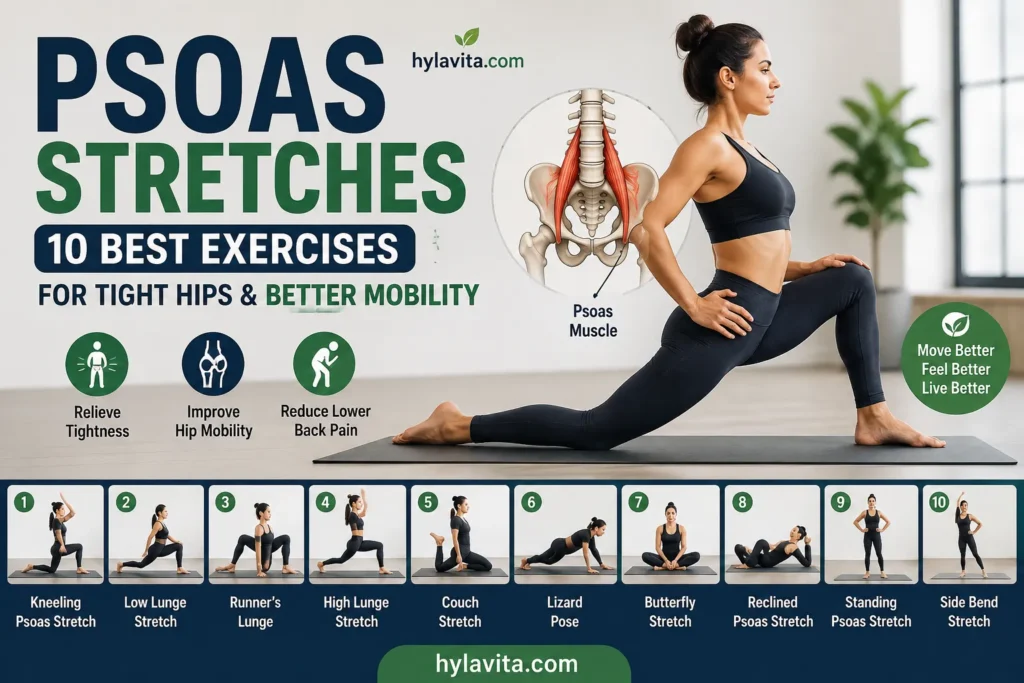
10 Best Psoas Stretches for Tight Hips
Here are ten simple, effective psoas stretches you can do at home with no equipment.
1. Kneeling Hip Flexor Stretch
This is the classic tight psoas stretch and a great place to start. Kneel on one knee with the other foot flat on the floor in front of you, forming two 90-degree angles. Gently push your hips forward until you feel a stretch in the front of your back hip. Keep your torso upright and hold. Pro: gentle and beginner-friendly. Con: can be uncomfortable on bare knees — use a mat or cushion.
2. Low Lunge Stretch
Similar to the kneeling stretch but deeper. From the kneeling position, raise your arms overhead and lean your torso slightly back. This adds a gentle backbend that stretches the psoas even further. Keep your core tight so you don’t overarch your lower back. Pro: deeper stretch than the basic version. Con: the added backbend can strain the lower back if your core isn’t engaged.
3. Standing Psoas Stretch
Stand tall and step one foot back, keeping both feet flat, similar to a static lunge but standing upright. Squeeze your back glute and push your hips forward slightly. This variation is useful if kneeling is uncomfortable on your knees. Pro: knee-friendly alternative. Con: slightly harder to isolate the stretch without practice.
4. Pigeon Pose
This yoga pose targets the hips and psoas together. Bring one knee forward and place it on the floor at an angle, while extending the other leg straight back. Lower your torso forward over the front leg for a deeper stretch. Go only as far as feels comfortable. Pro: stretches hips and psoas simultaneously. Con: can strain the front knee if your hips are very tight — ease in gradually.
5. Bridge Pose
Lie on your back with knees bent and feet flat on the floor. Lift your hips toward the ceiling while squeezing your glutes. This move stretches the psoas by opening the front of the hip while also strengthening the glutes, which helps take pressure off the psoas in daily movement. Pro: stretches and strengthens at once. Con: less intense stretch than the kneeling variations, so it’s better as a complement than a stand-alone fix.
6. Cobra Stretch
Lie face down and place your hands under your shoulders. Press up gently, lifting your chest while keeping your hips on the floor. This stretch opens the front of the body, including the psoas, and also helps counteract the effects of slouching. Pro: also helps posture. Con: not ideal if you have existing lower-back pain — keep the lift low and gentle.
7. Half-Kneeling Hip Flexor with Rotation
Start in the same position as the kneeling hip flexor stretch. Once you feel the stretch, slowly rotate your torso toward the side of your front leg. This adds a rotational element that can reach deeper layers of the hip flexor group. Pro: reaches deeper tissue. Con: the rotation adds spinal load, so move slowly and stop if you feel any twinge.
8. Butterfly Stretch
Sit on the floor with the soles of your feet together, knees falling out to the sides. Lean forward gently from your hips. While this stretch mainly targets the inner thighs, it also helps release tension around the hip joint that affects the psoas. Pro: gentle, good for cool-downs. Con: indirect — it targets the hip joint generally, not the psoas specifically.
9. Supine Psoas Stretch (Using a Table or Bed Edge)
Lie on your back at the edge of a bed or sturdy table, letting one leg hang off the edge while hugging the other knee to your chest. Let gravity gently pull the hanging leg down. This is a passive stretch, meaning your body weight does the work instead of active muscle effort. Pro: passive and very controllable. Con: needs a sturdy, appropriately-sized surface, which isn’t always available.
10. Dynamic Leg Swings
Stand near a wall for balance and swing one leg forward and backward in a controlled motion. This is a dynamic (moving) stretch rather than a held one. It works well as a warm-up before workouts since it stretches the psoas while also increasing blood flow. Pro: doubles as a warm-up. Con: not a substitute for static stretching if your main goal is deep tissue lengthening.
Sample Weekly Routine for Tight Psoas Relief
You don’t need to do all 10 stretches every day. Instead, try this simple approach:
- 3 times a week: Pick 4 to 5 stretches from the list above and hold each for 20–30 seconds per side
- Daily habit: Do the kneeling hip flexor stretch for 1–2 minutes if you sit most of the day
- Before workouts: Use dynamic leg swings to warm up the hips
Consistency matters more than intensity. A few minutes daily will do more than one long session per week.
Other Ways to Support a Healthy Psoas
Stretching alone isn’t always enough. Combining it with other habits gives better, longer-lasting results.
Strengthen Your Core and Glutes
A weak core forces the psoas to work harder than it should. Simple exercises like planks and glute bridges take pressure off this muscle and support better hip function overall. If you want a deeper dive into building a stronger core as part of your overall fitness routine, see Hylavita’s Fitness & Exercise section for related guides.
Move More Throughout the Day
If you sit for long periods, set a reminder to stand up and walk every 30 to 60 minutes. Even a short walk can prevent the psoas from staying shortened for too long.
Consider Professional Help
If tightness or pain doesn’t improve after a few weeks of consistent stretching, consider seeing a physical therapist. They can check your movement patterns and rule out other causes of hip or back pain, such as a strain, tendinopathy, or joint issue (see the Cleveland Clinic’s overview of hip flexor strain for how a true strain differs from simple tightness).
Frequently Asked Questions
How often should I do psoas stretches? Most people benefit from stretching the psoas 3 to 5 times per week. If you sit for long hours daily, a short daily stretch can help prevent tightness from building up again.
Can a tight psoas cause back pain? Yes, a tight psoas can pull on the lower spine and pelvis, which often leads to lower back discomfort. Stretching this muscle regularly is one simple way to ease that kind of pain.
How long does it take to loosen a tight psoas? This varies from person to person, but many people notice some relief within 1 to 2 weeks of consistent stretching. Full, lasting change often takes longer, especially if you sit for most of the day.
Are psoas stretches safe for beginners? Yes, most psoas stretches are gentle and safe for beginners. Start slowly, avoid bouncing, and stop if you feel sharp pain rather than a mild stretch.
What’s the difference between the psoas and hip flexors? The psoas is actually one of several hip flexor muscles, though it’s the largest and most important one. When people say “hip flexor stretch,” they are often stretching the psoas along with nearby muscles like the iliacus.
Conclusion
A tight psoas can quietly cause hip stiffness, back pain, and poor posture without you even realizing the real cause. The good news is that a consistent psoas stretching routine — weighed against its limits, and paired with core strengthening and more daily movement — can undo much of that tightness over time.
Start with two or three of the stretches listed above, stay consistent, and pay attention to how your body responds. Small, regular effort can lead to real, lasting improvements in how you move every day.
Medical Disclaimer: This article is for general informational and educational purposes only and is not a substitute for professional medical advice, diagnosis, or treatment.