Introduction
Everyone wants a strong, flat stomach. But most people train for it the wrong way.
Here are two common myths. First, crunches do not burn belly fat — after all, your body cannot choose where it loses fat. Second, you don’t need to train abs daily, since abs need rest like any other muscle.
Strong abs also do more than look good. In fact, they support your spine, improve posture, and protect your lower back.
In this guide, you’ll learn:
- How your ab muscles work
- The best training for abs exercises
- Simple workouts to start today
- How food affects visible abs
- Mistakes to avoid
So you don’t need a gym to begin — you just need a plan and some patience.
Understanding Your Abdominal Muscles
Your abs are not one muscle. Instead, they are a group of muscles that work together. Here is a quick look at each one.
| Muscle | Where It Is | Main Job | Example Exercises |
|---|---|---|---|
| Rectus abdominis | Front of the stomach | Bends the spine forward | Crunch, reverse crunch, leg raise |
| Obliques | Sides of the waist | Twists and bends the body sideways | Side plank, Russian twist |
| Transverse abdominis | Deep layer, wraps around the middle | Stabilizes the spine and torso | Dead bug, plank |
Rectus Abdominis (the “Six-Pack” Muscle)
This is the muscle most people mean when they say “abs.” It runs down the front of your stomach, from your rib cage to your pelvis.
You use it when you do a crunch or sit-up. It also helps you brace when you lift something heavy.
The six-pack look comes from bands of tissue that split this muscle into sections. Everyone has them — you only see them when your body fat is low enough.
Obliques (Internal and External)
Your obliques run along the sides of your waist. Each side has two layers: the external obliques sit on top, while the internal obliques lie underneath.
Together, they help you twist and bend sideways. They also stop your body from rotating when you don’t want it to, which makes them useful in sports like golf, tennis, and running.
Transverse Abdominis (Deep Core Stabilizer)
This is your deepest ab muscle. It wraps around your midsection like a natural belt.
It does not move your spine much. Instead, it holds your torso steady and supports your lower back. So even though you can’t see it from the outside, a strong one helps you move with better control.
Abs vs. Core: What’s the Difference?
Many people use these words as if they mean the same thing, but they don’t.
Abs refer to the muscles at the front and sides of the stomach — the rectus abdominis, obliques, and transverse abdominis. Core, on the other hand, is a much bigger group that includes your abs plus your lower back muscles, glutes, hip muscles, diaphragm, and pelvic floor.
Think of your core as a box around your middle. Your abs are just one side of that box, so a good plan trains the whole thing.
Benefits of Exercise for Abs
A strong midsection does more than change how you look — it also changes how you move and feel every day.
Better Posture and Spinal Support
Your abs help hold your spine in a stable position. When they are weak, your back muscles work harder, and over time, you may slouch more.
Strong abs share that work instead. As a result, they help you stand and sit with less effort. That said, good posture also depends on your back, glutes, and hips, so train those muscles too.
Reduced Lower Back Pain
Core exercises can help with lower back pain. In fact, studies show that core stability training can reduce pain in people with chronic lower back pain, and it works about as well as other types of exercise.
The key is to build strength slowly. For example, start with gentle moves like dead bugs and bird dogs. However, if your pain is severe or keeps returning, see a doctor or physical therapist first.
Improved Balance and Stability
Your core is your body’s center of control. It keeps your torso steady while your arms and legs move.
Because of this, a strong core helps you stay upright on uneven ground. It also helps you recover if you trip — which matters more as you get older, since good balance lowers your risk of falls.
Stronger Athletic Performance
Almost every sport needs power from the middle of your body. Think of throwing a ball, swinging a bat, or sprinting.
Your core links your upper and lower body, so it helps pass force between them. Of course, strong abs won’t make you a star athlete, but they do support better movement, and that helps you perform.
Better Function in Daily Movement
You use your abs all day — for example, when you pick up groceries, get out of bed, or reach for a high shelf.
Overall, a strong core makes these tasks feel easier. It also helps protect your back when you lift. So while they may seem small, daily moves add up, and a stronger middle pays off in real life.
Training
Here is a full directory of exercises across all levels:
| Level | Exercise | How to Do It | Sets and Reps |
|---|---|---|---|
| Beginner | Plank | Rest on your forearms and toes. Keep your body in a straight line. Squeeze your abs and glutes. | 2-3 holds of 20-30 seconds |
| Beginner | Glute bridge | Lie on your back with knees bent. Push through your heels and lift your hips. Squeeze your glutes at the top. | 2-3 sets of 10-15 |
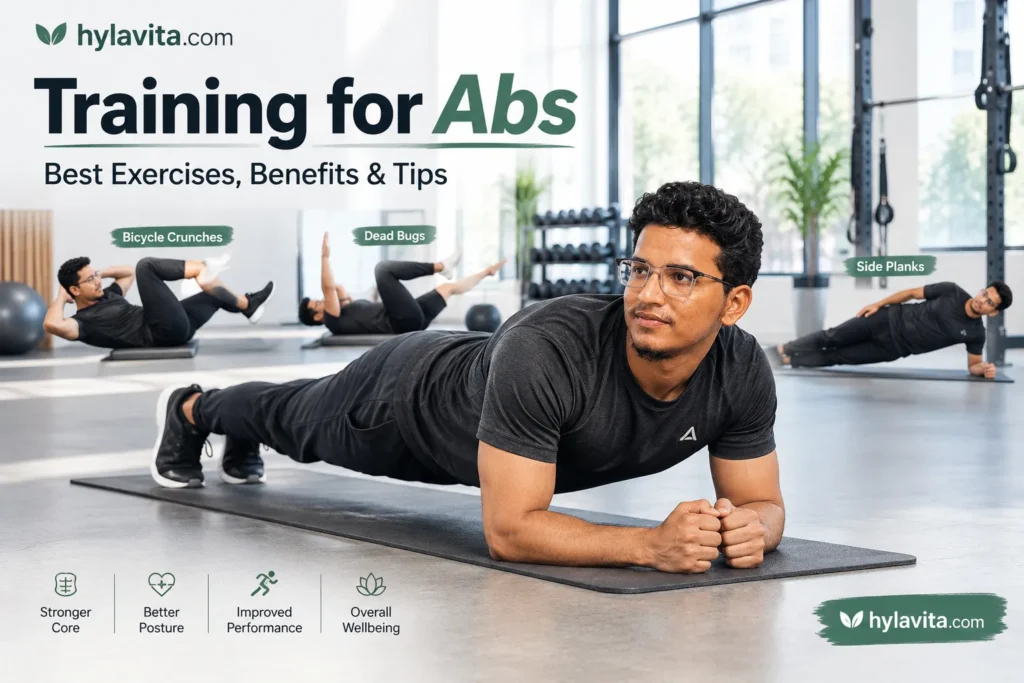
| Beginner | Bicycle crunch | Lie on your back. Bring one elbow toward the opposite knee. Switch sides in a smooth motion. | 2-3 sets of 10-12 per side |
| Intermediate | Reverse crunch | Lie on your back. Bring your knees toward your chest. Curl your hips off the floor. Lower slowly. | 3 sets of 10-15 |
| Intermediate | Russian twist | Sit with knees bent and lean back slightly. Turn your torso side to side. Hold a weight if you want more challenge. | 3 sets of 10-12 per side |
| Intermediate | Mountain climbers | Start in a high plank. Drive one knee toward your chest. Switch legs quickly. | 3 sets of 20-30 seconds |
| Intermediate | Side plank | Lie on your side. Prop up on your forearm. Lift your hips and hold a straight line. | 3 holds of 20-30 seconds per side |
| Advanced | Hanging leg raise | Hang from a bar. Keep your legs straight or slightly bent. Lift them toward hip height or higher. Lower with control. | 3 sets of 6-10 |
| Advanced | Ab wheel rollout | Kneel with the wheel under your shoulders. Roll forward slowly. Keep your abs tight. Pull back to the start. | 3 sets of 6-10 |
| Advanced | Dragon flag | Lie on a bench and grip behind your head. Lift your body into a straight line. Lower slowly without bending at the hips. | 3 sets of 3-6 |
| Advanced | Toes-to-bar | Hang from a bar. Lift your toes up to touch it. Control the swing on the way down. | 3 sets of 5-8 |
Best Exercises to Target Lower Abs
Here is a fact worth knowing: you don’t have “lower abs” and “upper abs” as separate muscles. The rectus abdominis is one long muscle, but some moves can make the lower part feel more active.
The best options are:
- Reverse crunch
- Hanging leg raise
- Lying leg raise
- Mountain climbers
The key is to curl your pelvis up, not just swing your legs — that tilt is what makes your lower abs work harder.
Best Exercises to Target Obliques
Your obliques handle twisting and side bending. They also stop unwanted rotation, so the best exercises train all three jobs:
- Side plank — Builds side strength and stability
- Russian twist — Trains rotation
- Bicycle crunch — Combines twisting and crunching
- Pallof press — Trains your body to resist rotation
- Suitcase carry — Fights side bending while you walk
For better results, mix rotation moves with anti-rotation moves — both make your obliques stronger.
Sample Abs Workout Routines
Here are three routines you can start today. So pick the one that fits your level, and rest 30 to 60 seconds between exercises.
10-Minute Beginner Routine
This routine builds a solid base. So move slowly and focus on form, then do two rounds.
- Dead bug — 8 reps per side
- Plank — 20-30 seconds
- Glute bridge — 12 reps
- Bicycle crunch — 10 reps per side
Rest one minute between rounds. If a move feels too hard, shorten the hold or do fewer reps instead.
20-Minute Intermediate Circuit
Do each exercise back to back, then rest. Repeat the circuit three times.
- Reverse crunch — 12 reps
- Russian twist — 10 reps per side
- Mountain climbers — 30 seconds
- Side plank — 30 seconds per side
Rest 60 seconds after each round. Once it feels easy, add a light weight to the Russian twist.
Advanced Ab Workout for Definition
This routine is tough. Do three sets of each move, resting 60 seconds between sets.
- Hanging leg raise — 8-10 reps
- Ab wheel rollout — 8-10 reps
- Weighted plank — 30-45 seconds
- Cable crunch — 10-12 reps
- Pallof press — 10 reps per side
The word “definition” can be misleading. Ab exercises build muscle, but you only see it when your body fat is low, since diet plays a big part too. We cover that later in this guide.
So to keep progressing, add reps, weight, or hold time over the weeks. This idea is called progressive overload.
How Often Should You Train Abs?
Most people do well training abs 2 to 3 times a week. Some train up to 4 times, but daily training is not needed.
That said, your abs also work during squats, deadlifts, and presses, so they get extra training from your other workouts. Therefore, leave a rest day between hard ab sessions, and if your abs feel sore or tired, give them more time to recover.
Exercise Without Equipment (At-Home Options)
You don’t need a gym to build a strong core. Your body weight is enough to start, and all you need is a little floor space.
Here are the best moves to do at home:
- Dead bug — Lie on your back. Lower one arm and the opposite leg. Keep your lower back flat. (2-3 sets of 8-10 per side)
- Plank — Hold a straight line on your forearms and toes. (2-3 holds of 20-40 seconds)
- Bicycle crunch — Bring one elbow toward the opposite knee. Switch sides smoothly. (2-3 sets of 10-12 per side)
- Reverse crunch — Curl your knees toward your chest. Lift your hips slightly. (3 sets of 10-15)
- Side plank — Prop up on one forearm. Lift your hips and hold. (2-3 holds of 20-30 seconds per side)
- Mountain climbers — From a high plank, drive your knees in quickly. (3 rounds of 20-30 seconds)
- Bird dog — On hands and knees, reach one arm and the opposite leg out. (2-3 sets of 8-10 per side)
A Simple 15-Minute Home Workout
Do each move in order. Rest 30 seconds after each one, then repeat the full round twice.
- Dead bug: 10 reps per side
- Plank: 30 seconds
- Bicycle crunch: 10 reps per side
- Reverse crunch: 12 reps
- Side plank: 20 seconds per side
How to Make Bodyweight Moves Harder
Bodyweight training works well, but your body adapts over time. So to keep progressing, you need to raise the challenge. Try these ideas:
- Add more reps or longer holds
- Slow down each rep
- Pause for 2 seconds at the hardest point
- Move to a harder version, like a longer-lever plank
- Add time under tension by doing fewer, slower reps
Simple Household Swaps
You can add light resistance with things you already own:
- Backpack with books — Hold it during Russian twists
- Water bottle or jug — Use it as a light weight for twists
- Towel on a smooth floor — Slide your feet out and in from a plank
- Sturdy chair or couch — Use it for incline planks or elevated feet
Either way, keep any weight light and stay in control, and never use anything unstable or slippery.
Tips for Exercise at Home
- Use a mat or a carpet to protect your spine and elbows
- Keep your neck relaxed during crunches — don’t pull on your head
- Focus on form, not speed
- Pick a set time each day so it becomes a habit
Abs With Equipment
Equipment lets you add resistance and keep progressing, which is the main reason to use it. After all, heavier or harder moves push your abs to grow stronger.
That said, you don’t need every tool — just pick one or two and use them well.
Ab Wheel, Cable Machine, and Stability Ball
Ab wheel. The rollout is one of the hardest ab moves. Kneel with the wheel under your shoulders, then roll out slowly and pull back. Stop before your hips sag, and start with a short range before you build up over time. (3 sets of 6-10)
Cable machine. Cables give steady tension through the whole rep, which makes them great for abs.
- Cable crunch: Kneel facing the machine. Hold the rope by your head. Curl your ribs toward your hips. (3 sets of 10-15)
- Pallof press: Stand sideways to the cable. Press the handle out and resist the pull. This trains your obliques and deep core. (3 sets of 10 per side)
Stability ball. The ball adds instability, so your core works harder to stay steady.
- Ball plank: Rest your forearms on the ball. Hold a straight line. (3 holds of 20-30 seconds)
- Ball crunch: Lie back over the ball. Curl up with control.
So keep the ball on a non-slip floor, and start with easier versions if your balance is shaky.
Dumbbells, Kettlebells, and Resistance Bands
Dumbbells. They are simple and easy to find. Hold one in each hand and walk — this is a farmer’s carry (3 walks of 20-40 seconds), and it trains your whole core. You can also hold one dumbbell at your chest during a weighted plank variation or a Russian twist (3 sets of 10 per side).
Kettlebells. The suitcase carry works well here (3 walks per side, 20-30 seconds). Hold one kettlebell at your side and walk with a straight, tall body — your obliques fight the urge to lean. However, only try Turkish get-ups after you learn the steps with a light weight or no weight.
Resistance bands. Bands are cheap and easy to store. Anchor one to a sturdy post or door, then do a banded Pallof press (3 sets of 10 per side) or a band pull-apart with a braced core. Overall, they are good for home workouts and travel.
Tips for Using Equipment Safely
- Start light — form matters more than weight
- Keep your back neutral during carries and twists
- Check that bands and anchors are secure
- Add weight slowly, only when you can do all reps with good form
Can You Spot Reduce Belly Fat?
Short answer: no. You can’t choose where your body loses fat, so doing more crunches will not burn fat from your stomach.
Studies back this up. For example, in one trial, people did six weeks of ab exercises, yet they lost no more belly fat than a control group. Instead, your body draws fat from all over, based on genetics, hormones, and other factors.
The Truth About Visible Abs
Everyone has abs — they just sit under a layer of fat. So to see them, you need to lose body fat. Ab training helps the muscle look fuller once that layer gets thinner.
In short, visible abs come from two things working together:
- Muscle: Built through regular ab training and full-body strength work
- Low body fat: Lowered through diet, activity, sleep, and time
Where you lose fat first is mostly genetic. Some people see lower abs last, while others see them first — that’s normal, and it isn’t a sign you’re doing something wrong.
Also, fat loss takes time. A safe pace is about 0.5 to 1 kg (1 to 2 pounds) per week, since crash diets often backfire because they cost you muscle.
Role of Body Fat Percentage
Body fat percentage decides how clear your abs look. The numbers below are rough ranges — everyone is different.
| Look | Men (Approx.) | Women (Approx.) |
|---|---|---|
| Abs faintly visible | 15-19% | 22-26% |
| Clear ab outline | 10-14% | 16-21% |
| Sharp, defined abs | Under 10% | Under 16% |
Some notes on these numbers:
- Women need more body fat than men for normal hormone and health function
- Very low body fat can harm your health — it may affect hormones, energy, and bone strength
- Body fat tests, like scales and calipers, can be off by several points
- Some people never get a full six-pack, even at low body fat, since muscle shape and tissue bands vary from person to person
So healthy body fat ranges are wider than the “visible abs” ranges — you don’t need to chase very low numbers to be fit and strong.
What Actually Works
- Eat in a small calorie deficit
- Do strength training 2 to 4 times a week
- Stay active with walking or cardio
- Sleep 7 to 9 hours
- Train abs 2 to 3 times a week for muscle
The next section covers food in more detail.
Note: If you have a health condition or a history of disordered eating, talk to a doctor or dietitian before cutting calories.
Nutrition Tips for Visible Abs
You can’t out-train a poor diet. Abs show up when your body fat drops, and food plays the biggest part in that.
Calorie Balance
Fat loss happens when you eat fewer calories than you burn — this is called a calorie deficit, and no food or ab move can skip this rule.
So keep the deficit small. For example, a cut of about 300 to 500 calories a day works well for most people, since that pace is steady and easier to stick with.
However, cutting too much can backfire — you may lose muscle, feel tired, and crave more food. So slow and steady wins here.
That said, you don’t have to count every calorie. Some people prefer to track for a few weeks to learn portion sizes, while others simply eat more whole foods and smaller portions. Either way, pick what you can keep doing.
Protein Intake
Protein helps you keep muscle while you lose fat. It also keeps you full longer than carbs or fat do.
Research suggests people who lift weights do well with about 1.6 to 2.2 grams of protein per kilogram of body weight each day. For a 70 kg person, that is roughly 110 to 155 grams.
So spread your protein across meals, and aim for a good serving at each one. Good sources include:
- Chicken, turkey, and lean beef (meat)
- Fish and eggs (animal-based)
- Greek yogurt and cottage cheese (dairy)
- Lentils, beans, and chickpeas (plant-based)
- Tofu and tempeh (plant-based)
If you have kidney disease, talk to your doctor before eating more protein.
Foods to Prioritize and Limit
No single food gives you abs. Still, your overall eating pattern matters a lot, so build most meals around foods that fill you up without adding too many calories.
| Prioritize | Limit |
|---|---|
| Lean protein | Sugary drinks like soda and juice |
| Vegetables and fruit | Deep-fried foods |
| Whole grains like oats and brown rice | Pastries, candy, and sweets |
| Beans and lentils | Heavily processed snacks |
| Nuts, seeds, and olive oil (in small portions) | Alcohol |
That said, you don’t need to ban your favorite foods. A simple 80/20 approach works for many people: eat nourishing food most of the time, and enjoy treats in small amounts.
Fiber helps too — it keeps you full and supports digestion. Good sources are vegetables, fruit, oats, and beans.
Also, liquid calories add up fast. For instance, a sugary drink can have 150 calories or more, and it doesn’t fill you up much.
Hydration
Water supports your energy, digestion, and workouts. Even mild dehydration can make training feel harder.
There is no single amount that fits everyone, but a common guide is to drink enough so your urine looks pale yellow. So drink more when you sweat a lot or when the weather is hot.
Water can also help with fullness — try a glass before meals. It’s a small habit that may help you eat a bit less.
Still, be careful with quick “water weight” tricks. Cutting water or using sweat suits can dry you out. Instead, know that they don’t remove real fat, and they can be unsafe.
Note: These are general guidelines. If you have a health condition, take medication, or have a history of disordered eating, talk to a doctor or registered dietitian first.
Cardio and Full-Body Exercise for Better Results
Ab exercises alone won’t get you visible abs. You also need to lower body fat and build muscle across your whole body, so cardio and full-body lifting both help.
Combining Strength Exercise and Cardio
Strength training and cardio work well together. Lifting helps you keep muscle while you lose fat, while cardio adds to your calorie burn and boosts heart and lung health.
Health guidelines suggest adults get at least 150 minutes of moderate cardio each week. They also suggest strength training for all major muscle groups on 2 or more days a week — that is a good starting point.
Here is a simple weekly plan:
- Monday — Full-body strength workout
- Tuesday — 30 minutes of brisk walking or cycling
- Wednesday — Rest or light stretching
- Thursday — Full-body strength workout + short ab session
- Friday — 20-30 minutes of intervals or jogging
- Saturday — Long walk, hike, or sport you enjoy
- Sunday — Rest
So you have two main cardio options:
- Steady cardio: Walking, cycling, or swimming at an easy to moderate pace. It is gentle and easy to recover from.
- Interval training: Short, hard efforts followed by rest. It saves time, but it feels tougher.
Either way, both burn fat, so the best choice is the one you enjoy and can repeat each week.
Also, daily steps matter too — walking more throughout the day adds up. In fact, many people find it easier to stick with than hard workouts.
That said, avoid doing too much too soon. Piling on hard cardio while eating very little can drain your energy and cost you muscle.
Compound Lifts That Work the Core
Compound lifts use many muscles at once. Your core works hard in these moves, since it keeps your spine steady while your arms and legs push, pull, or lift.
- Squat — Your abs and back brace to keep your torso upright
- Deadlift — Your core stays tight to protect your spine
- Overhead press — Your abs stop your lower back from arching
- Farmer’s carry — Your core fights to keep you tall and level
- Push-up — Your abs hold your body in a straight line
Squats. Take a deep breath and tighten your midsection before you go down. Keep your chest up and your back neutral — front squats challenge the core even more.
Deadlifts. Set your back before you pull. Brace your abs like you’re about to take a light punch, and keep the bar close to your body.
Overhead press. Squeeze your glutes and abs as you press. Don’t lean back or flare your ribs, since that shifts stress to your lower back.
So these lifts don’t replace direct ab work, but they do build real core strength. They also make your other exercises safer and stronger.
A few rules keep you safe:
- Start with light weights and learn the form first
- Add weight slowly over the weeks
- Consider asking a coach to check your technique
- Stop if you feel sharp pain
Safety Tips and Who Should Be Cautious
Ab training is safe for most people. Still, some situations call for extra care, so listen to your body and adjust when needed.
Lower Back or Neck Issues
Some ab moves put stress on the spine. For example, full sit-ups and fast twists can bother a sore back, and straight-leg raises and heavy rollouts can too.
So if your lower back is sensitive, try these instead:
- Dead bug
- Bird dog
- Plank or side plank
- Glute bridge
Either way, keep your movements slow and controlled. Don’t force your back to arch, and keep your ribs down and your abs tight.
For neck pain, watch how you do crunches. Don’t yank your head forward with your hands — instead, keep your chin slightly tucked. Rest your fingertips lightly behind your head, or cross your arms over your chest. You can also rest your tongue on the roof of your mouth to help keep your neck relaxed.
Mild soreness in your abs after a workout is normal. However, sharp, burning, or shooting pain is not. Likewise, numbness, tingling, or pain that runs down an arm or leg is not normal either, so stop and get checked.
Postpartum and Pregnancy Considerations
Pregnancy changes your body. Your belly grows, and your ab muscles stretch. Many women also develop diastasis recti, which is a gap between the two sides of the rectus abdominis.
During pregnancy:
- Talk to your doctor or midwife before you exercise
- Most healthy pregnancies allow regular, moderate exercise
- Avoid lying flat on your back for long periods after the first trimester, since this can reduce blood flow for some women
- Skip moves that make your belly bulge or dome, such as full sit-ups and heavy crunches
- Choose safer options like walking, pelvic tilts, and bird dogs
- Avoid exercises with a high risk of falls or belly impact
After birth:
- Get clearance from your doctor first — timing depends on your delivery and recovery
- Start with gentle work; deep breathing and pelvic floor exercises are good first steps
- Build up slowly to core moves and light strength work
- If you see doming or a ridge along your belly during a crunch, stop and switch to easier moves
- Talk to a pelvic floor physical therapist if you leak urine, feel heaviness, or have pain
Also, a C-section needs extra healing time, so follow your doctor’s advice on when to begin.
When to Consult a Professional
You can start most basic ab routines on your own. Still, get expert help in these cases:
- Doctor — You have chest pain, dizziness, a heart condition, or a new health concern
- Physical therapist — You have ongoing back or neck pain, or a past injury
- Pelvic floor therapist — You are postpartum or have leaks, pressure, or pelvic pain
- Certified trainer or coach — You want form checks or a personalized plan
- Registered dietitian — You need help with food plans or a history of disordered eating
Get medical help right away if you have:
- Sudden, severe back pain
- Numbness in your legs or groin
- Loss of bladder or bowel control
- Chest pain or trouble breathing
- Dizziness or fainting during exercise
So as a good rule, if something feels wrong, don’t push through it — ask a professional instead. After all, it’s better to check early than to lose weeks to an injury.
Note: This section gives general information. It does not replace personal medical advice.
FAQs
How long does it take to get abs?
There is no fixed timeline — it depends on your starting body fat, diet, genetics, and how consistent you are.
For example, someone with a little fat to lose may see abs in a few months, while someone with more to lose may need a year or longer. A safe fat loss pace is about 0.5 to 1 kg (1 to 2 pounds) per week.
So you may feel stronger in 4 to 8 weeks, but seeing clear abs takes longer. Stay patient and keep going.
Can I train abs every day?
You can do light core work daily, like planks or dead bugs. However, hard ab sessions need rest, just like other muscles.
Most people do well with 2 to 3 hard sessions a week. So if your abs feel sore or your form slips, take a break — more is not always better.
Are crunches or planks better?
Neither one wins, since they train your abs in different ways.
Crunches bend your spine and build the rectus abdominis, while planks build core endurance and stability. Planks are also gentler on the neck.
So a smart plan uses both — add side planks and carries to work your obliques too.
Can you get abs without a gym?
Yes. Your abs don’t care where you train, so bodyweight moves like planks, dead bugs, and reverse crunches work well.
To keep progressing, add reps, slow your tempo, or try harder versions. You can also add light household weights if you like, but diet matters even more than equipment, since it controls body fat.
Why can’t I see my abs even though I train them?
The most common reason is body fat. Your abs sit under a layer of fat, and until that layer gets thinner, the muscles stay hidden.
Other reasons include:
- Eating too many calories to lose fat
- Not building enough muscle over time
- Poor sleep or high stress
- Genetics, which affect where you store fat
- Water retention or bloating on the day you look
So check your food habits first, then make sure you train abs with progression. Give it time, and don’t compare yourself to edited photos.
Note: If you have a health condition or a history of disordered eating, talk to a doctor or dietitian before changing your diet.
Conclusion
Training for abs exercises works best when you follow a smart plan. It is not about doing endless crunches.
Here is a quick recap:
- Your abs are a group of muscles. Train the whole core, not just the front.
- Start with simple moves like dead bugs and planks. Progress slowly.
- Train abs 2 to 3 times a week. Rest between hard sessions.
- You can’t spot reduce belly fat. Visible abs come from lower body fat.
- Eat a small calorie deficit and enough protein.
- Add strength training and cardio for better results.
- Stop if you feel sharp pain, and ask a professional when unsure.
So building abs takes time — most people need several months of steady effort. Small habits add up, so stay patient.
Ready to start? Pick one routine from this guide, and try it two or three times this week. Focus on good form, not speed.
Hylavita’s segestion to read
- Dumbbell Exercises for Thighs: Full Lower-Body Guide
- Calisthenics Workout Plan for Beginners: How to Start Today
- Upper Body Dumbbell Workout: 15 Best Exercises
Disclaimer:This article is for general information and education only. It is not medical advice and does not replace guidance from a doctor, physical therapist, or registered dietitian. Talk to a qualified professional before starting a new exercise or diet plan, especially if you have an injury, health condition, or are pregnant or postpartum. Stop exercising and seek help if you feel sharp pain, dizziness, or chest discomfort.