
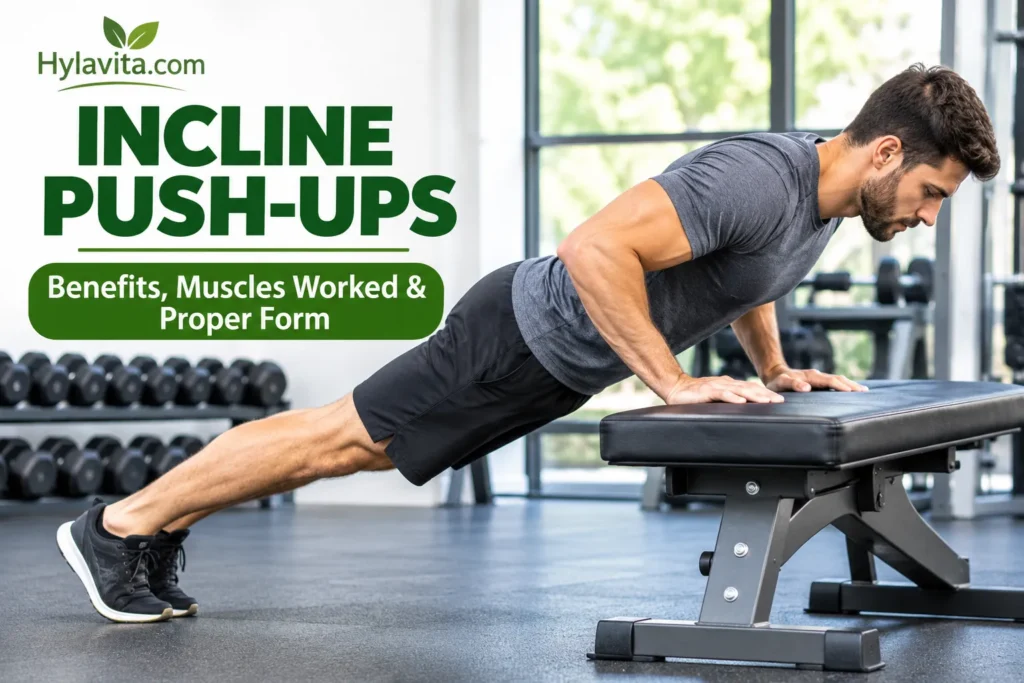
Incline push-ups are a simple way to build upper-body strength. They are easier than regular push-ups because your hands rest on an elevated surface. This makes them a good choice for beginners learning proper push-up form. They mainly work your chest, shoulders, and triceps. They also engage your core muscles during each repetition. You can perform them using a bench, sturdy table, or wall. No special gym equipment is needed. In this guide, you’ll learn their benefits, muscles worked, and proper technique.
What Are Incline Push-Ups?
Incline push-ups are a modified version of traditional push-ups. You place your hands on an elevated surface, such as a bench or sturdy table. Your feet stay on the floor throughout the exercise. This raised hand position reduces the amount of body weight you push. As a result, incline push-ups feel easier than standard push-ups. They are popular among beginners building upper-body strength. They also help experienced exercisers add variety to workouts. You can adjust the difficulty by changing the surface height.
What Muscles Do Incline Push-Ups Work?
Incline push-ups mainly target your chest, shoulders, and triceps. They also engage your core to keep your body stable.
Chest Muscles (Pectorals)
Your chest muscles do most of the pushing work. They help move your upper arms toward your body. Incline push-ups mainly target the pectoralis major. This is the large muscle across your chest. You use it when lowering and pushing your body.
Triceps
Your triceps sit along the back of your upper arms. They help straighten your elbows during each repetition. These muscles work harder as you push your body upward. Stronger triceps can also support other pushing exercises.
Shoulders (Anterior Deltoids)
Your front shoulder muscles assist with the pushing movement. They help move your upper arms forward during each repetition. These muscles work alongside your chest and triceps. Proper hand placement helps you perform the exercise comfortably.
Core Muscles
Your abdominal muscles help keep your body straight. Your core works to prevent your hips from dropping. It also helps control your body throughout each repetition. Keep your stomach muscles engaged during the entire movement.
Benefits of Incline Push-Ups
Incline push-ups offer several benefits for different fitness levels. They provide a simple way to train your upper body.
Build Upper-Body Strength
Incline push-ups strengthen several upper-body muscles together. They mainly work your chest, shoulders, and triceps. Regular practice can improve your pushing strength over time. This strength can support other bodyweight exercises.
Improve Push-Up Technique
Incline push-ups help you practice proper push-up movements. You can focus on hand placement and body alignment. The reduced resistance makes learning the movement easier. You can build better control before trying harder variations.
Support Chest and Triceps Development
This exercise places resistance on your chest and triceps. These muscles work together during every repetition. Consistent training can help improve their strength and development. However, muscle growth also depends on training and nutrition.
Reduce Exercise Difficulty for Beginners
Standard push-ups can feel difficult when starting exercise. Incline push-ups offer an easier starting point. The elevated hand position reduces the load on your arms. This allows beginners to practice with better control. You can lower the surface as your strength improves.
Require Minimal Equipment
You do not need expensive equipment for incline push-ups. A sturdy bench, table, or wall can work. You can perform this exercise at home or gym. This makes it easy to include in different workout routines. Always choose a stable surface before starting.
How to Do Incline Push-Ups With Proper Form
Proper form helps you train effectively and control each repetition. Follow these simple steps to perform incline push-ups correctly.
Step 1: Choose an Elevated Surface
Find a sturdy bench, table, or similar surface. Make sure it cannot slide or move during exercise. Choose a height that matches your current strength.
Step 2: Position Your Hands
Place both hands slightly wider than shoulder-width apart. Keep your fingers pointing forward or slightly outward. Grip the surface comfortably without lifting your palms.
Step 3: Align Your Body
Walk your feet backward until your body forms a straight line. Keep your head, back, hips, and legs aligned. Tighten your stomach and avoid dropping your hips.
Step 4: Lower Your Chest
Bend your elbows and slowly lower your chest. Keep your elbows at a comfortable angle near your body. Stop when your chest approaches the elevated surface. Avoid forcing a deeper movement.
Step 5: Push Back Up
Press your palms firmly against the elevated surface. Straighten your elbows and return to your starting position. Keep your body straight throughout the movement. Repeat with slow and controlled movements.
Common Incline Push-Up Mistakes to Avoid
Small mistakes can make incline push-ups less effective. They may also place unnecessary stress on your joints.
- Letting your hips sag: Keep your stomach tight and maintain a straight body position.
- Flaring your elbows too far: Keep your elbows at a comfortable angle. Avoid spreading them directly sideways.
- Using an unstable surface: Choose a sturdy surface that cannot move or tip.
- Moving too quickly: Lower and raise your body with control. Avoid bouncing through repetitions.
- Using a limited range: Lower your chest comfortably toward the surface. Do not shorten every repetition unnecessarily.
Focus on proper technique instead of rushing through more repetitions. Stop if you experience sharp pain or discomfort.
Incline Push-Ups vs. Regular Push-Ups
Incline push-ups and regular push-ups train similar upper-body muscles. However, they differ in difficulty and body positioning.
| Feature | Incline Push-Ups | Regular Push-Ups |
|---|---|---|
| Hand position | Elevated surface | Floor |
| Difficulty | Generally easier | Generally harder |
| Body position | Angled toward surface | More horizontal |
| Muscles worked | Chest, shoulders, triceps | Chest, shoulders, triceps |
| Best for | Beginners and progression | Building greater pushing strength |
Incline push-ups reduce the amount of body weight you push. Regular push-ups require more strength to move your body. Both exercises train similar muscles through pushing movements. Incline push-ups suit beginners and people rebuilding strength. Regular push-ups suit those comfortable with floor variations. Choose based on your current ability and exercise goals.
How Many Incline Push-Ups Should You Do?
Beginners can start with 2–3 sets of 8–12 repetitions. Choose a surface that allows you to maintain proper form. Rest for around 60–90 seconds between sets. You can adjust repetitions according to your fitness level. Avoid training through pain or extreme muscle fatigue. As the exercise becomes easier, increase repetitions gradually. You can also choose a slightly lower surface. Focus on controlled movements instead of chasing high numbers. Training two or three times weekly can fit many beginner routines. Allow recovery time between challenging sessions.
Incline Push-Up Variations
You can change incline push-ups by adjusting hand placement and surface height. These variations help match different strength levels.
Wall Incline Push-Ups
Place your hands against a wall at chest height. Step backward and perform the pushing movement. This variation offers the least resistance.
Bench Incline Push-Ups
Place your hands on a sturdy workout bench. Keep your body straight while lowering your chest. This is a common beginner-friendly variation.
Low-Surface Incline Push-Ups
Use a stable surface closer to floor height. This increases the amount of body weight you push. Try this variation as your strength improves.
Close-Grip Incline Push-Ups
Bring your hands closer together on the elevated surface. Keep your elbows near your body during each repetition. This variation places more emphasis on your triceps.
Frequently Asked Questions
Are Incline Push-Ups Good for Beginners?
Yes, incline push-ups are a good beginner-friendly exercise. They reduce resistance compared with standard floor push-ups. This helps beginners practice proper movement and build strength.
Do Incline Push-Ups Build Chest Muscles?
Yes, incline push-ups work your chest muscles. They also involve your shoulders and triceps. Consistent training can support chest muscle development.
Are Incline Push-Ups Easier Than Regular Push-Ups?
Yes, incline push-ups are generally easier than regular push-ups. Your elevated hand position reduces the load on your upper body. A higher surface usually makes the exercise easier.
Can Incline Push-Ups Help Build Arm Strength?
Yes, incline push-ups help strengthen your arms. Your triceps work during the pushing movement. Your shoulders and chest also assist with each repetition.
Conclusion
Incline push-ups are a simple exercise for building upper-body strength. They target your chest, shoulders, triceps, and core muscles. Their adjustable difficulty makes them suitable for beginners. You can perform them using a bench, table, or wall. Focus on proper form and controlled movements during every repetition. Start with a comfortable surface and manageable repetitions. Gradually increase the difficulty as your strength improves. With consistent practice, incline push-ups can become useful additions to your workout routine.
Hylavita’s suggestion to read
- Which Muscles Do Incline Push-Ups Work? A Simple Guide
- What Is a Push Day Workout? Best Exercises, Benefits & Tips
- Best Home Gym Equipment on a Budget: Affordable Picks for Every Fitness Level
Disclaimer: This article is for informational and educational purposes only. Incline push-ups may not be suitable for everyone. Always use proper form and exercise within your fitness level. Consult a qualified healthcare professional before starting a new exercise routine, especially if you have an injury or medical condition.