Do you catch yourself slouching at your desk, again? You’re not alone. Most of us spend hours hunched over phones and laptops, and our bodies pay the price.
The good news is you can fix this without expensive equipment or a gym membership. Posture yoga exercises are one of the simplest, most effective ways to retrain your body to sit and stand tall. According to Harvard Health, paying attention to posture is one of the simplest strategies for preventing back pain and improving how you look and feel. In this article, you’ll learn 10 easy yoga poses for posture that you can start doing today, right in your living room.
Whether you’re a student who studies for hours, a professional glued to a screen, or just someone who wants to feel less stiff, these moves are for you. If you’re looking for more beginner-friendly wellness guides, check out our health and fitness articles on Hylavita for related tips.
Why Bad Posture Happens (And Why Yoga Helps)
Bad posture doesn’t happen overnight. It builds up slowly from sitting too long, looking down at phones, and weak core muscles.
Over time, your chest muscles tighten and your back muscles weaken. This pulls your shoulders forward and rounds your upper back. The result? Neck pain, back pain, and that tired, slouched look.
Yoga for good posture works because it does two things at once. First, it stretches the tight muscles (like your chest and hip flexors). Second, it strengthens the weak ones (like your back and core). This balance is exactly what your body needs to stand straighter, naturally.
Research summarized by Harvard Health shows that yoga helps stretch and strengthen the muscles that support the spine, including the deep muscles that stabilize your vertebrae. This is one reason doctors and physical therapists often recommend it alongside other posture care.
How to Practice These Posture Yoga Exercises Safely
Before you jump in, keep a few basics in mind. These small habits make a big difference.
Warm Up First
Don’t go straight into deep stretches with cold muscles. Spend two to three minutes doing gentle movements, like arm circles or slow neck rolls, before you start.
Move Slowly and Breathe
Yoga isn’t a race. Move into each pose slowly, and breathe deeply through your nose. Holding your breath makes muscles tense up, which works against you.
Listen to Your Body
A gentle stretch is fine. Sharp pain is not. If a pose hurts, ease off or skip it. Over time, flexibility improves on its own.
10 Best Posture Yoga Exercises to Try Today
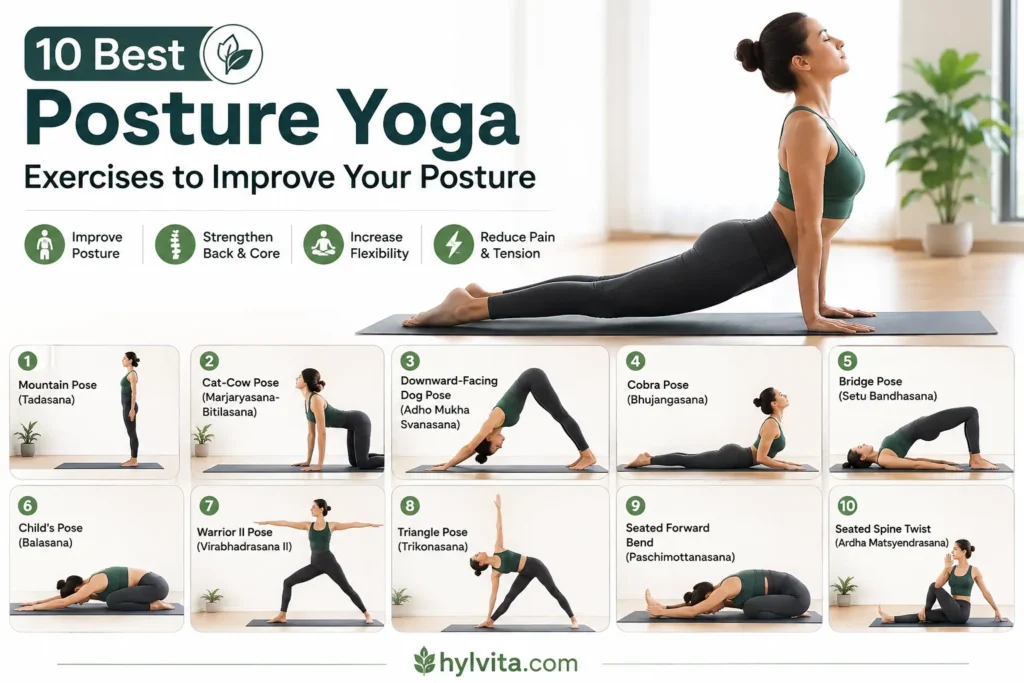
Here are 10 exercises to improve posture that target the muscles most affected by sitting and screen time. Try to do a few of these daily for the best results.
1. Mountain Pose (Tadasana)
This might look like just standing, but it’s the foundation of good alignment. Stand with feet hip-width apart, roll your shoulders back and down, and lengthen your spine as if a string is pulling the top of your head up.
Hold for 30 seconds while breathing normally. This pose teaches your body what “neutral posture” actually feels like. Cleveland Clinic notes that Mountain Pose helps you rediscover healthy spinal alignment and opens the chest for easier breathing.
2. Cat-Cow Stretch (Marjaryasana-Bitilasana)
Get on your hands and knees. Arch your back and drop your belly for cow pose, then round your spine and tuck your chin for cat pose.
Move slowly between the two, syncing breath with movement. This gently mobilizes the entire spine and relieves stiffness from sitting.
3. Cobra Pose (Bhujangasana)
Lie face down, place your hands under your shoulders, and gently lift your chest off the floor. Keep your elbows slightly bent and your shoulders away from your ears.
Cobra strengthens the lower back and opens the chest, directly countering the forward slump caused by desk work.
4. Bridge Pose (Setu Bandhasana)
Lie on your back with knees bent and feet flat on the floor. Press through your feet and lift your hips toward the ceiling.
This pose strengthens the glutes and lower back while stretching the front of the hips and chest, a common tight spot for people who sit all day.
5. Child’s Pose (Balasana)
Kneel down, sit back on your heels, and stretch your arms forward as your chest lowers toward the floor. This is a resting pose, but it gently stretches the back and shoulders.
Use it between other poses, or anytime you need a break during your posture yoga exercises routine. Cleveland Clinic explains that Child’s Pose also calms the nervous system, which can help release tension held in the shoulders and neck.
6. Downward-Facing Dog (Adho Mukha Svanasana)
From hands and knees, tuck your toes and lift your hips up and back, forming an inverted V-shape. Keep a slight bend in the knees if your hamstrings feel tight.
This pose strengthens the shoulders and back while stretching the entire backside of the body, from calves to spine.
7. Locust Pose (Salabhasana)
Lie face down with arms by your sides. Lift your chest, arms, and legs off the floor at the same time, squeezing your shoulder blades together.
This is one of the best yoga poses for posture because it directly strengthens the upper and lower back muscles that keep you upright.
8. Thread the Needle
Start on hands and knees. Slide your right arm under your left arm, lowering your right shoulder and ear to the floor.
This move releases tension between the shoulder blades, a spot that gets tight from rounded shoulders and screen time. Repeat on the other side.
9. Standing Forward Fold (Uttanasana)
Stand tall, then hinge at your hips and fold forward, letting your head and arms hang loose. Keep a soft bend in the knees.
This stretch releases tension in the lower back and hamstrings, both of which affect how your pelvis tilts, and in turn, your posture.
10. Warrior II (Virabhadrasana II)
Step your feet wide, turn one foot out, and bend that knee to a right angle. Stretch your arms out parallel to the floor and gaze over your front hand.
This pose builds leg and core strength while opening the chest and hips, helping you build the stability that supports better posture all day, not just during yoga.
Benefits and Risks of Posture Yoga Exercises
Like any physical practice, posture yoga exercises have real benefits, but they aren’t completely risk-free either. Knowing both sides helps you practice smarter.
The Benefits
- Stronger back and core muscles. Poses like Locust and Bridge build the muscles that hold your spine upright.
- Looser chest and hip flexors. Stretches like Cobra and Warrior II counter the tightness caused by sitting.
- Less stiffness and tension. Gentle movement through Cat-Cow and Thread the Needle can ease neck and shoulder tightness.
- Better body awareness. Poses like Mountain Pose train your brain to notice when you start to slouch.
- Lower stress levels. Slow breathing during yoga can calm the nervous system, and stress itself often makes posture worse.
The Risks
- Injury from overstretching. Pushing too far into a pose, especially cold, can strain muscles or joints.
- Not a quick fix. Yoga will not correct years of poor posture in a few sessions. It takes consistent practice.
- Not suitable for every condition. People with spinal injuries, severe osteoporosis, or recent surgery should get medical clearance first.
- Wrong form can backfire. Doing a pose incorrectly, especially deep backbends or forward folds, can add strain instead of relieving it.
If you have an existing back or joint issue, it’s worth asking a doctor or physical therapist before starting, so you get the benefits of yoga for posture without the setbacks.
How Often Should You Practice Yoga for Posture?
Consistency matters more than intensity. Doing 10 to 15 minutes of these exercises to improve posture most days of the week will help more than one long session per week.
Think of it like brushing your teeth. A little effort daily keeps problems from building up. Over a few weeks, many people notice they sit straighter without even thinking about it.
Simple Tips to Support Better Posture Beyond Yoga
Yoga helps a lot, but daily habits matter too. Small changes add up over time.
- Set a reminder every hour to check your sitting position
- Keep your screen at eye level to avoid looking down
- Take short walking breaks during long work sessions
- Sleep with proper neck support to avoid morning stiffness
None of these replace yoga poses for posture, but they support the progress you make on the mat. For more daily wellness habits, you can browse the lifestyle and self-care guides on Hylavita.
For additional stretches specifically aimed at posture correction, Cleveland Clinic’s guide to posture exercises is a helpful resource to pair with your yoga routine.
FAQs About Posture Yoga Exercises
Can yoga really fix bad posture?
Yes, yoga can improve posture by strengthening weak muscles and stretching tight ones. However, results take consistent practice over weeks or months, not overnight.
How long does it take to see results from posture yoga?
Many people notice small improvements, like less stiffness, within two to three weeks of daily practice. Full postural changes usually take longer, often a few months of regular effort.
Is yoga for good posture safe for beginners?
Yes, most of these poses are beginner-friendly. Start slow, use modifications if needed, and avoid pushing into pain.
Can I do these posture yoga exercises at home without equipment?
Absolutely. All 10 poses in this list need nothing more than a yoga mat, or even just a soft carpet. No special equipment is required.
How many times a week should I do posture yoga exercises?
Aim for at least four to five times a week for noticeable results. Even a short 10-minute session is better than skipping it entirely.
Conclusion
Fixing your posture doesn’t need to be complicated or time-consuming. These 10 posture yoga exercises target the exact muscles that get weak and tight from modern-day sitting and screen habits.
Start with two or three poses today, and slowly build your routine from there. Your back, neck, and shoulders will thank you.
Ready to feel the difference? Roll out your mat and try one of these poses right now.
Disclaimer:
This article is for general information only and is not medical advice. Talk to your doctor before starting yoga if you have an injury, chronic pain, or a health condition.