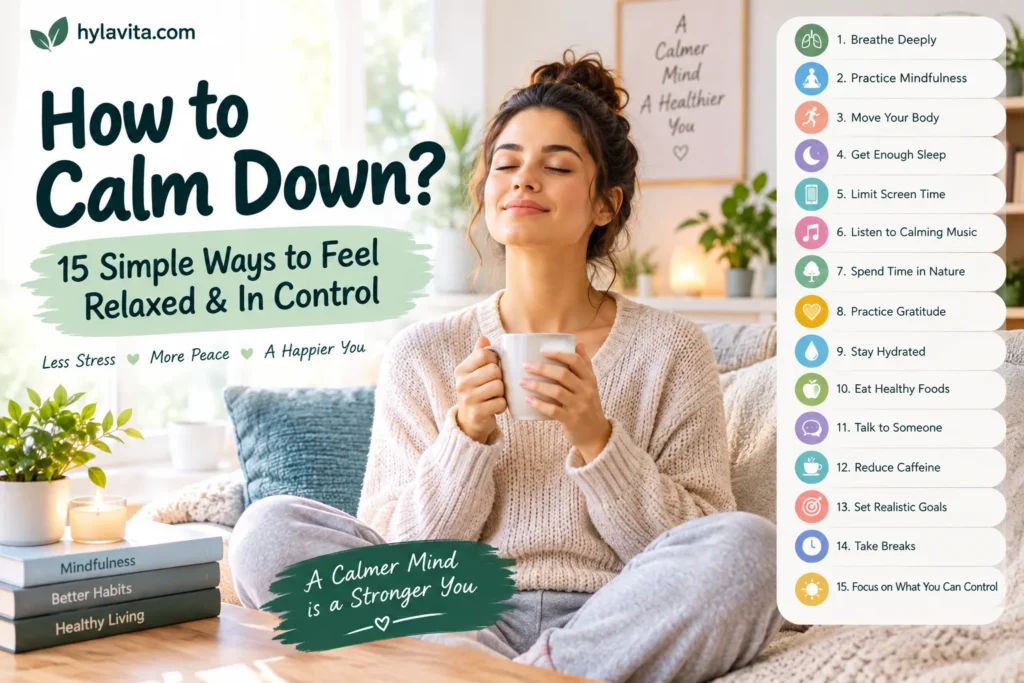
Your heart is racing. Your thoughts won’t slow down. You just want to feel normal again.If you’re searching for how to calm down, you’re not broken — you’re human. Stress and anxiety hit everyone at some point, whether it’s before a big exam, a stressful meeting, or just a hard day. The good news is that calming down is a skill. Like any skill, you can learn it and get better at it with practice.
This guide covers 15 simple, practical ways to relax your mind and body — along with the honest advantages and drawbacks of each, so you can pick what actually fits your situation instead of guessing. No fancy equipment, no complicated steps — just real techniques you can use right now, wherever you are.
For a deeper dive into everyday stress-reduction habits, see our full Hylavita wellness library — [link to your specific Stress Management or Mindfulness & Meditation category/post here].
Why It’s Hard to Calm Down When You’re Stressed
When you feel anxious, your body goes into “fight or flight” mode. Your brain thinks there’s danger, even if the danger is just a work deadline.
This triggers physical changes: faster heartbeat, shallow breathing, tense muscles. Your body is preparing to run or fight, not to sit still and think clearly.
That’s why “just relax” never works. You need actual tools that talk to your body, not just your willpower.
Ways to Calm Down Quickly (For Immediate Relief)
These techniques work fast. Use them when you need to calm down right now, not in an hour.
1. Try the 4-7-8 Breathing Method
Breathe in through your nose for 4 seconds. Hold for 7 seconds. Breathe out slowly through your mouth for 8 seconds.
This method is designed to slow your heart rate and signal to your brain that you’re safe. According to the Cleveland Clinic, the counting pattern gives your mind something other than your worries to focus on while activating your parasympathetic (“rest and digest”) nervous system. Repeat it three or four times for the best effect.
Advantages:
- Free, private, and can be done anywhere — no one has to know you’re doing it
- Works within one to two minutes for most people
- Doubles as a wind-down tool at bedtime
Disadvantages:
- Holding the breath can feel uncomfortable or even trigger dizziness for some people, especially those with respiratory conditions
- Evidence is mostly anecdotal and from small studies — it isn’t a guaranteed fix for everyone
- Requires a moment of privacy or stillness, which isn’t always available mid-crisis (e.g., during a live presentation)
2. Splash Cold Water on Your Face
Cold water on your face triggers something called the “dive reflex” — a nerve response that can slow your heart rate within seconds by shifting blood flow toward your core and brain.
Advantages:
- Extremely fast — effects can begin in under a minute
- Requires nothing but water
- Backed by real physiology (the trigeminal-vagal nerve pathway), not just folklore
Disadvantages:
- Not recommended for people with certain heart conditions, since it does briefly slow heart rate — check with a doctor if you have a cardiac history
- Some clinicians caution that intense cold exposure can spike adrenaline first and briefly worsen symptoms in people with panic disorder before it calms them
- Not practical in a lot of public or professional settings
3. Name What You See, Hear, and Feel (5-4-3-2-1 Grounding)
Look around and name 5 things you can see, 4 things you can touch, 3 things you can hear, 2 things you can smell, and 1 thing you can taste. According to Healthline, this sensory-based grounding exercise pulls your mind out of anxious thoughts and back into the present moment by engaging multiple senses at once.
Advantages:
- No equipment, cost, or privacy needed
- Well-studied for panic attacks, dissociation, and PTSD-related flashbacks
- Easy to teach to kids or people new to anxiety management
Disadvantages:
- Can feel awkward or hard to concentrate on during a severe panic spike
- Effects are usually temporary — it interrupts the spiral but doesn’t address the underlying cause
- May need several rounds before it “clicks” for first-time users
4. Unclench Your Jaw and Shoulders
Stress hides in your body without you noticing. Check your jaw, shoulders, and hands right now — are they tight? Consciously relax them.
Advantages:
- Takes seconds and can be done discreetly in meetings, classrooms, or public transit
- Builds body awareness over time, so you catch tension earlier
- No cost, no tools
Disadvantages:
- Provides only mild, short-lived relief on its own
- Chronic jaw or shoulder tension (like TMJ) may need physical therapy rather than a quick unclench
- Easy to forget to do consistently without a reminder or habit trigger
5. Step Outside for Fresh Air
A short walk outside changes your environment and gives your brain new input to focus on. Even two minutes helps.
Advantages:
- Combines movement, light exposure, and a change of scenery in one simple action
- No cost and no planning required
- Can be extended into light exercise for added benefit (see #10)
Disadvantages:
- Not always accessible — weather, safety, mobility limits, or a demanding workplace can make stepping outside difficult
- Effects are usually mild and short-term as a standalone fix
- Loses effectiveness if used as an avoidance strategy for problems that need direct attention
How to Relax Your Mind (Mental Techniques)
Calming your body is step one. Calming your mind is step two. These techniques target racing or repetitive thoughts.
6. Write Down What’s Bothering You
Sometimes anxious thoughts feel huge in your head but small on paper. Grab a notebook or your phone and write out what’s worrying you — a “brain dump.”
Advantages:
- Costs nothing and takes as little as five minutes
- Can improve emotional processing and even sleep when done as an evening habit
- Creates a written record you can look back on to track patterns
Disadvantages:
- Writing about distressing events without structure can occasionally increase rumination for some people
- Doesn’t solve the underlying problem — it clears mental clutter, not the cause
- Requires a private moment, which isn’t always available in the middle of a busy day
7. Challenge the Worst-Case Thought
Ask yourself: “Is this thought true, or does it just feel true?” Anxiety often exaggerates how bad things really are. For example, if you think “I’m going to fail completely,” ask what evidence actually supports that.
Advantages:
- A core, well-researched cognitive-behavioral technique
- Builds a long-term skill, not just a one-time fix
- Free and can be practiced silently, anywhere
Disadvantages:
- Hard to do in the middle of intense anxiety or a panic attack — the body often needs to calm down first (try #1–4)
- Can feel dismissive if done poorly (“just don’t worry”) rather than genuinely examining the evidence
- Takes practice to do well; it’s not usually instantly effective the first few tries
8. Set a “Worry Time”
Instead of trying to stop worrying (which rarely works), set aside 10–20 minutes later in the day just for worrying. When anxious thoughts pop up earlier, tell yourself, “I’ll think about this at 6 PM.”
Advantages:
- A structured, evidence-informed technique (sometimes called “worry postponement”) used in cognitive behavioral therapy
- Frees up mental space during the rest of the day
- Pairs well with journaling (#6)
Disadvantages:
- Takes discipline and consistency to build the habit
- Doesn’t work well for acute, in-the-moment panic — it’s a longer-term management strategy
- Some worries genuinely need immediate attention (e.g., safety concerns), and this technique isn’t meant for those
9. Listen to Calm, Familiar Music
Music you know well is comforting because your brain doesn’t have to work to process it. Choose something slow and familiar, not something new or upbeat.
Advantages:
- Passive — you don’t have to “do” anything else while it plays
- Can be layered into a commute, work break, or bedtime routine
- Widely accessible for free
Disadvantages:
- Effectiveness is highly individual — what’s calming for one person may be distracting for another
- Requires headphones or privacy in shared spaces
- Not a substitute for addressing the source of stress
How to Calm Anxiety Naturally (Long-Term Habits)
Quick fixes help in the moment. But if anxiety shows up often, these habits build calm into your daily life.
10. Move Your Body Daily
Exercise may help ease anxiety and depression symptoms by releasing endorphins and giving your mind something else to focus on, according to the Mayo Clinic. It doesn’t need to be intense — a daily walk counts, and consistency matters more than intensity.
Advantages:
- Backed by substantial research linking regular activity to lower anxiety over time
- Improves sleep, mood, and physical health simultaneously
- Flexible — walking, yoga, dancing, and sports all count
Disadvantages:
- Benefits build over weeks, not minutes — it’s not an instant fix for acute anxiety
- Physical limitations, injury, or fatigue can make daily exercise unrealistic for some people
- Starting a new routine can itself feel like “one more stressful task” if not eased into gradually
11. Cut Back on Caffeine
Caffeine can mimic anxiety symptoms — faster heartbeat, jitteriness, restlessness — and, per the Sleep Foundation, consuming it too late in the day can also disrupt sleep, which further compounds anxiety.
Advantages:
- A concrete, controllable lifestyle change
- Can improve both anxiety and sleep quality simultaneously
- No cost — often saves money
Disadvantages:
- Cutting caffeine too abruptly can cause withdrawal headaches, fatigue, and irritability
- Some people are far more caffeine-sensitive than others, so results vary
- May take days to weeks to notice a meaningful difference
12. Get Consistent Sleep
Poor sleep and anxiety feed each other in a loop. The Sleep Foundation notes that anxiety disorders and sleep problems frequently occur together, with each one able to worsen the other. Aim for a regular sleep and wake time, even on weekends.
Advantages:
- Addresses a root contributor to anxiety rather than just a symptom
- Improves mood, focus, and physical health broadly
- Doesn’t require any special tools
Disadvantages:
- Anxiety itself can make falling asleep harder, creating a frustrating cycle
- A rigid sleep schedule can be difficult with shift work, caregiving, or irregular schedules
- Persistent insomnia may need professional evaluation rather than lifestyle tweaks alone
13. Practice Deep Breathing Every Day, Not Just During Panic
Most people only try breathing exercises when they’re already anxious. Practicing daily, even for 5 minutes, trains your nervous system to calm down faster overall.
Advantages:
- Builds a skill that becomes more effective with regular use
- Very low time investment
- Complements almost every other technique on this list
Disadvantages:
- Requires ongoing commitment to see the “training” benefit — a single session won’t build the same resilience
- Easy to skip on busy days, breaking consistency
- Some people find it difficult to sit still and focus without guided audio or an app
How to Calm Yourself Down in Social or High-Pressure Moments
Some situations need calm on the spot — a job interview, a difficult conversation, or public speaking.
14. Slow Your Speech on Purpose
When anxious, people tend to talk faster. Consciously slowing your speech signals your brain to slow down too, and it also tends to make you sound more confident to others.
Advantages:
- Invisible to others — no one knows you’re using a technique
- Improves how you’re perceived (calmer, more authoritative) in real time
- Works in virtually any social setting
Disadvantages:
- Takes conscious effort and practice to do naturally under pressure
- Can feel unnatural or forced at first
- Doesn’t address the internal anxious feeling directly — it’s a behavioral workaround, not a cure
15. Use a Grounding Object
Carry something small — a smooth stone, a ring, a pen you like. When anxiety spikes, hold it and focus on how it feels, similar to how fidget tools work for concentration.
Advantages:
- Discreet and portable
- Can be personalized and become a comforting habit or ritual
- No learning curve
Disadvantages:
- Provides mild, distraction-based relief rather than addressing the anxiety directly
- Easy to lose or forget to bring
- Some people become overly reliant on the object and feel more anxious without it
When to Get Extra Support
These tips help with everyday stress and mild anxiety. However, if anxiety is constant, overwhelming, or affecting your daily life — interfering with school, work, relationships, or basic functioning — it’s worth talking to a doctor or therapist. The National Institute of Mental Health notes that persistent anxiety lasting six months or more, especially alongside restlessness, fatigue, or trouble concentrating, may indicate an anxiety disorder that benefits from professional treatment.
There’s no shame in needing more support than a breathing exercise can offer. Anxiety, when persistent, is a medical concern worth addressing properly — and effective treatments exist. [Link this paragraph to your site’s mental-health professional directory, therapy-finder resource, or related Hylavita article if you have one.]
If you are in crisis or having thoughts of harming yourself, please reach out immediately:
- 988 Suicide & Crisis Lifeline (US): Call or text 988
- Crisis Text Line: Text HOME to 741741
FAQ: How to Calm Down
What is the fastest way to calm down? The 4-7-8 breathing technique and splashing cold water on your face are two of the fastest methods, often working within seconds because they directly affect your nervous system rather than just your thoughts. That said, individual results vary, and what works fastest for one person may not for another.
How can I calm down without medication? Breathing exercises, grounding techniques, movement, and reducing caffeine are all natural, non-medication approaches. Many people combine a few of these methods depending on the situation. For anxiety that’s persistent or severe, talk to a healthcare provider about the full range of treatment options, which may or may not include medication.
Why do I feel anxious for no clear reason? Anxiety can build up from poor sleep, too much caffeine, ongoing stress, or unresolved worries, even if no single event triggered it. It doesn’t always need a clear cause to be real.
Can breathing exercises really reduce anxiety? Many people find that slow, controlled breathing helps calm the body’s stress response. It’s a simple, low-risk tool, though it works better for some people than others and isn’t a guaranteed cure for anxiety disorders.
How long does it take to calm down after a panic attack? This varies by person, but panic attacks commonly peak within about 10 minutes and ease within 20 to 30 minutes. Using grounding or breathing techniques during this time may help it pass more smoothly.
A note on this section: anxiety and panic attacks are sensitive topics. If you’re dealing with these personally and finding them hard to manage, please consider reaching out to a doctor or mental health professional — the tips above are general information, not a diagnosis or treatment plan.
Conclusion
Learning how to calm down isn’t about eliminating stress completely — that’s not realistic. It’s about having tools ready for when stress shows up, matched honestly to their real benefits and limits, so it doesn’t control your day.
Start small. Pick one or two techniques from this list, like the 4-7-8 breathing method or a short daily walk, and try them consistently. Over time, calm stops being something you chase and becomes something you can create on demand.
If anxiety keeps showing up despite trying these methods, consider reaching out to a mental health professional for extra support.
Medical Disclaimer: This article is for general educational purposes only and is not a substitute for professional medical or mental health advice, diagnosis, or treatment.