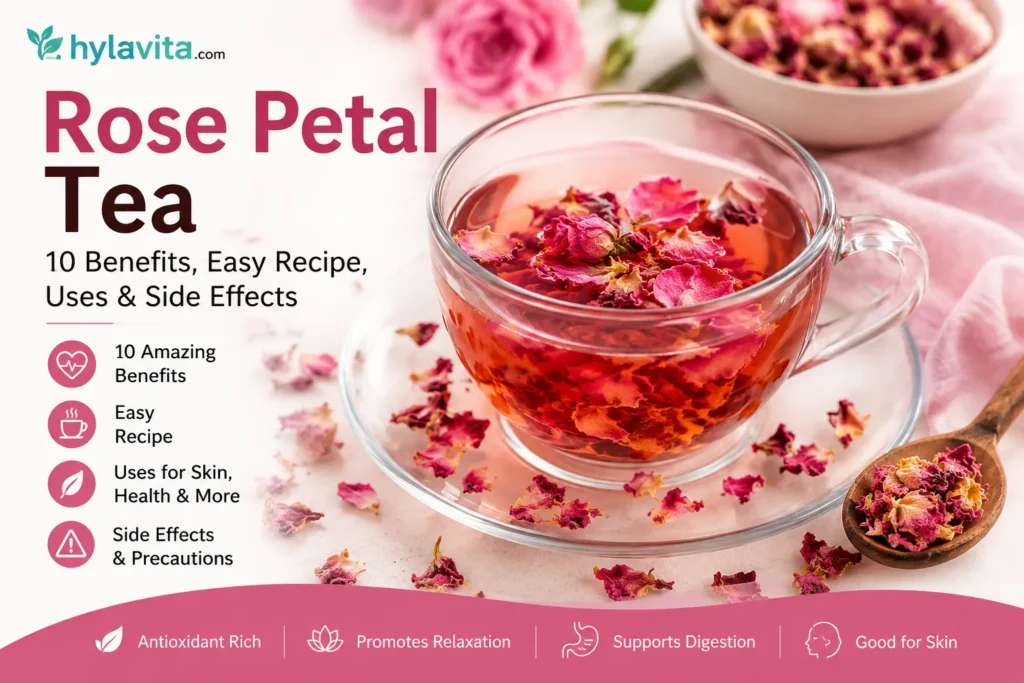
Picture a warm cup that smells like a garden and tastes like a gentle hug. That’s rose petal tea.
If you’ve been curious about this pretty pink drink, you’re not alone. More people are turning to rose petal tea for its calming effects, its skin-friendly nutrients, and its simple, soothing taste. But does it actually do anything for your health, or is it just a nice-smelling drink?
In this guide, we’ll cover the real benefits, the honest advantages and disadvantages, an easy recipe you can make tonight, smart ways to use it, and the side effects worth knowing before you start. We’ve checked the claims below against research summaries from the U.S. National Institutes of Health and Harvard Health Publishing so you’re getting a balanced picture, not just marketing language.
What Is Rose Petal Tea?
You make rose petal tea by steeping dried or fresh rose petals in hot water. It’s naturally caffeine-free, which makes it a good choice any time of day.
People have used rose petals in food and medicine for centuries, especially in Middle Eastern, South Asian, and Mediterranean traditions. Today, rose petal tea is easy to find in health food stores, or you can make it at home with petals from your own garden (as long as they haven’t picked up any pesticide residue).
The taste is light, floral, and slightly sweet. Some people compare it to a milder version of hibiscus tea, but without the tartness. Harvard Health’s overview of herbal teas notes that true “herbal teas” aren’t technically tea at all — they’re infusions of flowers, fruit, or herbs in water, not the Camellia sinensis plant that produces black, green, and oolong tea. That’s part of why they’re naturally caffeine-free (Harvard Health Publishing).
Rose Petal Tea vs. Rose Hip Tea
These two are often confused, but they’re not the same thing. Makers brew rose petal tea from the flower petals, while rose hip tea comes from the fruit that forms after the rose blooms and drops its petals.
Rose hips are known for higher vitamin C content. Petals, on the other hand, win out for their calming aroma and antioxidant content.
10 Rose Petal Tea Benefits
Here’s where things get interesting. Let’s look at the benefits that keep showing up in traditional use and early research — with the caveat that, as you’ll see in the Disadvantages section below, most of this evidence is preliminary.
Benefits for Physical Health
- Rich in antioxidants – Rose petals contain plant compounds like polyphenols, which help fight everyday cell damage caused by free radicals. A review of herbal teas’ role in cellular health backs up that antioxidant-rich infusions like rose may support the body’s natural defense processes (PMC, National Library of Medicine).
- May support digestion – Many people drink it after meals to ease bloating or an upset stomach, a use rooted in traditional herbal practice.
- Can ease menstrual discomfort – A systematic review and meta-analysis of randomized controlled trials found that Rosa damascena (Damask rose) meaningfully reduced menstruation-related headache, fatigue, and bloating, though its effect on pain severity and anxiety specifically was not statistically significant (PMC, National Library of Medicine). In other words: some benefit is plausible, but it’s not a proven cramp cure.
- May support heart health – The antioxidants in rose petals may help support healthy blood vessels over time, as part of a balanced diet.
- Gentle on hydration – Since it’s mostly water with mild flavor, it’s an easy way to drink more fluids if plain water feels boring.
Benefits for Skin and Beauty
- Supports skin health from within – The antioxidants may help protect skin cells, working alongside (not replacing) your regular skincare routine.
- Naturally hydrating – Good hydration habits, including herbal teas, often show up as clearer, more supple-looking skin.
- Mild anti-inflammatory properties – Traditional remedies have long used rose to calm minor skin redness and irritation.
Benefits for Mind and Mood
- Calming aroma – The scent alone can help you feel more relaxed, similar to how lavender is used for calm.
- May reduce stress – Small studies on rose aroma and rose tea suggest it may support a sense of calm, though — again — it’s not a substitute for medical or mental health treatment.
In short, rose petal tea benefits touch on your body, your skin, and your mood — which is a big reason it has stayed popular for so long. Just don’t mistake “promising” for “proven.”
Advantages and Disadvantages of Rose Petal Tea
A fair review means weighing both sides. Here’s the honest breakdown.
Advantages
- Caffeine-free, so it won’t disrupt sleep or add to daily caffeine intake.
- Simple and inexpensive to make at home with dried petals, hot water, and a few minutes.
- Naturally low in calories and sugar-free unless you add sweetener.
- Versatile — usable as a drink, a cooled facial rinse, or a base blended into other teas.
- Generally well-tolerated by most healthy adults when you make it from food-grade petals.
- Some clinical support for easing specific menstrual symptoms like headache, fatigue, and bloating (PMC).
Disadvantages
- Evidence is still limited. Many of the most-repeated claims (stress relief, skin benefits, heart health) rest on small studies, animal research, or traditional use rather than large, well-controlled human trials.
- Not a treatment for any medical condition. It shouldn’t replace prescribed care for anxiety, menstrual disorders, or skin conditions.
- Allergy risk. People allergic to roses or related plants may react with itching, rash, or a runny nose.
- Pesticide exposure risk if the label doesn’t say food-grade or organic — florist roses are not safe to brew.
- Limited pregnancy/breastfeeding safety data, so medical guidance is recommended before regular use.
- Possible medication interactions. The NIH’s National Center for Complementary and Integrative Health notes that herbal products, in general, can interact with prescription drugs — including blood thinners — even when they’re “natural” (NCCIH).
- Unregulated for quality. Like other herbal products, the FDA doesn’t review rose petal tea for safety or effectiveness before it reaches store shelves, so what’s on the label may not perfectly match what’s in the package (NCCIH).
- Long-term, heavy-use safety is understudied, so moderation is the safer default.
Easy Rose Petal Tea Recipe
You don’t need fancy equipment or rare ingredients. Here’s a simple recipe you can try today.
Ingredients
- 1 to 2 tablespoons of dried rose petals (or a handful of fresh, pesticide-free petals)
- 1 cup of hot water (not boiling — just under a boil works best)
- Optional: honey, lemon, or a cinnamon stick for extra flavor
Steps to Make It
- Boil water, then let it sit for about 30 seconds so it’s hot but not scalding.
- Pour the water over the rose petals in a cup or teapot.
- Cover and steep for 5 to 7 minutes. Longer steeping gives a stronger flavor.
- Strain out the petals.
- Add honey or lemon if you like, and enjoy warm.
For an iced version, simply let it cool and pour over ice. It’s refreshing on a hot afternoon.
Tip: Use organic or food-grade dried rose petals. Chemical treatments common in florist bouquets make those petals unsafe to drink.
Everyday Uses of Rose Petal Tea
Rose petal tea isn’t just for sipping. Here are a few practical ways people use it.
A daily wellness drink. Many people add a cup of rose petal tea to their evening routine to wind down before bed, since it’s caffeine-free and calming.
A facial steam or rinse. Some people use cooled, brewed rose tea as a gentle face rinse or facial steam for a spa-like feel at home. Always patch-test first to check for skin sensitivity.
A base for other drinks. Rose petal tea blends well with green tea, hibiscus, or chamomile. Mixing it in gives your regular tea a subtle floral twist without overpowering it.
A gift or self-care ritual. Because it looks and smells lovely, homemade rose tea blends make a thoughtful, low-cost gift for friends who enjoy herbal teas.
Side Effects and Precautions
Rose petal tea is generally safe for most healthy adults when you make it from food-grade petals. However, it’s not completely risk-free for everyone.
- Allergies: People allergic to roses or other plants in the same family may experience itching, rash, or a runny nose.
- Pregnancy and breastfeeding: There isn’t enough solid research on rose tea’s safety during pregnancy, so it’s best to check with a doctor first.
- Medication interactions: Rose tea may interact with certain medications, including blood thinners, due to its mild effects on blood vessels. Speak to a healthcare provider if you’re on regular medication — see the NIH’s guidance on herb and dietary supplement interactions for more on why “natural” doesn’t automatically mean “risk-free.”
- Pesticide exposure: Only use petals labeled as food-grade or organic. Chemical-treated petals aren’t meant for consumption.
- Too much of a good thing: Like most herbal teas, researchers haven’t closely studied the effects of drinking excessive amounts (many cups a day, every day), so moderation is wise.
If you notice any unusual symptoms after drinking rose petal tea, stop and consult a doctor.
FAQs About Rose Petal Tea
Is rose petal tea good for daily use? For most healthy adults, a cup or two a day is generally fine. As with any herbal tea, it’s smart to change things up rather than drinking only one type every single day.
Can rose petal tea help with weight loss? There’s no strong scientific evidence that rose petal tea directly causes weight loss. It may support a healthy routine by replacing sugary drinks, but it’s not a magic solution on its own.
What does rose petal tea taste like? It has a light, floral, slightly sweet taste, similar to how a rose smells. It’s much milder than perfumed rose products, since brewing tones down the intensity.
Can I use fresh rose petals instead of dried ones? Yes, as long as they’re pesticide-free and you can safely identify them as an edible rose variety. Fresh petals usually need a slightly longer steeping time than dried ones.
Does rose petal tea have caffeine? No, rose petal tea is naturally caffeine-free. This makes it a good option for evening relaxation or for anyone cutting back on caffeine.
Conclusion
Rose petal tea is more than a pretty drink. From its antioxidant content to its calming aroma, the benefits of rose petal tea make it worth a try, especially if you’re looking for a gentle, caffeine-free addition to your day. At the same time, the disadvantages above are worth keeping in mind — the research is still early, and this tea works best as a small, pleasant addition to your routine rather than a treatment for any health condition.
Medical Disclaimer: This article is for general educational purposes only and is not medical advice. It does not diagnose, treat, or cure any condition, and it is not a substitute for consultation with a licensed physician, pharmacist, or registered dietitian.