
Introduction
Soursop is a spiky green fruit. It grows in tropical places like the Caribbean and Southeast Asia. People have used it for years.
But now, the leaves are getting more attention than the fruit.You’ll see soursop leaf tea in stores today. Social media talks about it a lot too. People claim it helps with cancer, sleep, and blood sugar.
So what’s true and what’s not?
This guide breaks it down. We’ll cover the real benefits, safe uses, and risks to know before you try it.
What Are Soursop Leaves?
Soursop comes from a tree called Annona muricata. It belongs to the custard apple family.
The tree is native to the Caribbean and Central America. It also grows well in parts of Africa and Southeast Asia. Farmers there have grown it for generations.For a long time, people used soursop leaves in folk medicine. They made tea from the leaves. They used it for pain, fever, and stress. This tradition is common in Latin America and West Africa.
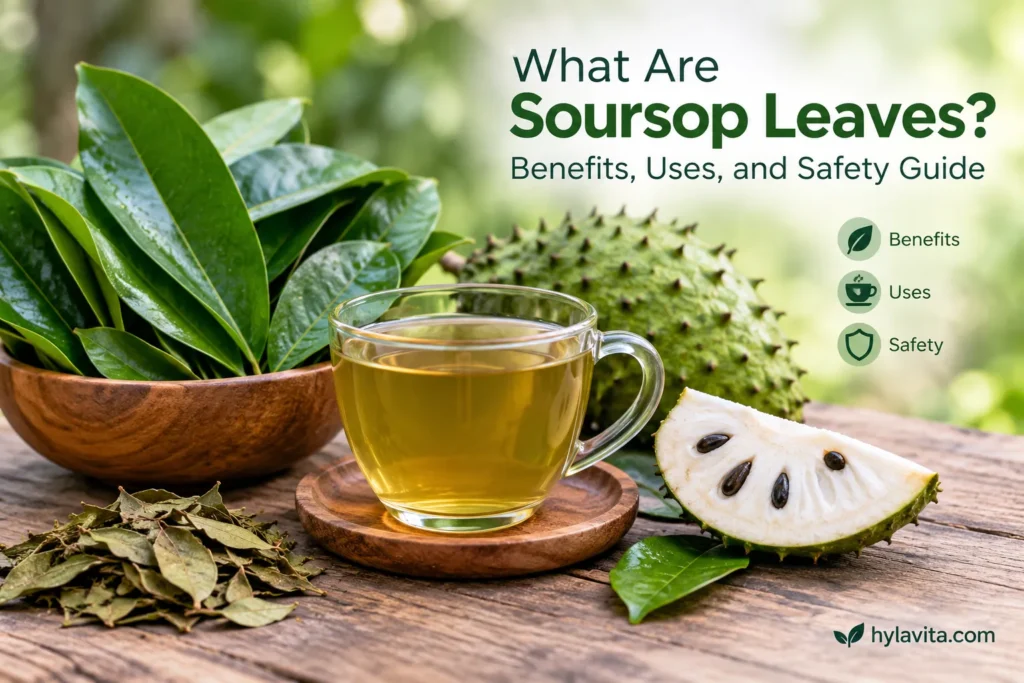
The leaves are different from the fruit. The fruit is sweet and soft inside. The leaves are dark green, smooth, and slightly bitter. People dry them first, then brew them into tea.That’s the key difference. The fruit is food. The leaves are used more like an herbal remedy.
Nutritional & Active Compounds in Soursop Leaves
Soursop leaves don’t offer much in the way of everyday nutrition. They’re not something you eat for vitamins, like a vegetable.Instead, they contain plant compounds. Scientists call these “bioactive compounds.” They’re the reason researchers study the leaves at all.
Here are the main ones:
Acetogenins. These are the most studied compounds in soursop. They’re found in the leaves, seeds, and bark. Early lab studies look at their effects on cells.
Flavonoids. These act as antioxidants. Many plants contain them. They help protect cells from damage.
Alkaloids. These are natural compounds found in many medicinal plants. Researchers are still studying their effects on the body.
Tannins. These give the leaves their bitter taste. They also have mild antioxidant properties.
Why do scientists care about these compounds? Because early lab and animal studies suggest they might have health effects. But most of this research is still early. It’s not the same as proven human results.
That’s an important distinction to keep in mind as we go through the benefits next.
Potential Health Benefits of Soursop Leaves
Let’s look at what soursop leaves might do. Keep in mind, most of this comes from early research. Human studies are still limited.
4.1 Antioxidant Properties
Soursop leaves contain flavonoids and tannins. These act as antioxidants. Antioxidants help fight off free radicals in the body. Free radicals can damage cells over time. This is one of the better-supported benefits so far.
4.2 Anti-Inflammatory Potential
Some lab studies show soursop leaf extract may reduce inflammation. This could help with swelling or joint pain. But most of this research is done on animals, not humans. More studies are needed to confirm it works the same way in people.
4.3 Support for Immune Function
Antioxidants play a role in immune health. Because soursop leaves are rich in them, some believe they support the immune system. This idea makes sense in theory. But there’s no strong human evidence yet to prove it directly.
4.4 Interest in Cancer Research
This is the most talked-about claim. Some lab studies show soursop compounds affect cancer cells in test tubes. A few animal studies show similar results.
But here’s the truth: these are early-stage studies. They are not proof that soursop cures or treats cancer in humans. No major health organization approves it as a cancer treatment. If you have cancer, please talk to your doctor before trying any herbal remedy.
4.5 Blood Sugar Support
Some animal studies suggest soursop leaf extract may lower blood sugar. This is an interesting early finding. But it hasn’t been well-tested in humans yet. Don’t replace diabetes medication with soursop tea. Always check with your doctor first.
4.6 Skin Health and Topical Uses
In folk medicine, people apply soursop leaf paste to the skin. They use it for wounds, boils, and skin infections. This is a traditional practice, passed down for generations. Scientific proof for this use is still limited.
4.7 Sleep and Relaxation
Many people drink soursop leaf tea before bed. They say it helps them relax and sleep better. This is a popular traditional use. Some believe the calming effect comes from compounds in the leaves. Again, solid scientific proof is still lacking here.
How Soursop Leaves Are Used
There are a few common ways people use soursop leaves. Here’s a quick look at each one.
5.1 Soursop Leaf Tea
This is the most popular way to use the leaves. People boil dried or fresh leaves in water. Then they strain it and drink it warm. It’s simple to make at home. This is also the easiest way to find it in stores.
5.2 Powders, Capsules, and Supplements
Some brands sell soursop leaf in powder form. You can mix it into water or smoothies. Others sell it as capsules or supplements. These are more convenient for daily use. But quality can vary between brands. Always check for third-party testing when possible.
5.3 Topical Applications
People also use soursop leaves on the skin. They crush the leaves into a paste. This paste is called a poultice. They apply it to wounds, boils, or sore joints. Some also use leaf extracts in skin products. This is a traditional practice, not a proven medical treatment.
5.4 Traditional Preparation Methods
In many cultures, people prepare soursop leaves by hand. They pick fresh leaves, then dry them in the sun. Once dried, they store them for later use. Some communities also boil the leaves with other herbs. These methods have been passed down for generations.
How to Make Soursop Leaf Tea
Making soursop leaf tea is easy. Here’s a simple way to do it at home.
Step-by-Step Instructions
- Take 3 to 5 dried soursop leaves.
- Rinse them quickly under clean water.
- Boil 2 cups of water in a pot.
- Add the leaves once the water boils.
- Let them simmer for 10 to 15 minutes.
- Turn off the heat and cover the pot.
- Let it sit for 5 more minutes.
- Strain the leaves out.
- Pour the tea into a cup.
Serving Suggestions
Drink it warm for the best taste. Add a little honey if you like it sweeter. A slice of lemon works well too. Many people drink one cup a day. Try to avoid drinking it every single day for long periods. It’s best used occasionally, not as a daily habit. If you’re unsure, ask your doctor first.
Safety, Side Effects & Precautions
Soursop leaves are not risk-free. It’s important to know the downsides before you try them.
7.1 Known Risks
Soursop leaves contain a compound called annonacin. Some studies link high, long-term intake to nerve damage. Researchers in the Caribbean studied this link closely. They found a possible connection to brain health problems, similar to Parkinson’s disease. This risk seems tied to heavy, regular use over time. Occasional use in small amounts appears to carry lower risk. Still, it’s something to take seriously.
7.2 Who Should Avoid It
Some people should skip soursop leaf tea completely.
Pregnant and breastfeeding women should avoid it. There isn’t enough safety research for this group.
People with Parkinson’s disease, or a family history of it, should also avoid it. The annonacin link makes this extra important.
People on regular medication should be careful too. This includes blood pressure or diabetes medication.
7.3 Drug Interactions
Soursop leaves may interact with certain medications. This includes drugs for blood pressure and blood sugar. It may also affect blood thinners. If you take any prescription medicine, talk to your doctor first. This step matters, even if the tea seems natural and harmless.
7.4 Recommended Intake Limits
There’s no official daily limit set by health authorities. But most experts suggest moderation. One cup a day, a few times a week, is a safer approach. Avoid drinking it every day for weeks or months. Long-term, heavy use carries the most risk. When in doubt, less is better.
Soursop Leaves vs. Soursop Fruit
The leaves and the fruit are not the same thing. They’re used in different ways.
| Feature | Soursop Fruit | Soursop Leaves |
|---|---|---|
| Type | Food | Herbal remedy |
| Taste | Sweet, creamy | Bitter |
| Common use | Eaten fresh, juiced | Brewed as tea |
| Key nutrients | Vitamin C, fiber | Flavonoids, tannins, alkaloids |
| Safety | Generally safe to eat | Use in moderation, some risks |
| Who should be careful | Most people can enjoy it | Pregnant women, Parkinson’s risk, those on medication |
| Daily use | Fine as part of diet | Not recommended daily, long-term |
So which one should you choose? If you want a healthy snack, go for the fruit. If you’re curious about herbal tea, the leaves are an option. Just use them carefully, and not too often.
What Does the Research Actually Say?
Let’s be honest about the science here. There’s a gap between tradition and proof.
Traditional medicine has used soursop leaves for generations. Many people trust it based on personal experience. That counts for something. But it’s not the same as scientific proof.
Most current research happens in labs, not in humans. Scientists test soursop compounds on cells in test tubes. Some studies use animals, like rats or mice. These early results are interesting. But they don’t guarantee the same effect in people.
Very few human clinical trials exist on soursop leaves. This is true for most of the claims, including cancer, blood sugar, and sleep. Without human trials, we can’t say these benefits are proven.
This doesn’t mean the leaves have zero value. It just means we need more research. Until then, treat these benefits as possible, not confirmed. Talk to a doctor before using soursop leaves for any health condition. That’s the safest way to approach it.
Frequently Asked Questions (FAQ)
Is soursop leaf tea safe to drink daily?
Daily use isn’t recommended. Occasional use, a few times a week, is safer. Long-term daily use may raise health risks. Talk to your doctor if you want to drink it often.
Can soursop leaves cure cancer?
No, there’s no proof of this. Some lab studies show interesting effects on cancer cells. But these are early results, not human proof. No health authority approves soursop as a cancer treatment. Never replace medical treatment with herbal tea.
How long can you take soursop leaf tea?
There’s no official safe time limit. Most experts suggest short-term, occasional use only. Avoid using it every day for weeks or months. Long-term use may increase health risks over time.
Where to buy soursop leaves?
You can find them at health food stores. Many online shops sell dried soursop leaves too. Some Caribbean or Latin grocery stores carry them as well. Always choose a trusted seller with good reviews.
Conclusion
Soursop leaves have a long history in folk medicine. People use them for tea, skin care, and more.
Some early research looks promising. But most of it comes from labs, not real human trials. The truth is, we don’t have solid proof yet. Many of the health claims are still unconfirmed.
That doesn’t mean you can’t try soursop leaf tea. Just use it in moderation, not every day. Be extra careful if you’re pregnant, breastfeeding, or on medication.
Before adding soursop leaves to your routine, talk to your doctor. This is especially true if you have a health condition. Your doctor can help you decide if it’s right for you.
Soursop leaves might offer some benefits. But your safety always comes first.
Hylavita’s sugestion to read
- Rose Petal Tea: 10 Benefits, Advantages & Disadvantages, Easy Recipe, Uses & Side Effects
- Honeybush Tea: Benefits, Caffeine, Side Effects & How to Brew It
- Decaf Green Tea: Benefits, Caffeine Content, Side Effects & More
Disclaimer: This article is for general information only. It is not medical advice. Soursop leaves have not been approved to treat, cure, or prevent any disease. Always talk to a qualified healthcare provider before using soursop leaves, especially if you’re pregnant, breastfeeding, or taking medication.